It was 1977, in a triple-decker apartment building outside of Boston, that my love of nature was born. It was a very “unnatural” place to fall in love with the wild, but our collection of National Geographic magazines let my imagination travel the globe.
One of my favorites was the August 1963 issue featuring Jane Goodall and her groundbreaking account, “My Life among Wild Chimpanzees.”
Her remarkable story was the light bulb moment that sparked my dream to share the wonders of nature with the world. And years later, by channeling her compassion for animals, I was fortunate enough for that dream to come true.
Jane Goodall Showed Compassion for All Living Creatures
In 2006, while hosting Animal Planet’s flagship series, I got a call asking if I’d like to work with Jane Goodall. I was thrilled—until I learned she was reviewing the network’s programs and found some at odds with her message.
I braced myself. What if she didn’t like my work? But to my relief, she had singled mine out as work she respected. For a young biologist shaped by her example, it was the highest honor.
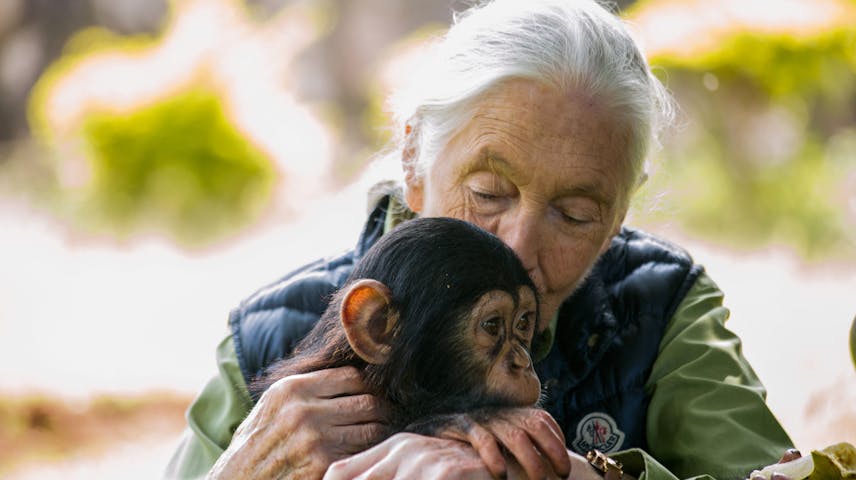
That affirmation pushed me to work even harder, just as she had inspired so many others. When I visited a Jane Goodall Institute sanctuary on Ngamba Island in Uganda, I saw how far her influence reached.
There, I met a young, orphaned chimp who had survived unimaginable horror: a ranger found him clinging to his mother’s lifeless body, which was being roasted on a spit. The ranger could’ve easily turned away or sold the baby to traffickers. Instead, he risked his life to get the baby to safety.
That ranger didn’t have wealth or power; he simply understood that every creature deserves compassion. That’s the power of Jane’s work—showing us that empathy can save a life, and perhaps even change the world.
Maybe that’s because Jane, who began her research without a Ph.D., didn’t come from the ivory tower. Instead, she brought curiosity, humility and an extraordinary gift of observation.
Goodall’s Work Led to Game-changing Science
She used patience, not force, to build trust with animals. It paid off. When her favorite chimpanzee, David Greybeard, became the first animal recorded using a tool to gather termites, Jane changed the game of science forever.
At a time when the scientific establishment prized distance and detachment, she chose connection. She treated animals with respect, giving them names, not numbers.
She proved you don’t need prestige to make lasting discoveries. You simply need to care.
And that she did. Even at 91, she was still traveling the world nonstop, speaking up for the voiceless and speaking out against the forces destroying them, from climate change to the illegal wildlife trade.
She received the Presidential Medal of Freedom, was knighted by the British crown, honored as a United Nations Messenger of Peace and, yes, even got her own Barbie doll. She was beloved by royalty and rock stars, primatologists and preschoolers alike.
But accolades never changed her. Whether it was an auditorium packed with dignitaries or a remote village in Africa, she’d walk in, monkey stuffed animal in hand and proceed to joyfully bellow out the “hello” hoots of a chimpanzee greeting.
Goodall also Set an Example for the Rest of Us to Follow
The Jane Goodall Institute announced on October 1, 2025, that its founder had passed away. I’m heartened that her relentless joy will live on through Roots & Shoots, a program that empowers young people across the globe to act. By shattering the glass ceiling for science, she’s also inspired tens of thousands of women who are leading the way as pioneers in conservation.
As a father of two daughters, I am quick to remind them that if Jane can do it, they can do it, too.
And yet, as we celebrate her legacy, a sense of despair looms large. Our climate is warming, rainforests are being decimated and species are vanishing by the hour.
Jane spent her life showing us the beauty and humanity we stand to lose, yet many of our leaders still turn away. They dismiss science, dismantle our time-tested protections and label it all a hoax. They demand that we see nothing, say nothing, hear nothing, while they drill deeper, burn hotter and exploit more.
What does it say about our society when nature is reduced to profit, humanity is bought and sold and our natural heritage is auctioned off to the highest bidder?
I want to yell: “Jane, we still need you!” Because she stood so firmly against all of it. With every speech and every sanctuary visit, she insisted that our wild places are not expendable. They are sacred. They connect us all yet belong to no one.
Jane understood the brevity of life—not as a reason to rush, but as a reason to pay attention. She’d want us to stay curious, to connect and to truly see the world around us.
And to remember that, like David Greybeard eating termites with a stick, the truth may surprise you, but it will find you if you care.
So let us honor Jane Goodall by caring enough to protect the fragile beauty she helped us see. By ensuring there’s still something wild and wonderful left for those who come next.
Jeff Corwin is a wildlife biologist, executive producer, television host, outdoorsman and fisherman.