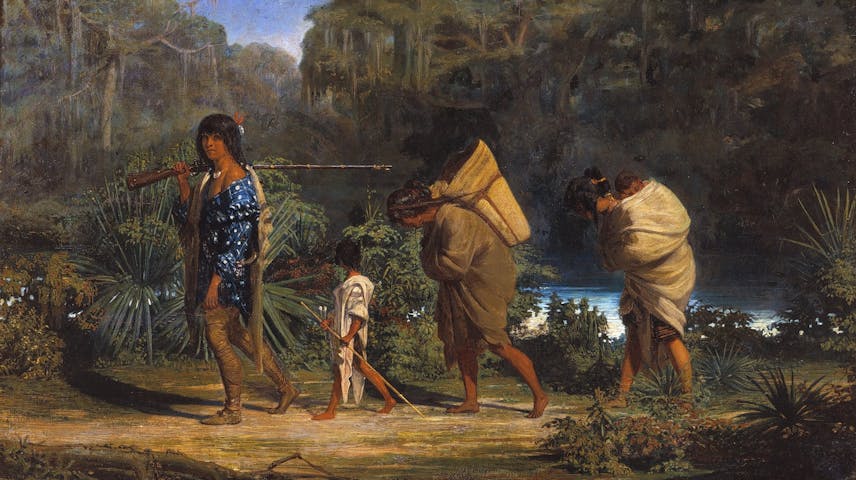
Background: Who Was Here First?
Long before Europeans arrived in North America, Native Americans had lived on the land for thousands of years. By the early 1800s, many nations in the southeastern United States, including the Cherokee, Creek, Chickasaw, Choctaw and Seminole had built established communities with their own governments, farms and cultures. White American settlers, however, wanted this land for themselves, and the U.S. government largely took their side.
Growing Pressure on Native Lands
As the 1800s began, American settlers pushed into the backcountry of the South, moving into what would become Alabama and Mississippi. They saw Native Americans as obstacles blocking their path westward. Settlers pressured the federal government to do something about it.
Presidents Thomas Jefferson and James Monroe both suggested that eastern nations should trade their lands for territory west of the Mississippi River, but neither president actually made it happen. Real change came through violence first.
Andrew Jackson and the Creek War
In 1814, General Andrew Jackson led U.S. forces against the Creek people, defeating them decisively at the Battle of Horseshoe Bend in present-day Alabama. After the battle, Jackson forced the Creek to sign a treaty. They gave up more than 20 million acres of land—roughly half of modern Alabama and a fifth of Georgia.
Over the next decade, Jackson became the leading force behind “Indian removal,” personally helping negotiate nine of the eleven major removal treaties. His aggressive approach would define U.S. policy toward Native Americans for years to come.
How Native Americans Responded
Facing an enemy they couldn’t defeat militarily, most nations tried a strategy of appeasement—giving up large portions of their land hoping they could keep at least some of it. The Cherokee, Creek, Chickasaw and Choctaw all made painful sacrifices trying to find a peaceful solution.
The Seminole Nation in Florida took a different approach and fought back. They resisted removal in two wars—the Second Seminole War (1835–1842) and the Third Seminole War (1855–1858). In the end, neither peaceful negotiation nor armed resistance saved any Native Americans from removal.
The Indian Removal Act of 1830
When Andrew Jackson became president in 1829, he pushed Congress to pass the Indian Removal Act of 1830. The law set up a process for removing Native Americans from their homelands. On paper, it offered them land west of the Mississippi, financial help to relocate and a promise of government protection in their new home—forever.
In reality, Jackson and his allies used the law to pressure, bribe and threaten Native American nations into signing removal treaties. It was rarely a free or fair choice.
By the end of Jackson’s presidency, his government had signed nearly 70 removal treaties, relocating close to 50,000 Native Americans to what was called “Indian Territory”—a region that would later become eastern Oklahoma.
The Cherokee Fight Back—In Court
The Cherokee Nation refused to go quietly. Rather than wage war, they took their case to the U.S. Supreme Court. In the 1831 case Cherokee Nation v. Georgia, Chief Justice John Marshall described Native American communities as “domestic dependent nations,” comparing their relationship to the U.S. to that of a child depending on a guardian. This didn’t fully protect Cherokee rights.
But the following year, in Worcester v. Georgia (1832), the Supreme Court went further. In that case, it ruled that Native nations were sovereign nations, meaning Georgia state laws did not apply to them and the federal government could not simply take their land.
President Jackson ignored the ruling entirely. According to legend, he reportedly said something like, “The Court has made its decision—now let them enforce it.” Whether he said it or not, his actions made his attitude clear.
The Trail of Tears
Jackson’s government obtained the signature of a small faction of Cherokee leaders on the Treaty of New Echota in 1835. The vast majority of Cherokee people, led by Principal Chief John Ross, rejected the treaty and protested it loudly. Even prominent U.S. senators Daniel Webster and Henry Clay spoke out against it. Congress ratified it anyway.
In 1838, the U.S. Army and Georgia state militia forced the Cherokee people from their homes at gunpoint and marched them over 1,000 miles to Indian Territory in present-day Oklahoma. The journey took place in brutal winter conditions with little food, shelter or medicine.
The results were devastating. Out of roughly 15,000–16,000 Cherokee people who made the march, an estimated 3,000–4,000 died along the way. The Cherokee called this journey Nunna daul Tsuny: “The Trail Where They Cried.” We know it today as the Trail of Tears.
The Outcome
By the 1840s, virtually every Native American nation had been removed from the entire region stretching from the Atlantic coast to the Mississippi River. Through a combination of forced treaties, broken promises, ignored court rulings and outright violence, the U.S. government cleared the way for westward expansion—at an enormous human cost to the people who had called this land home for generations.