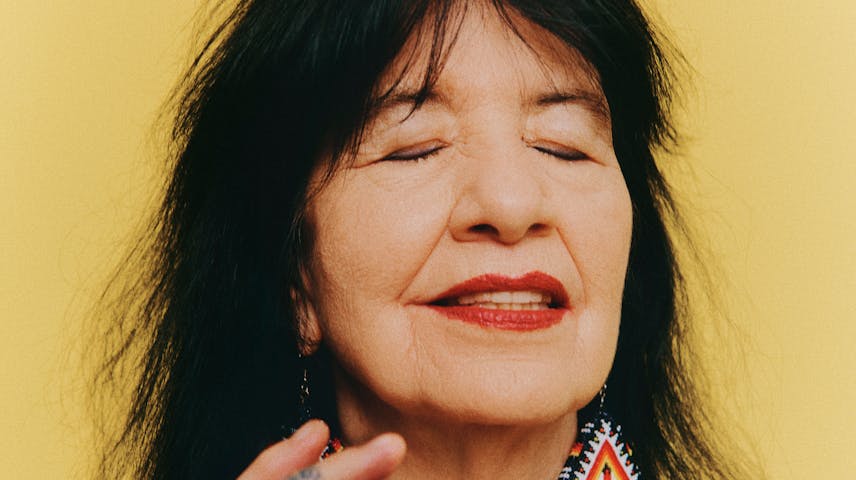
Poet Joy Harjo poses for a portrait. Photo by: Julien Lienard/Contour/Getty Images
By
Joy Harjo
Text Type
Poem
Words
145
Published
1989
Don’t bother the Earth spirit who lives here. She is working on a story. It is the oldest story in the world and it is delicate, changing. If she sees you watching she will invite you in for coffee, give you warm bread, and you will be obligated to stay and listen. But this is no ordinary story. You will have to endure earthquakes, lightning, the deaths of all those you love, the most blinding beauty. It’s a story so compelling you may never want to leave; this is how she traps you. See that stone finger over there? That is the only one who ever escaped.
Have students take out their copies of Braiding Sweetgrass and turn to the chapter “Witch Hazel” on p. 75. Instruct students to take out their homework from the previous lesson.
Lesson 6 Homework: Students were instructed to read the poems “Perhaps the World Ends Here” and “Don’t Bother the Earth Spirit” and the chapter “Witch Hazel” in Braiding Sweetgrass (pp. 75–82) and annotate the text by underlining moments where an everyday object or place is treated as something meaningful or sacred.
Quick Write
Instruct students to do a Quick Write in response to the following prompt.
Say these directions: In your homework reading, you encountered both Kimmerer and Harjo describing the natural world. In two or three sentences, answer the following question:
What is one idea the two writers seem to have in common in how they talk about the earth?
One idea they have in common is that they both use contrasting elements to describe some part of the earth. Kimmerer describes bright yellow witch hazel flowers against the gray winter sky, and Harjo describes “the deaths of all those you love” and “the most blinding beauty.” Both of the authors see important parts of the Earth as involving multifaceted elements.
Teacher Tip
This Quick Write is a warm-up to activate homework reading, not a formal assessment. Listen for whether students notice at least one shared quality in the writers’ language, particularly how both writers treat everyday things (a table, flowers, the earth’s surface) as meaningful or sacred.
Students who struggle during this Launch may need additional support during the Learning in Action portion of the lesson. If several students focus only on surface-level similarities (“both write about nature”), point out the figurative language: “Did anyone notice that both writers seem to treat the earth as something alive or active?”
Connection to Today’s Learning
Say: Today, we’re going to examine how both Braiding Sweetgrass and the poems of Joy Harjo use figurative language to express ideas about the earth.
Fluency Practice
Have students take out their copies of “Perhaps the World Ends Here” by Joy Harjo, and instruct them to follow along as you read it aloud.
Say: I’m going to model how to read “Perhaps the World Ends Here’ fluently and clearly, using the punctuation and the stanzas to help me navigate the flow of the poem. Follow along with your copy as I read the poem.
Read the poem aloud, modeling fluency and accuracy. You may want to overemphasize some prosody choices, such as using different-sized pauses for commas, periods, semicolons, and em dashes.
Set a purpose for reading the poem a second time, and have students echo-read with you.
Say: I’m going to read this poem again. This time, you’re going to echo-read with me. Try to really think about the different punctuation marks that indicate a pause and how long I choose to pause for each one, then do the same in your echo reading.
Read the poem a second time, emphasizing your prosody choices around pauses even more than the first time. For example, you might use a long pause and a shift in tone for the em dash. Encourage students to follow your lead as they echo read.
Instruct students to practice their fluency by reading the poem to a partner, who will provide feedback on their fluency, and then switching places. Set a purpose for reading the text a third time by explaining that students should try to read smoothly for expression while following the poem’s structure, including the flow of the stanzas, and pausing for punctuation.
Say these directions: Read the poem “Perhaps the World Ends Here” aloud one more time to practice your fluency. This time, you will read with a partner. First, Partner A will read the full poem while Partner B listens for three things: smooth phrasing, pauses for punctuation, and expression that matches the meaning of the poem. Next, Partner B will give one strength and one next step. Then you will switch roles and repeat.
🎯PURPOSE
Support students in using oral reading to make meaning from poetry by connecting punctuation, line breaks, and tone to the poem’s ideas.
Language Focus:
Fluency of language, including pause, phrasing, expression, stanza
Noticing how oral delivery supports interpretation
Giving peer feedback with specific language
🗣️SAY / ASK
Model one line twice, once flat and once expressive, and ask students which version better communicates meaning.
Encourage partners to give feedback that is specific (e.g., “Name one place where the reader used punctuation well and one place to revise”).
“Read it with feeling.” → “Use expression that matches the meaning of the line.”
“Stop there.” → “Pause at the punctuation and at the stanza break so the listener can follow the poet’s idea.”
I paused at ___ because ___.
This line should sound ___ because ___.
One strength in your reading was ___.
Encourage students to connect the rhythm of the poem to oral storytelling or spoken-word traditions they know from home, community, or other languages.
👁️WATCH FOR / SUPPORT IF NEEDED
If students read each line word-by-word without phrasing → Prompt: “Try scooping the words into meaningful phrases and reading the whole phrase smoothly.”
If students are unsure how tone connects to meaning → Prompt: “What is happening in this part of the poem, and what kind of voice would match that idea?”
Students adjust pacing and pause based on punctuation and stanza breaks.
Students give a partner feedback that names a specific fluency feature and connects it to meaning.
Connection to Today’s Learning
Say: Today, we are going to analyze how figurative language helps develop similar ideas in both Braiding Sweetgrass and the poems of Joy Harjo. Being able to read poetry fluently and accurately will help you get a good sense of how a poem’s language helps develop its meaning.
Part A: Analyzing Figurative Language in Joy Harjo’s Poetry (RL.8.4, L.8.5.a) (15 minutes)
Teach: Figurative Language in “Perhaps the World Ends Here”
Display the poem “Perhaps the World Ends Here” so all students can view it. Students should also have their own individual copies of the poem.
Say: In the Literacy Lab, you practiced reading this poem fluently. Now we’re going to analyze the figurative language in this poem. Think about the following question as we discuss: How does Harjo use the kitchen table to express ideas about the earth and human life?
Ask: What is at the center of this poem? What happens there?
The kitchen table is at the center. Harjo describes everything that matters in human life happening at or around the table—babies growing up, people gossiping, dreams, wars, birth, and death. The table holds all of what life has in store for us.
Ask: Is Harjo really just talking about a table? What figure of speech is she using, and what does the table represent?
She’s using the table as an extended metaphor. The table represents the earth itself. It’s the place where all of human life happens. When she writes, “The gifts of earth are brought and prepared, set on the table,” the table and the earth become the same thing. Everything begins and ends there at the table.
Tell students that “the gifts of earth are brought and prepared, set on the table” is a direct connection to Kimmerer’s reciprocity idea in Braiding Sweetgrass. Tell students to holdon to this phrase, and explain that you will come back to it in Learning in Action: Part B.
Ask: Find one example of personification in the poem. What idea does it convey?
“Our dreams drink coffee with us as they put their arms around our children.” Harjo personifies dreams as people who sit at the table with us. This conveys the idea that our hopes and memories are just as present and real as the people sitting with us—the table (and the earth) holds all of it together.
Turn and Talk
Transition students into pairs to read and discuss “Don’t Bother the Earth Spirit” with their partners.
Say these directions: Read “Don’t Bother the Earth Spirit” with your partner. Then discuss the following questions with your partner.
Display the following questions.
How does Harjo personify the earth in this poem? What human qualities does she give the earth spirit?
Harjo personifies the earth as “she”—a storyteller who “is working on a story,” who “will invite you in for coffee, give you warm bread.” The earth has the qualities of a host and an artist. She is generous but also powerful—“this is how she traps you.”
The poem says, “This is no ordinary story.” What does the earth spirit’s story include, and what does this suggest about the earth’s power?
The story includes “earthquakes, lightning, the deaths of all those you love, the most blinding beauty.” This suggests the earth’s power includes both devastating destruction and astonishing beauty, and humans can’t escape either one.
Say: Both of these poems portray the earth as something else—as a table that holds all of human life and as a storyteller who writes a story we can’t escape. Now we’re going to look at how Kimmerer does something similar in “Witch Hazel” and compare the three.
Provide students with a confidence continuum (i.e., 1–5). As needed, model how to demonstrate a level of confidence using the continuum.
Reflection
Reflect on your understanding of reading and discussing a poem using the Reflection routine.
How confident are you in your ability to discuss how a poem uses figurative language to develop its ideas?
Situation
Try this
Struggling with: Interpreting figurative language
Ask questions about the meaning of figurative language, even if it seems obvious or familiar. Ex. “What does the author mean when she says the earth spirit is “working on a story”?
Ready for extension: Using figurative language to develop meaning
Ask: What is another way you could use figurative language to express the idea that the earth shapes our experiences like a storyteller shapes a story?
I could say that the earth spirit is like a chef or baker, adding certain ingredients to a dish.
🎯PURPOSE
Support students in explaining how figurative language shapes meaning in the poems, not just identifying literary devices.
Language Focus:
Analytical verbs, including represents, conveys, suggests, personifies
Sentence structures for naming a figure of speech and explaining its effect
Oral discussion language for building on a partner’s idea
🗣️SAY / ASK
Push students from labeling to explaining by following up with “What does that figure of speech help Harjo say about the earth or human life?”
When students give a strong idea in informal language, restate it using academic vocabulary, and invite them to repeat it.
“The table is like life.” → “The table functions as an extended metaphor for the earth and the full cycle of human life.”
“The dreams seem real.” → “Harjo personifies dreams to show that memories and hopes are active presences in human life.”
Harjo uses ___ as a metaphor for ___.
This personification conveys the idea that ___.
Building on that idea, the poem suggests ___.
Invite students to connect the poem’s use of an everyday object as a symbol to similar storytelling traditions, sayings, or family examples from their own communities.
👁️WATCH FOR / SUPPORT IF NEEDED
If students can name personification or metaphor but cannot explain its meaning → Prompt: “What larger idea does this image help the reader understand?”
If students confuse literal description with figurative meaning → Prompt: “Is the poet only describing what is there, or is she using it to stand for something bigger?”
Students name a figure of speech and explain what it represents or conveys.
Students use evidence from a specific line to support an interpretation rather than summarizing the whole poem.
Part B: Drawing Connections Between Figurative Language in Multiple Texts (RL.8.4, RI.8.4, W.8.4, L.8.5.a) (15 minutes)
Continue to keep students in pairs for this part of the lesson.
Say these directions: With your partner, reread the middle two paragraphs on p. 79 of “Witch Hazel,” from “Hazel leaned on my mother’s arm . . .” to “It just lightens your heavy heart, is what it does.” As you read, look for the answers to the following questions.
Display the following questions.
How does Kimmerer (or her neighbor Hazel) use figurative language to describe the witch hazel? What figure of speech do you notice?
Hazel personifies the witch hazel when she says it “remind[s] us that there’s always somethin’ good even when it seems like there ain’t” and that “it just lightens your heavy heart.” She talks about the plant as if it has the intention to comfort people.
What idea does this figurative language convey about the relationship between humans and the earth?
The earth offers gifts on its own timeline, not ours. Humans have to be patient and humble enough to accept beauty when the earth provides it, even at an unexpected time.
Teacher Tip
If you live in a temperate climate, you may want to prompt students’ understanding of the significance of witch hazel blooming in November by asking them to describe November (cold, gray, leaves have mostly fallen) and describe the season they associate with flowers (spring or possibly summer). If you do not live in a temperate climate, you may want to briefly explain or remind students of the seasonal changes in foliage that are common in temperate areas.
Quick Write
Say: Notice what all three texts share: Harjo portrays the earth as a table that holds human life and personifies it as a storyteller who writes the story of existence. Kimmerer personifies witch hazel as a comforter that arrives on its own schedule. In all three, the earth is active and operating on its own terms. Now you’re going to write about this connection.
Say these directions: Choose one of the poems and complete a Quick Write to answer the following question:
How do Kimmerer in “Witch Hazel” and Joy Harjo in your chosen poem each use figures of speech—such as personification, extended metaphor, or imagery—to show that the earth is active and alive?
Choose ONE Harjo poem to compare with the excerpt from “Witch Hazel.”
Identify at least one figure of speech from each text.
Explain what the figure of speech means—not just what it describes, but what idea it conveys about the earth
Cite specific text evidence from both writers.
Use previously learned vocabulary words where possible.
“Don’t Bother the Earth Spirit”: In “Witch Hazel,” Kimmerer personifies the witch hazel plant through her neighbor Hazel’s voice. Hazel speaks about the plant as if it intentionally comforts people, saying, “It just lightens your heavy heart.” This personification conveys the idea that the earth offers gifts to humans on its own schedule—the witch hazel blooms in November, when everything else is dormant, and people must be patient enough to receive it. In “Don’t Bother the Earth Spirit,” Harjo uses personification even more directly by describing the earth as “she,” a storyteller “working on a story” that “is the oldest story in the world.” The earth spirit invites you in for coffee and warm bread, but the story she tells includes “earthquakes, lightning, the deaths of all those you love, the most blinding beauty.” This conveys the idea that the earth is powerful and operates on its own terms. Humans are not in control. They are listeners, obligated to stay. Both writers use personification to show that the earth is active and alive, not just a setting for human life. In both texts, humans must be mindful that the earth has its own timing and sacred rhythms. The difference is in tone: Kimmerer’s “Witch Hazel” is warm and comforting, while Harjo’s earth spirit is more powerful and even a little dangerous.
“Perhaps the World Ends Here”: In “Witch Hazel,” Kimmerer describes the plant’s November blooming as an unexpected gift, and her neighbor Hazel personifies it as something that “lightens your heavy heart.” This conveys the idea that the earth provides beauty on its own schedule. In “Perhaps the World Ends Here,” Harjo uses an extended metaphor—the kitchen table represents the earth itself. She writes, “The gifts of earth are brought and prepared, set on the table,” making the table and the earth one and the same. Harjo also personifies dreams as people who “drink coffee with us” and “put their arms around our children.” Both writers show that the earth is not a passive backdrop. It actively holds and shapes human life. Kimmerer shows this through a single plant that arrives on its own sacred schedule. Harjo shows it through a table that witnesses the full cycle of human existence. Both ask us to be conscious of how deeply our lives depend on the earth.
Teacher Tip
If students struggle to choose a poem, suggest: “Perhaps the World Ends Here” is a good choice if you want to write about how the earth holds and nurtures human life. “Don’t Bother the Earth Spirit” is a good choice if you want to write about how the Earth has its own power and humans must respect it.
Situation
Try this
Struggling with: Identifying the connection
Provide a sentence frame: “Both writers use ____ (figure of speech) to show that the earth is ____. Kimmerer shows this when she writes ____, while Harjo shows this when she writes ____.”
Struggling with: Choosing evidence
Point to specific lines. “Perhaps the World Ends Here”: “The gifts of earth are brought and prepared, set on the table.” “Don’t Bother the Earth Spirit”: “She is working on a story. It is the oldest story in the world.” “Witch Hazel”: “It just lightens your heavy heart, is what it does.”
Ready for extension: Comparing ideas
Ask: Both Harjo’s poems and Kimmerer’s excerpt share the idea that the earth is alive and active. But do they agree on whether the earth is more nurturing or more powerful? Use evidence from at least two of the three texts to argue one way or the other.
Kimmerer’s idea is that the earth is nurturing, while Harjo’s poems suggest that the earth is powerful, like how she explains the earth has a story to tell that includes “earthquakes” and “lightning.”
🎯PURPOSE
Support students in composing a clear comparative response that connects evidence, figurative language, and ideas about the earth.
Language Focus:
Compare/contrast language, including both, while, similarly, however, in contrast
Explanation language, including shows, conveys, suggests, reveals
Evidence-linking structures for written analysis
🗣️SAY / ASK
Before writing, have partners orally rehearse one comparison sentence and one difference sentence using evidence from both texts.
If students write plot summary instead of analysis, point them back to the figure of speech, and ask what idea about the earth it helps communicate.
“They both show nature doing something.” → “Both writers portray the earth as active and alive through figurative language.”
“This part means the plant helps people.” → “This personification suggests that the earth offers comfort on its own timing rather than according to human control.”
In “Witch Hazel,” Kimmerer uses ___ to show ___.
In Harjo’s poem, ___ represents or personifies ___.
Both writers show ___, but Harjo’s tone is ___ and Kimmerer’s tone is ___.
Encourage students to plan orally first and to draw on familiar ways of comparing ideas from conversation, then translate those ideas into more formal written language.
👁️WATCH FOR / SUPPORT IF NEEDED
If students include evidence but do not explain it → Prompt: “After the quote, add: This shows that . . .”
If students explain only one text well and mention the second text briefly → Prompt: “Now balance your response by adding one full sentence of analysis for the second text.”
Students write about both texts using comparison language and at least one piece of evidence from each.
Students explain what the figure of speech conveys about the earth instead of only naming the device.
Pulse Check (L.8.5.a)
Which of the following statements most accurately compares Kimmerer’s “Witch Hazel” and Joy Harjo’s poems?
They both share the idea that the earth has its own timing, but they disagree as to whether to accept it.
Incorrect: Both texts take the view that humans must accept that the earth has its own timing.
They both share the idea that the earth has its own timing, but they use different figures of speech to show it.
Correct: The timing of the earth is an important theme for both writers, but they employ different figures of speech, such as personification and imagery.
They both share the idea that the earth has its own timing, but they explain differently how that came to be.
Incorrect: Neither text focuses on how the earth came to have its own timing, just the fact that it does and that humans must accept it.
They both share the idea that the earth has its own timing, but they are set at different times in history.
Incorrect: None of the Joy Harjo poems are set at any particular time in history, while “Witch Hazel” is set when Kimmerer was a small child.
Turn and Talk
Instruct students to turn-and-talk with a partner about the following question.
Say these directions: Turn and talk with a partner about the following question.
How do both writers treat the earth in their respective writing?
Both writers treat the earth as active and alive, not a backdrop but a participant. Both show that the earth operates on its own schedule, and humans must accept this with patience and humility. Both Kimmerer and Harjo use personification to show that the earth is a living, active presence in human life and that living responsibly means being mindful of the earth’s own timing and rhythms.
Instruct students to complete the following homework using their Journal.
Read the chapter “Allegiance to Gratitude” in Braiding Sweetgrass (pp. 83–99) and annotate the text to mark two or three moments when Kimmerer connects scientific observation with Indigenous knowledge or traditional teachings.