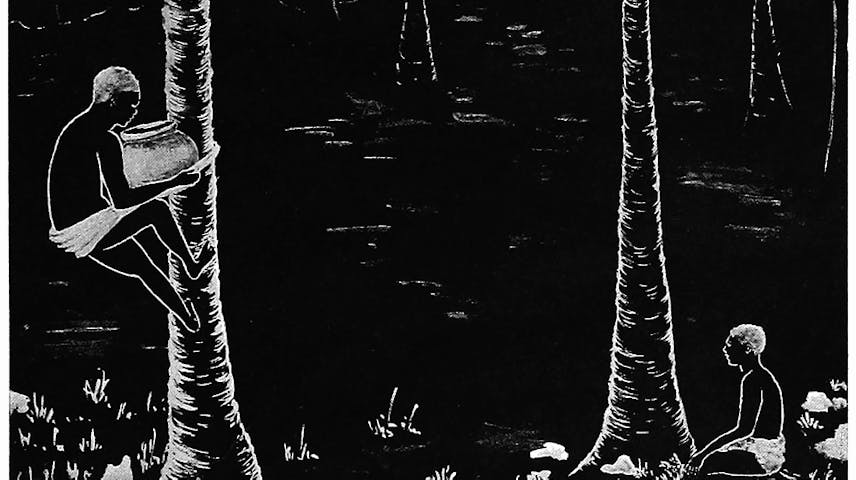
Again and again, Anansi tried to climb the tree. Photo by: West African Folk-Tales published in 1919. Public domain
By
Compiled by W. H. Barker and Cecilia Sinclair, in the book West African Folk-Tales.
Text Type
Folk Tale
Words
383
Lexile
780L
Published
1919
There once lived, in Fanti-land, a man named Father Anansi. He possessed all the wisdom in the world. People came to him daily for advice and help.
One day the men of the country were unfortunate enough to offend Father Anansi, who immediately resolved to punish them. After much thought he decided that the severest penalty he could inflict would be to hide all his wisdom from them. He set to work at once to gather again all that he had already given. When he had succeeded, as he thought, in collecting it, he placed it all in one great pot. This he carefully sealed and determined to put it in a spot where no human being could reach it.
Now, Father Anansi had a son, whose name was Kweku Tsin. This boy began to suspect his father of some secret design, so he made up his mind to watch carefully. Next day he saw his father quietly slip out of the house, with his precious pot hung round his neck. Kweku Tsin followed. Father Anansi went through the forest till he had left the village far behind. Then, selecting the highest and most inaccessible-looking tree, he began to climb. The heavy pot, hanging in front of him, made his ascent almost impossible. Again and again he tried to reach the top of the tree, where he intended to hang the pot. There, he thought, wisdom would indeed be beyond the reach of everyone but himself. He was unable, however, to carry out his desire. At each trial the pot swung in his way.
For some time Kweku Tsin watched his father’s vain attempts. At last, unable to contain himself any longer, he cried out, “Father, why do you not hang the pot on your back? Then you could easily climb the tree.”
Father Anansi turned and said: “I thought I had all the world’s wisdom in this pot. But I find you possess more than I do. All my wisdom was insufficient to show me what to do, yet you have been able to tell me.” In his anger he threw the pot down. It struck on a great rock and broke. The wisdom contained in it escaped and spread throughout the world.
Source: West African Folk-Tales - William H. Barker. 1919.
Explain that students will begin the unit by reading a folktale about how wisdom is shared.
Say: In this unit, we will explore how stories preserve memory, identity, and culture. Today, we will read a folktale and an informational article to consider what each teaches about wisdom and history, and how they are shared.
Turn-and-Talk
Provide students with copies of “How Wisdom Became the Property of the Human Race” and display the story for the class. Read aloud as students follow along. Then, pair students to share responses to the following questions.
Say these Directions: As we read the folktale, consider the lesson the story conveys. Then, take turns discussing the following questions with a partner.
Display the following questions for students.
Father Anansi owns all the wisdom at the start. Do you think that is actually possible? Why or why not?
I do not think one person can hold all the wisdom of the world. The story tells us that Kweku Tsin, who is just a child, notices and realizes something Father Anansi does not. Father Anansi admits, “I find you possess more [wisdom] than I do.” He is angry that he can’t possess it all and that he needs his son to give him wisdom about climbing the tree.
How does Kweku Tsin know to suggest a different way to reach the top of the tree?
Kweku Tsin “made up his mind to watch carefully” and “for some time Kweku Tsin watched his father’s vain attempts.” We can infer that his wisdom came from paying attention, thinking carefully, and living in the world. The story suggests that wisdom can come from experience and observation.
What does this folktale explain about how wisdom should work in the world?
The folktale explains that wisdom should be shared and that trying to keep knowledge for yourself will fail. It also explains why wisdom is spread across all humans instead of just one person, because we benefit when we can share our knowledge.
Connection to Today's Learning:
Say: We have seen how a folktale can convey a lesson about how wisdom is shared. Next, you will read an informational article to explore why humans record and preserve stories over time.
Part A: Annotating for Central Ideas (RI.8.2) (20 minutes)
Close Read & Annotation
Have students remain in pairs. Provide students with copies of “How We Have Turned Memories and Stories into Histories.” Partners will take turns reading paragraphs or sections of the article. Students will annotate for central ideas as they read.
Say these Directions: You will read an informational article that considers why humans record and share stories and histories. As you read, think about the central idea the article conveys. Look for repeated ideas or words, such as history, stories, and memory. Consider the main message the author wants you to think about these key topics.
Teach: Identifying a Central Idea
Say these Directions: With your partner, annotate for the following:
Display the following annotation criteria.
Reasons humans have recorded history throughout time
References to memory, identity, or survival
Examples of why oral traditions are as important as evidence-based histories
Provide time for students to read and annotate. Circulate to ensure students are identifying repeated ideas and connecting details to a central idea. Then bring students back together for a whole-class discussion.
Participate in the class discussion of the following questions:
Ask: According to the article, what is one reason humans record stories?
The article shows that people have used stories and records to “share what they know and learn.” We read that history is a “shared knowledge of the past.” This tells us that humans record stories to preserve memory so that important knowledge can last beyond one person’s lifetime.
Ask: Why are oral stories as important as evidence-based histories?
According to the article, when only written records remain, people lose “the vivid, personal sense of engagement with the past that existed in oral cultures where history was always told as a story.” Written history usually records limited information—often about upper classes and rulers—whereas oral histories include everyone.
🎯PURPOSE
Support students in identifying repeated ideas in an informational text and naming those ideas with precise language.
Language Focus:
Central idea language
Annotation verbs, including highlight, underline, and circle
Cause-effect connectors, including because, so, and when
🗣️SAY / ASK
Encourage students to name the repeated idea in their own words before quoting or paraphrasing details.
Prompt students to explain how a detail connects to memory, identity, or survival instead of leaving annotations as isolated marks.
You said, “people kept stories so they wouldn’t forget”—we can say: “The article suggests that humans recorded stories to preserve memory across generations.”
That idea connects to identity because stories help groups remember who they are.
One repeated idea I notice is ___.
This detail matters because it shows ___.
The article suggests that humans recorded stories to ___.
Invite students to connect the article’s ideas to traditions in their own families or communities for preserving memory, including sayings, celebrations, stories, recipes, songs, or photographs.
👁️WATCH FOR / SUPPORT IF NEEDED
If students highlight many details without explaining them → Prompt: "What idea connects these details? Finish the sentence: 'These details all show ___.'"
If students summarize only one section → Prompt: "Look for another place in the article where that same idea shows up again."
Students identify a repeated idea and connect at least one annotation to that idea.
Students use words such as memory, identity, culture, or survival knowledge to explain why a detail matters.
Part B: Making Connections Between Texts (RL.8.2, RI.8.2) (10 minutes)
Give One, Get One
During Give One, Get One, one student will share a response, supporting it with evidence from both texts. Then, the second student will share a response to the same question. Students will compare responses and add evidence to create a deeper understanding of the texts. Students might switch partners or stay with the same partners from Learning in Action Part A.
Say these Directions: You will now make connections between the folktale and the informational article. For each question, find at least one detail from each text and explain how they connect.
Display the following questions for students to use as they engage in the Give One, Get One routine.
The article suggests that stories have always been humanity’s most powerful tool for survival. How does this idea connect to the Anansi story? Use at least one piece of evidence from both texts to support your answer.
From the article, we read that “even the earliest members of our species . . . could share ideas not just about where water holes or lions are, but also about last year’s bush fire.” These “histories” are important to basic survival, and the “origin stories” share important ideas about the world. The Anansi story is one of those “origin stories.” It shares the important idea that wisdom cannot be contained, and it should not be. The story explains, “The wisdom contained in it escaped and spread throughout the world.” Together, the texts suggest that survival depends on sharing knowledge, not hiding it or hoarding it.
The Anansi story was told long before anyone wrote it down. What does that suggest about the purpose of this specific example of the oral tradition?
The article tells us that “people who cannot write down information rely on such ‘oral tradition’” to pass down knowledge. The Anansi story teaches a lesson about sharing wisdom. In the story, we read that Father Anansi drops the pot and “the wisdom contained in it escaped and spread throughout the world.” The story, as part of the oral tradition, was a way for people to pass on values and survival knowledge.
What message does each text communicate about knowledge, and what shared idea do they reveal when considered together?
In the folktale, the message is that wisdom does not belong to one person alone. In the article, the central idea is that humans preserve stories and records so knowledge can survive across time. When we compare these ideas, we can conclude that important knowledge has to be recorded and shared if people want to preserve it.
Provide time for students to discuss and exchange ideas. Circulate to ensure students are using evidence from both texts and clearly explaining the connection.
🎯PURPOSE
Support students in comparing a literary theme and an informational central idea using evidence from both texts.
Language Focus:
Compare-contrast language, including both, similarly, while, and unlike
Evidence-linking language, including “in the story,” “in the article,” and “this shows”
Interpretive verbs, including suggests, reveals, and explains
🗣️SAY / ASK
Require students to name each text before giving evidence so the comparison stays clear.
Prompt students to move past topic-level connections and explain the shared idea or lesson.
You said, “They both talk about stories.” We can say: “Both texts show that stories carry wisdom people need to keep and share.”
That idea connects to survival knowledge because the texts suggest that people depend on shared knowledge to live and continue their culture.
In the story, ___, while in the article, ___.
Both texts suggest that ___.
This evidence shows that storytelling matters because ___.
Encourage students to use a home-language rehearsal with a partner before sharing in English, especially when clarifying abstract ideas like identity, culture, or wisdom.
👁️WATCH FOR / SUPPORT IF NEEDED
If students mention one text but not the other → Prompt: "Now add a detail from the second text that connects to the same idea."
If students retell the plot instead of naming a theme or central idea → Prompt: "What lesson or message does that event teach?"
Students cite one relevant detail from each text.
Students state a shared idea that goes beyond a simple topic match.
Situation
Try this
Struggling with: Making Connections
Provide a frame for connecting ideas and have students insert details that support the connection: Ex. “Both texts show that ___ matters because ___.”
Struggling with: Inferring ideas
Provide guided questions to scaffold students’ inferences. Ex. What did Kweku Tsin say? How did he know? What does this suggest about wisdom?
Ready for extension
Invite students to add a third connection to modern life by naming one story, tradition, or community practice today that helps preserve knowledge and/or history.
Check for Understanding
Provide students with a confidence continuum (i.e., 1–5). As needed, model how to demonstrate a level of confidence using the continuum.
Reflection
Reflect on your ability to make connections across texts using the Reflection routine.
How confident do you feel in your ability to make connections about central ideas between the folktale and the article?
Students have explored the idea that stories act as memory systems by comparing a folktale about shared wisdom with an informational article about how humans record history. Transition students from discussion to synthesis by instructing students to complete a Quick Write.
Quick Write
Say these Directions: Read the question below and then write a brief response (two to three sentences) in your journal. Use at least one detail from the folktale and one from the article in your response.
Ask: What might happen if stories about our past were to disappear?
If stories about our past disappeared, people could lose important knowledge and part of their identity. In the Anansi story, the message is that wisdom should be shared by everyone, so if that story disappeared, people might lose that lesson about community. In the article, humans record stories so that memory and survival knowledge can last over time. Without those stories, a group might forget what it values, what it has learned, and even how it survived before.
Provide students with a copy of the following articles:
“10 Things: Going Interstellar”
“These Sci-Fi Visions for Interstellar Travel Just Might Work”
As students read, instruct them to annotate and take notes in their Journal on the following questions:
What makes interstellar travel different from other types of space exploration humans have done? Which challenges are physical? Which are psychological or social?
In the WIRED article, how do scientists and writers imagine solving problems that do not yet have final answers?
If humans had to leave Earth permanently, what would matter most to take with us, and why?