Loading...
Lesson 37: March and Op-Ed, Explanatory Writing, Part 5
50 min
California CCSS: Focus Standards
California CCSS: Supporting Standards
ELD Standards
Student Lesson
Lesson 37: March and Op-Ed, Explanatory Writing, Part 5
Student Learning Objectives
1
Content
Students will draft explanatory paragraphs comparing Lewis’s and Reid’s points of view and explain how they address opposing viewpoints within their respective texts.
2
Language
Students will compare Lewis’s and Reid’s points of view and explain how each addresses an opposing viewpoint by using comparison structures, logical connectors, and evidence integration frames.
Essential Question
What is civic memory, and how does testimony help us remember and learn?
Connections to
Knowledge-Building:
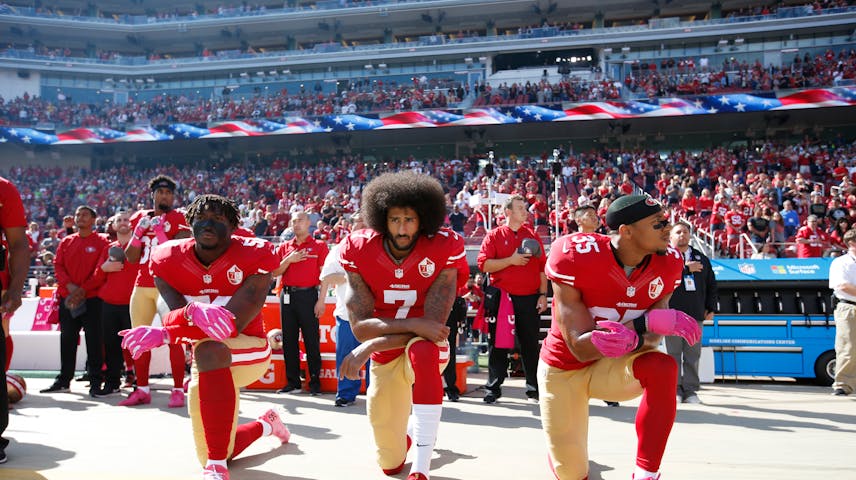
Students will compare Lewis’s protest work during the Civil Rights Movement to Eric Reid and Colin Kaepernick’s modern-day protest of police brutality.
Enduring Understanding:
People shape civic memory through storytelling.
Future Lessons:
In Lessons 40 and 41, students will begin working on the Showcase Performance Task.
Unit Performance Task:
Students will need to know how to draft explanatory paragraphs for their Civic Memory Briefs.
Lesson Pacing
| Lesson Flow | Purpose of Learning Experience |
|---|---|
Launch5 Minutes | Students will review the writing skills and strategies they learned in this unit and set one goal for their writing today. |
Literacy Lab10 Minutes | Students will investigate active and passive voice in writing. |
Learning in Action30 Minutes | Students will respond to a question prompt by writing an explanatory paragraph using the skills and strategies they learned in this unit. |
Vocabulary
Vocabulary Addressed in Lesson
Not available for this lesson
Additional Vocabulary
Not available for this lesson
Material List
March: Book One, by John Lewis, Andrew Aydin, and Nate Powell
Unit 1 Lesson 37 Student Edition
Routines
Quick Write
Lesson Sequence
Have students take out March: Book One and “Eric Reid: Why Colin Kaepernick and I Decided to Take a Knee” with their annotations.
Lesson 36 Homework: Students were instructed to reflect on the following questions: How does Lewis’s points of view in March compare to Reid’s points of view in the article? How are they similar, and how are they different?
Say these Directions: Take out March: Book One and “Eric Reid: Why Colin Kaepernick and I Decided to Take a Knee” with your annotations. Review the writing skills and strategies listed below.
Using verbals
Using transition words/phrases to clarify relationships among ideas
RACE writing strategy
Using commas to signal pauses or clarify meaning
Combining sentences
Using ellipses in quotations to indicate omitted text
Say: Think about a goal for your explanatory writing today. Respond to this question: What is one goal you wish to accomplish with your writing today?
Model a writing goal using the sample response below, or create a model of your own.
My goal is to write a clear explanatory paragraph that compares Lewis’s and Reid’s points of view and uses transitions to show similarities while also explaining how each author responds to opposing viewpoints.
Connection to Today’s Learning
Say: Today, you’ll use the writing strategies and skills we’ve practiced throughout the unit to draft an explanatory paragraph that compares Lewis’s and Reid’s points of view and explains how each one addresses opposing viewpoints. By the end of class, you should have a focused draft that uses evidence, clear reasoning, and strong transitions to connect your ideas.
Introduce Active and Passive Voice in Writing:
Say: Writers can choose active voice or passive voice depending on what they want readers to pay attention to. In the active voice, the subject does the action. Writing in the active voice is usually clearer and more direct. In passive voice, the subject receives the action. Writers sometimes use passive voice when the doer is unknown or unimportant, or when they want to emphasize what happened rather than who did it. Active voice is usually the default in strong explanatory writing, but passive voice can be useful when you need to focus on the event or result. When writing about literature, you want to try to write in the active voice as much as possible because it is more formal. You can check what voice a sentence is written in by adding “by ___” to the sentence. If it still makes sense, the sentence is often passive.
Model Active and Passive Voice in Writing:
Say: Here is an example of a sentence written in the active voice: “In the book, the author reveals the main character’s fear through sharp, short dialogue.” In this sentence, the subject (the author) is doing the action (reveals). The sentence is clear and direct.
Say: Here is the same idea in passive voice: “In the book, the main character’s fear is revealed through sharp, short dialogue.” Now the focus shifts to what is revealed (the fear), not who is doing the revealing.
Say: Here’s another active voice example: “The narrator describes the setting to create tension before the conflict begins.” The subject (the narrator) is doing the action (describes).
Say: Here is a passive voice version: “The setting is described to create tension before the conflict begins.” This version emphasizes the description and its effect, but it sounds less specific because it hides who is doing it.
Active Voice | In the book, the author reveals the main character’s fear through sharp, short dialogue. | The subject (the author) is doing the action (reveals). |
|---|---|---|
The narrator describes the setting to create tension before the conflict begins. | The subject (the narrator) is doing the action (describes). | |
Passive Voice | In the book, the main character’s fear is revealed through sharp, short dialogue. | The focus shifts to what is revealed (the fear), not who is doing the revealing. |
The setting is described to create tension before the conflict begins. | This version emphasizes the description and its effect, but it sounds less specific because it hides who is doing it. |
Say: When you are writing an explanatory paragraph, try to use the active voice to keep your analysis clear and focused on who or what is doing the action.
Reflection (L.8.3.a) |
|---|
Reflect on your ability to use active and passive voice in explanatory writing.
|
Connection to Today’s Learning
Say: As you write today, try using active voice to write about the memoir and the op-ed so that your comparisons are direct and clear, like “Lewis emphasizes . . .” and “Reid argues . . .”
Drafting an Explanatory Paragraph (RI.8.6, W.8.2.a–f, W.8.4) (30 minutes)
Introduce the writing prompt to students. Give them the entire Learning in Action time to draft their paragraph responses to the written prompt using the writing skills they have learned throughout the unit. Remind students to use their homework assignments, their text annotations, and both texts to support their writing.
Teach: Using Precise Language and Formal Style
Say: Strong explanatory writing does more than answer the question. It uses precise language, which means choosing exact words instead of vague words like things, stuff, good, bad, or a lot. It also uses domain-specific vocabulary, which means words that address this topic, like nonviolent protest, civil rights, injustice, discrimination, equality, critics, and oppression. Formal style means the writing sounds academic and serious, not casual. For example, instead of saying Reid talks about people being mad, I can write “Reid responds to critics who misinterpret kneeling as disrespectful.” Instead of saying Lewis shows people being treated badly, I can write “Lewis depicts protesters confronting injustice and segregation through nonviolent action.” These choices make the explanation clearer, stronger, and more trustworthy.
Less precise / less formal | More precise / more formal |
|---|---|
Both texts show that protesting works. | Both texts present nonviolent protest as a powerful response to injustice. |
Reid talks about people being mad. | Reid responds to critics who misinterpret kneeling as disrespectful. |
Lewis shows people being treated badly. | Lewis depicts protesters confronting discrimination and segregation. |
Say these Directions: Before you draft, scan your annotations and identify a few strong words from the unit and the texts that you can use in your paragraph. As you write, choose exact verbs like argues, depicts, emphasizes, responds, and presents, and keep your tone formal by avoiding casual words and phrases.
Say these Directions: Read the writing prompt and use the full time to draft your paragraph response. Use the writing skills practiced throughout the unit, and support your ideas with your homework assignments, text annotations, and evidence from both texts. Use precise language and domain-specific vocabulary to explain the topic, and maintain a formal style throughout your paragraph. Respond to this question:
How do Reid and Lewis share similar points of view in their respective texts, and what is one example of how they respond to a conflicting viewpoint in their texts?
Reid and Lewis share the point of view that protest can be both respectful and powerful, especially when it is grounded in moral purpose and carried out with nonviolent discipline. In Reid’s op-ed, he explains that he and Kaepernick kneel to protest police brutality and systemic oppression, and he argues that the gesture is not meant to insult the country. For example, Reid responds directly to critics who claim kneeling is disrespectful when he writes, “It baffles me that our protest is still being misconstrued as disrespectful. . . . We chose it because it’s exactly the opposite.” Reid further explains that the kneeling is protected by our “fair and free” nation, in which protest is a civil right. Similarly, in March, Lewis shows protest as principled action by depicting Nashville students choosing nonviolence as a way to seek justice through respect and “love for your attacker” (p. 82). He also shows how the protesters continue to address their attackers and governmental critics by standing up for their cause in a nonviolent way—for example, when the protesters are arrested and refuse to pay the fines because it would be “contributing to, and supporting the injustice and immoral practices that have been performed in the arrest and conviction” (p. 108). And, on pp. 117–121, the Nashville protesters respond to “law and order” resistance by marching to City Hall to defend themselves against violence by confronting the mayor through a conversation about justice and equality. As a result, both authors present nonviolent protest as a way to address injustice and discrimination.
Teacher Tip |
|---|
Remind students of the sentence-combining writing strategy they learned in previous lessons. Tell them that today’s writing activity is a good opportunity to combine ideas about Reid and Lewis and their points of view through sentence combining. Remind students to use their Personal Dictionaries to find target vocabulary from throughout the unit that they can use in their writing. |
Checklist RI.8.6, W.8.2.a–f, W.8.4, L.8.3.a |
|---|
As you draft your paragraphs, check if you:
|
Lesson 37 Writing Rubric: Explanatory Paragraph — Lewis & Reid on Protest
Writing prompt: How do Reid and Lewis share similar points of view in their respective texts, and what is one example of how each responds to a conflicting viewpoint?
Criteria | 1 — Beginning | 2 — Developing | 3 — Proficient |
|---|---|---|---|
Topic Sentence & Shared POV (W.8.2.a) Introduce a Shared Point of View | No shared point of view is stated, or the authors are discussed separately without a link. The topic sentence names only one author, or names a shared topic without a point of view. | The topic sentence names a shared topic (for example, protesting) rather than a shared point of view. Comparison structure is attempted but weak or partial. | The topic sentence names a specific shared point of view between John Lewis (March: Book One) and Eric Reid (“Why Colin Kaepernick and I Decided to Take a Knee”) — not just a shared topic. Framing uses comparison structures such as Both Lewis and Reid share the point of view that ___. |
Active & Passive Voice (L.8.3.a) Voice for Clarity & Emphasis | The paragraph does not use active or passive voice purposefully. Sentences are unclear about who is acting or who is being acted upon. | The paragraph uses active or passive voice in some sentences, but the choice is not always purposeful or does not clearly serve the meaning. | The paragraph uses active voice purposefully to name who is acting (for example, Lewis argues, Reid explains) and passive voice where the receiver of the action is more important. Voice choices strengthen the clarity of the comparison between the two authors’ points of view. |
Quick Write
Instruct students to reflect on their writing goal from the Launch.
Say these Directions: Reflect on your writing goal from the Launch. Consider this question:
What are the strengths of your writing? Where do you still want to grow?
My writing is strongest when I clearly compare Reid and Lewis and use specific evidence to support my point. I still want to grow in combining sentences more smoothly and using transition words to explain my ideas more clearly because some of my writing is still choppy.
Remind students that they will begin working on their Civic Memory Brief Performance Task in Lesson 40. Introduce the homework to complete before the next lesson:
In your Journal, reflect on the following question:
What do you hope to accomplish when writing your Civic Memory Brief?
Lesson Texts
Novel
March: Book One
John Lewis, Andrew Aydin, Nate Powell

Short-Form Text
Eric Reid: Why Colin Kaepernick and I Decided to Take a Knee
Eric Reid, New York Times
Read text