“I believe in nonviolence as a way of life, as a way of living.”
John Lewis was born to a family of sharecroppers outside of Troy, Alabama, at a time when African Americans in the South were subjected to a humiliating segregation in education and all public facilities, and were effectively prevented from voting by systematic discrimination and intimidation.
From an early age, John Lewis was committed to the goal of education for himself, and justice for his people. Inspired by the example of Rosa Parks and Dr. Martin Luther King, Jr. in the Montgomery bus boycott, he corresponded with Dr. King and resolved to join the struggle for civil rights. After attending segregated public schools in Pike County, Alabama, he graduated from the American Baptist Theological Seminary in Nashville, Tennessee and completed a bachelor’s degree in religion and philosophy at Fisk University.
As a student he made a systematic study of the techniques and philosophy of nonviolence, and with his fellow students prepared thoroughly for their first actions. They began with sit-ins at segregated lunch counters.
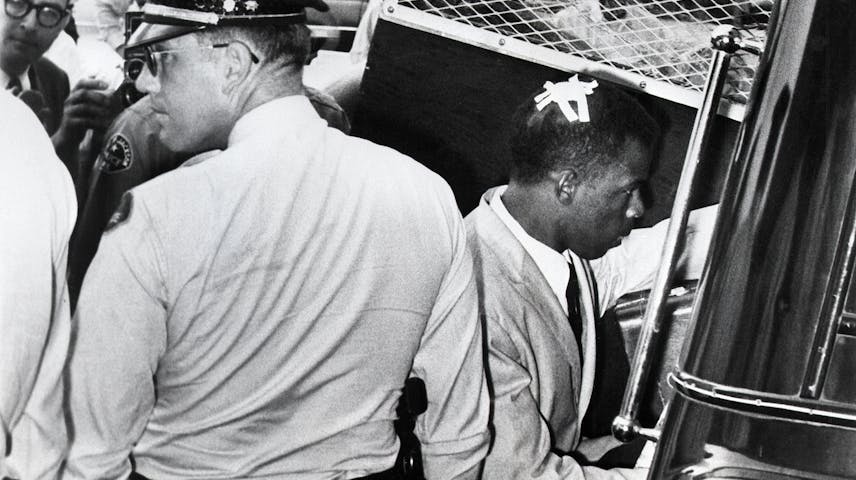
Day after day, Lewis and his fellow students sat silently at lunch counters where they were harassed, spat upon, beaten and finally arrested and held in jail, but they persisted in the sit-ins. In 1961, Lewis joined fellow students on the Freedom Rides, challenging the segregation of interstate buses. In the Montgomery bus terminal, he was again attacked by a mob and brutally beaten.
Lewis was one of the founding members of the Student Nonviolent Coordinating Committee (SNCC), and served as its president from 1963 to 1966 when SNCC was at the forefront of the student movement for civil rights. By 1963, he was recognized as one of the “Big Six” leaders of the Civil Rights Movement, along with Dr. King, Whitney Young, A. Phillip Randolph, James Farmer and Roy Wilkins. He was one of the planners and keynote speakers of the March on Washington in August 1963, the occasion of Dr. King’s celebrated “I Have a Dream” speech.
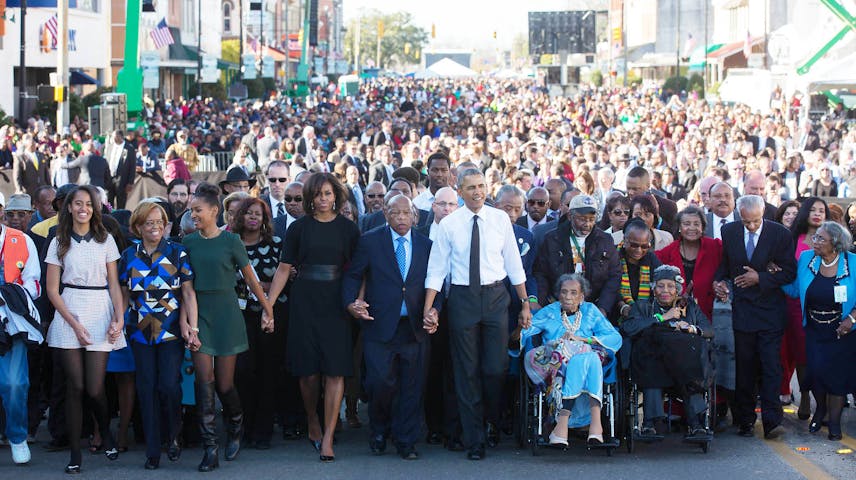
In 1964, Lewis coordinated SNCC’s efforts for “Mississippi Freedom Summer,” a campaign to register black voters across the South. The following year, Lewis led one of the most dramatic protests of the era. On March 7, 1965 — a day that would become known as “Bloody Sunday” — Lewis and fellow activist Hosea Williams led over 600 marchers across the Edmund Pettus Bridge in Selma, Alabama. At the end of the bridge, they were met by Alabama state troopers, who ordered them to disperse. When the marchers stopped to pray, the police discharged tear gas and mounted troopers charged the demonstrators, beating them with nightsticks. Lewis’s skull was fractured, but he escaped across the bridge to a church in Selma. Before he could be taken to the hospital, John Lewis appeared before the television cameras calling on President Johnson to intervene in Alabama.
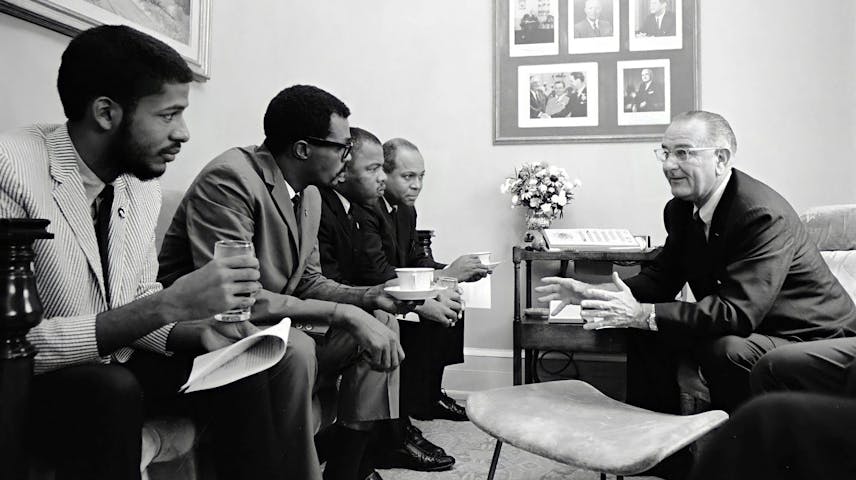
Scenes of the violence, and of the injured John Lewis, were broadcast around the world, and outraged public opinion demanded that the president take action. Two days later, Dr. King led 1,000 members of the clergy on a second march from Selma to Montgomery, with the eyes of the world watching. A week and a day after Bloody Sunday, President Johnson appeared before a joint session of Congress to demand passage of the Voting Rights Act, empowering the federal government to enforce the voting rights of all Americans. The passage of the Voting Rights Act finally brought the federal government into the struggle, squarely on the side of the disenfranchised voters of the South.
The violent deaths of his friends Martin Luther King, Jr. and Senator Robert Kennedy in 1968 were a great blow to John Lewis, but he remained committed as ever to the philosophy of nonviolence. As Director of the Voter Education Project (VEP), he helped bring nearly four million new minority voters into the democratic process. For the first time since Reconstruction, African Americans were running for public office in the South, and winning.
Lewis settled in Atlanta, Georgia, and when the former Governor of Georgia, Jimmy Carter, became President, he tapped John Lewis to head the federal volunteer agency, ACTION. In 1981, after Jimmy Carter had left the White House, John Lewis was elected to the Atlanta City Council, where he became an effective advocate of neighborhood preservation and government reform. In 1986 he ran for Congress, and John Lewis, whose own parents had been prevented from voting, who had been denied access to the schools and libraries of his hometown, who had been threatened, jailed and beaten for trying to register voters, was elected to the United States House of Representatives.
From then on, he was re-elected repeatedly by overwhelming margins, on one occasion running unopposed. For more than 30 years, he represented a district encompassing the city of Atlanta and parts of four surrounding counties. Congressman Lewis sat on the House Budget Committee and House Ways and Means Committee, where he served on the Subcommittee on Health. He served as Senior Chief Deputy Democratic Whip, as a member of the Democratic Steering Committee, the Congressional Black Caucus, and the Congressional Committee to Support Writers and Journalists. Apart from his service in Congress, he was Co-Chair of the Faith and Politics Institute.
Congressman Lewis received numerous honorary degrees and awards, including the Martin Luther King, Jr. Nonviolent Peace Prize, the NAACP Spingarn Medal, the Martin Luther King, Jr. Memorial Award of the National Education Association, and the John F. Kennedy “Profile in Courage” award for lifetime achievement.
His courage and integrity have won him the admiration of congressional colleagues on both sides of the aisle. Senator John McCain has written a moving tribute to John Lewis in his book Why Courage Matters. Congressman Lewis gives his own account of his experiences in the Civil Rights era in Walking with the Wind: A Memoir of the Movement, published in 1998.
Congressman Lewis began the 2008 presidential campaign as a supporter of Senator Hillary Rodham Clinton. His decision to switch his support to Senator Barack Obama was considered a major turning point in the campaign. When Lewis appeared at President Obama’s inauguration, he was the only surviving speaker from the 1963 March on Washington.
In addition to his advocacy of domestic issues, Congressman Lewis took a passionate interest in human rights on the international stage. In 2009, he was arrested, with three other U.S. Representatives, outside the Embassy of Sudan, where they were protesting the obstruction of aid to refugees in Darfur.
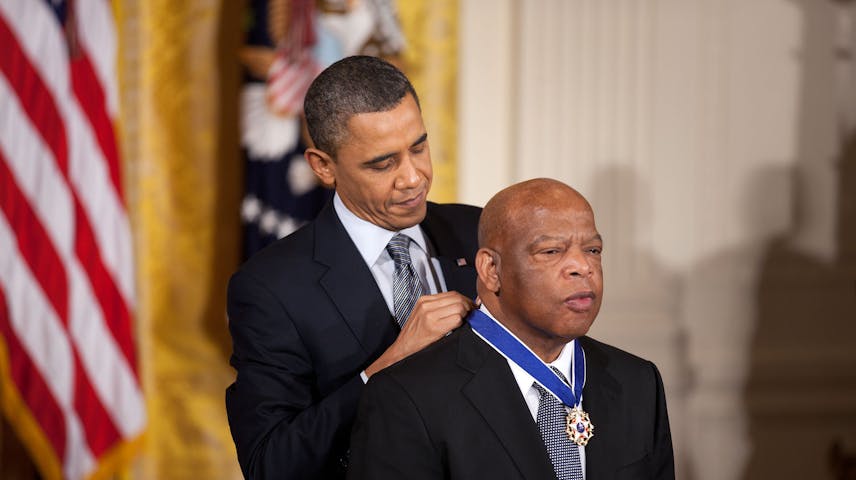
The Congressman was an ardent supporter of health insurance reform. In an eerie echo of his past struggles, he was subjected to angry catcalls and abusive language by opponents of the 2010 health care bill as he entered the Capitol for a crucial vote. As in years past, his courage was unwavering, and the passage of the Patient Protection and Affordable Care Act became one of the proudest achievements of his legislative career. In a ceremony at the White House, President Barack Obama awarded him the nation’s highest civilian honor, the Presidential Medal of Freedom.
In the 2018 election, John Lewis was elected to his 16th term in the House of Representatives. In the last days of 2019, Congressman Lewis announced that he had been diagnosed with Stage 4 pancreatic cancer. He resolved to return to Washington for the 2020 session of Congress to continue working while he pursued treatment.
Following this announcement, supporters, admirers and his colleagues in Congress offered prayers, support and tributes to a beloved hero of the struggle for freedom and justice. John Lewis served in Congress until his last days, recording a virtual town hall with former President Obama, and speaking at Black Lives Matter Plaza in Washington a month before his death.