
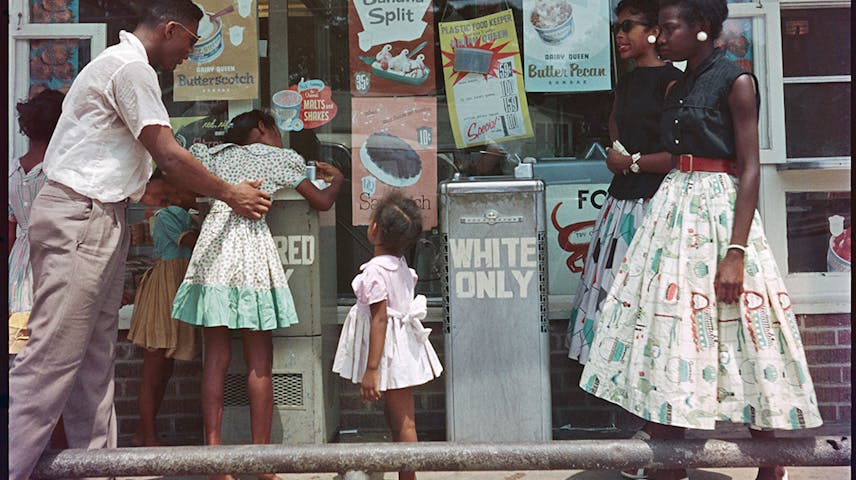
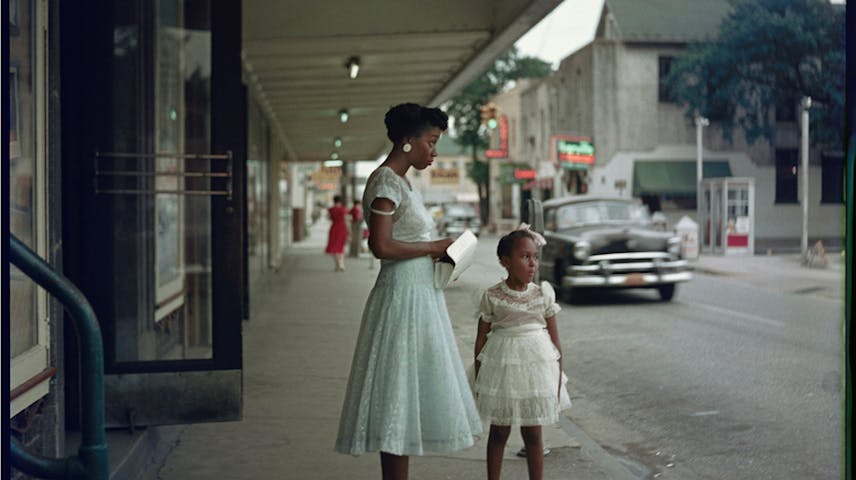
Untitled, Shady Grove, Alabama, photo by Gordon Parks, 1956. Photo by: Courtesy of and copyright The Gordon Parks Foundation
By
Gordon Parks Foundation
Text Type
Photo Gallery
Words
260
Published
1956
Introduce the concept of civic change and briefly explain the three forces that often drive it: systems, collective action, and personal testimony. Display the image and prompt students to consider how collective action challenged segregation during the Civil Rights Movement.
Say these Directions: Civic change happens when communities work to make laws and society more fair. This often happens when three forces work together:
Systems: The formal structures, such as laws, courts, and government policies.
Collective Action: Groups of people organizing, protesting, and acting together to demand progress.
Personal Testimony: Individuals brave enough to share their lived experiences to ensure history is remembered and passed down.
In this unit, you will investigate how these forces worked together during the Civil Rights Movement. As you observe the image of the 1960 lunch counter sit-in, think about how people might have used collective action to challenge a system of segregation in a public space.
Reflect and Respond
Say these Directions: Take 30–45 seconds to observe silently. As you look closely at the image or information presented, think about the questions being asked. Record your thinking in the Reflect and Respond graphic organizer, using the “My thoughts and responses” box and the “Questions I have” box to capture your ideas.
Provide students with the following questions to guide their observations of the image.
What do you notice about who is included in the image?
I notice that it is two black women, and those are the only two people at the lunch counter.
What physical “rules” or barriers do you notice in this public space?
The lunch counter is physically roped off, as if they are telling people not to sit there.
What kind of rules or power might be operating here?
They are not allowing people to sit at the lunch counter.
What might someone in the photo later tell others about this moment?
They will probably try to explain why they are sitting there and why they thought it was important to sit there, even though they were being told not to.
Say these Directions: After observing the image, answer the following question with a partner.
How does this image help you think about systems and collective action?
It makes me think that you can push against systems that are unfair if you are working together, collectively.
Prompt students to complete a Think-Pair-Write-Share. Encourage students to share their ideas and record as many ideas as possible. Instruct students to record their answers in the “Thought I want to share” box.
In the remaining five minutes, bring the class back together, and invite volunteers to share ideas they listed and any questions they still have. Record key ideas somewhere visible (e.g., system, rules/power, collective action, testimony, change over time) for students to revisit later in the lesson.
Teacher Tip |
|---|
Address with students the use of racial slurs throughout the unit’s upcoming anchor text, and establish ground rules for respectful dialogue. Ensure students understand that the slurs used repeatedly in the anchor text should not be read aloud and are not allowed to be used at any time, in or out of class. Explain that the historical context of these slurs relates to hatred and bigotry and that they are not synonyms for Black people. |
Display the two Essential Questions for the unit.
How does storytelling become a tool for civic change?
What is civic memory, and how does testimony help us remember and learn?
Say these Directions: Look at the words civic, segregation, and discrimination. Think about what each word means and how it connects to the ideas and events you are studying in this unit. As you discuss these words with your classmates, consider how they help explain the experiences and issues explored in the texts.
Civic: related to a community and how people participate in public life, including rights, responsibilities, and how decisions are made (laws, voting, government, and community action)
Say: Participating in a sit-in would be considered a civic act—using the responsibility as a member of a community to challenge a law.
Segregation: the practice of separating people into different groups and keeping them apart in schools, neighborhoods, public places, or services—often by law or policy
This was a deliberate system. It wasn’t just “staying apart”; it was a legal structure designed to deny access.
Say: The roped-off lunch counter in our Launch image is a physical example of segregation.
Discrimination: treating someone unfairly because of who they are (such as their race, gender, religion, disability, or background), including denying equal opportunities or rights
Say: Discrimination is the tool used to enforce segregation.
Say these Directions: Turn and talk in small groups to discuss the questions provided. These questions will help you better understand the Essential Questions for this unit. As you discuss, ask questions that connect to the ideas being shared and respond to others’ questions using relevant evidence and ideas. Listen carefully to your classmates, acknowledge new information that others share, and express your own ideas when appropriate. Use the context provided with each question to help guide your discussion if you need additional support.
Ask: What is an example of civic change? Think about the systems we discussed at the beginning of the lesson (laws, protests, testimony).
A city changes a rule after community members speak at meetings, write letters, and organize peacefully for a safer crosswalk near a school. The change shows how public participation can lead to new policies that affect everyone.
Ask: What do you think civic memory means?
Context if needed: If civic is the community and memory is what we keep, how do these work together?
Civic memory is what a community chooses to remember and pass down about important events—through stories, memorials, museums, holidays, and public lessons. It shapes how people understand their shared past and what they believe matters today.
Ask: Why might it be important for people to remember times when segregation and discrimination were lawful?
Context if needed: Relate this to our responsibility to the future.
Remembering helps people recognize how unfair systems can be created and defended by laws, not just by individual choices. It can also help communities notice warning signs, protect rights, and make more responsible decisions about what should change and what should never be repeated.
As students participate in discussion, circulate and listen for evidence that students can accurately interpret the Essential Questions. Encourage students to use the new vocabulary in their responses as well.
Provide students with a copy of the Notice, Wonder, Connect graphic organizer to engage in a Gallery Walk.
Say these Directions: You are now civic investigators. Your goal is to look for examples and information about segregation and discrimination. As you read and analyze the sources, look for evidence that shows how one event or action led to another and how these moments helped influence the way people remember and respond to the events of the Civil Rights Movement.
Using the following sources, you will move through the gallery in small groups, using the Notice, Wonder, Connect graphic organizer.
Segregation Story, 1956: Use this resource to see the “daily limits” and physical reality of segregation.
SNCC Brochure: Use this resource to see how frustration with discrimination and injustice was organized into a movement.
Congressman John R. Lewis: Use this resource to see how one person’s testimony moved from the streets to the halls of government.
Say these Directions: Use the following questions to guide your discussion and analysis.
What does each source show you?
Each source shows a different part of how segregation was experienced and challenged. The photo essay shows what segregation looked like in real places and how unequal rules shaped daily life. The SNCC Brochure shows how one organizing group, called the Student Nonviolent Coordinating Committee, turned discrimination and inequality into action by inviting people to join a movement that had already made a lot of impact. The John Lewis profile shows how one person’s experiences and choices connected to larger efforts for change, including leadership, organizing, and work within civic institutions.
Who was John Lewis, and what were his accomplishments?
John Lewis was a civil rights leader who helped organize nonviolent protests for voting rights as a young activist. He took on national leadership responsibilities in the movement and worked with other organizers to push for change through marches, public action, and testimony. Later, he became a longtime U.S. lawmaker, carrying that commitment to justice into government service.
Why is John Lewis’s story worthy of deeper investigation?
His story connects everyday experiences under segregation to the choices people made to challenge unfair laws and systems. The sources show that change did not happen by accident—it required organized groups, public pressure, and individuals willing to take risks. Studying Lewis helps people see how personal experiences, collective action, and civic institutions can interact to reshape what a society accepts and what it changes.
Ask students to review their Notice, Wonder, Connect graphic organizers. Explain that before we begin reading March: Book One, we must synthesize how our “investigation” of the gallery helps us define the unit’s Essential Questions.
Students respond to the following prompt to demonstrate their understanding of the unit’s foundation:
Say these Directions: Choose one visual detail or caption from the gallery walk. Explain how that specific piece of evidence helps you answer one of our Essential Questions: How does storytelling become a tool for civic change? OR What is civic memory, and how does testimony help us remember and learn?
The SNCC Brochure shows how storytelling pushes civic change by turning personal frustration and collective injustice into a shared “call to action.” Similarly, the John Lewis profile connects to civic memory because it shows how one person’s private experience can become a “public testimony” that shapes laws and what a nation chooses to remember. Together, these sources remind us that remembering history accurately is a civic responsibility that helps us guide our decisions today.
Instruct students to take notes in their Journal on the following prompt:
Prompt:
Based on the evidence you gathered today regarding segregation and John Lewis’s life, what do you predict will be the most significant “civic change” described in March: Book One, and what makes you think so?