
By
Standard News Bureau
Recommended For
Upper Elementary School - Middle School
Words
221
Lexile
0L
Published
2026-05-01
Have students take out March: Book One, Bloody Sunday gallery, and “Confrontations for Justice” with their homework from the previous lesson, along with their 3-2-1 Summaries from Lessons 4 and 5.
Say these Directions: Turn and talk with a partner about the connections you notice among the events related to Bloody Sunday that are depicted in all three texts. Discuss how the events in each source help you better understand what happened and why these events were important.
Ask: What is a key event related to Bloody Sunday that appears in all three texts? How is it shown in each one?
Ask: How do the connected events help to explain why Bloody Sunday was an impactful moment?
Then, use the Think-Write-Pair-Share routine to develop a brief, 1–2 sentence response to the following question:
Ask: What are the key events related to Bloody Sunday depicted in the three texts?
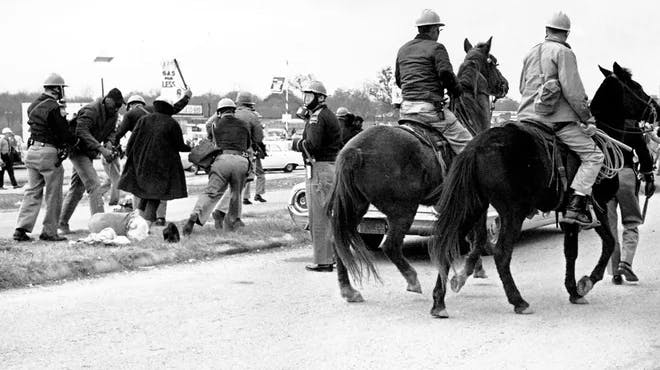
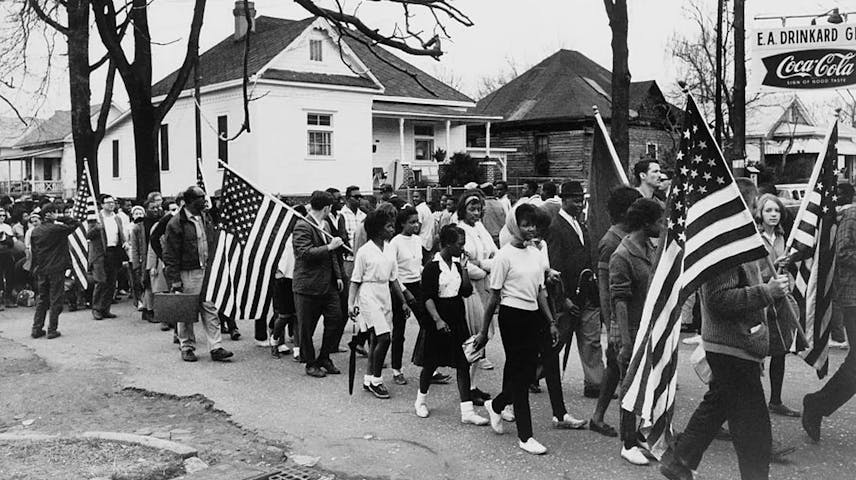
In March and “Confrontations for Justice,” the key events include marchers reaching the Edmund Pettus Bridge, being ordered to disperse, and then being attacked when troopers advance. In the Bloody Sunday photo gallery, the key events are the violence against the marchers and the aftermath of the violence.
Review 2–3 quick responses.
Remind students that they have analyzed pp. 1–11 of March, Bloody Sunday photo gallery, and “Confrontations for Justice” during the previous two close-reading lessons.
Say: We analyzed the events of Bloody Sunday using multiple sources. Let’s recall what we discovered about these events from our readings.
Say: Today, we’re going to write full-paragraph responses to these questions. I will model a response to the first question, and you will write your own responses to the second question. First, we will review a strategy called RACE that can help you write clear responses to questions using text evidence.
Say these Directions: Today you will use the RACE strategy to respond to a question by writing an explanatory paragraph that includes evidence from the texts. RACE stands for “Restate the question” + “Answer the question” + “Cite evidence” + “Explain your answer.”
RACE = Restate + Answer + Cite + Explain
R – Restate the question
Restate the question as a declarative sentence
Establishes the main topic of the paragraph
A – Answer the question
Provide an answer to the question
Tells the reader what to expect in the paragraph
C – Cite evidence from the texts
Specific quote or paraphrase from the texts
Must be introduced smoothly (not just dropped in)
E – Explain your answer
Tells what the evidence shows
Points to specific words/phrases
Makes the connection explicit for the reader
Model taking notes that align with the RACE strategy using a graphic organizer to respond to the sample question “What are the key events of Bloody Sunday?”:
Restate | There were several key events in Bloody Sunday. |
|---|---|
Answer | The marchers begin their peaceful protest for voting rights, walking across the Edmund Pettus Bridge in Selma. The Alabama state troopers order the marchers to stop and disperse and dismiss the marchers’ request to communicate with the mayor. The troopers then advance on the marchers and physically attack them with billy clubs, whips, and tear gas. |
Cite evidence | March: Book One says the troopers declare “This is an unlawful assembly!” and order marchers to “DISPERSE” (p. 6). “Confrontations for Justice” says in the third paragraph of the introductory section that marchers were attacked with “. . . clubs, bullwhips, and tear gas.” |
[Explain] | This evidence shows that the key events of Bloody Sunday include a peaceful march for voting rights and the violent suppression of that march by Alabama law enforcement. |
Transition: Explain to students that you are going to use the notes from the RACE graphic organizer to create a model paragraph.
Model a complete RACE paragraph in response to the question “What are the key events of Bloody Sunday?” using pp. 1–11 of March, “Confrontations for Justice,” and the Bloody Sunday photo gallery. Teacher Model:
Say these Directions: As you follow along, examine the example RACE paragraph that responds to the question “What are the key events of Bloody Sunday?” The paragraph uses evidence from pages 1–11 of March, the text “Confrontations for Justice,” and the Bloody Sunday photo gallery to show how the RACE strategy can be used to write an explanatory response.
Say: Watch as I write a RACE paragraph explaining the key events of Bloody Sunday. I’ll use four different formats to show you the four parts of the RACE Strategy.
Display your Model Paragraph:
There are several key events of the historical event Bloody Sunday.Those key events include peaceful demonstrators gathering at the Edmund Pettus Bridge to march from Selma to Montgomery for equitable access to voting rights and being stopped by the Alabama state troopers through physical force. For example, in March, troopers declare the march unlawful and order “DISPERSE” (p. 6), then command “Troopers—advance!” (p. 7), attacking the marchers after shouting “TEAR GAS!!” (p. 8). In “Confrontations for Justice,” the text explains that marchers were stopped at the bridge, ordered to disperse, and then attacked as troopers advanced with weapons and tear gas. It also notes that John Lewis was seriously injured. [Together, these details show that Bloody Sunday centers on a peaceful march by civil rights leaders to try to earn equitable voting rights that was stopped by Alabama law enforcement through intimidation and physical violence.]
Partner-Read: Place students in pairs. Have one partner read aloud the model paragraph while the other listens and then switch roles to read the paragraph again. Partners should stop readers for skipped words, incorrect endings, or altered phrasing.
Say these Directions: Work with a partner. One partner will read the model paragraph aloud while the other partner listens carefully. Then switch roles and read the paragraph again. As you listen, stop the reader if a word is skipped, an ending is read incorrectly, or the phrasing changes, and help correct it before continuing.
Review each component with the students:
Point to the bolded section (R): “I restated the question as a statement.”
Point to the underlined section (A): “I named the key events I will explain.”
Point to the italicizedsection (C): “I used evidence from both sources and cited March with page numbers.”
Point to the [section in brackets] (E): “I explained what the evidence shows—how commands and escalation define the major events.”
Situation | Try this |
|---|---|
Struggling with: Applying the RACE strategy | Use a non-example, and guide students to unpack why it does not demonstrate high-quality RACE writing. Non-example: “Bloody Sunday was dangerous. The marchers were hurt. This shows it was dangerous.” What’s missing? The writer does not cite evidence from either text and does not introduce evidence smoothly, and the explanation repeats the same idea instead of showing how specific details prove the claim. Strong Explanation:
|
Say these Directions: The model paragraph explained the events of Bloody Sunday. Now you will think about the three texts you read about these events and analyze how each text shows the events of Bloody Sunday in similar and different ways. Work with a partner to draft and revise a paragraph using the RACE strategy in response to the question below.
Ask: How do the three texts depict the events of Bloody Sunday similarly and differently?
Personal Dictionary: Review your Personal Dictionary. Choose 2-3 words that you have added so far to include in your response.
The three texts depict some of the events of Bloody Sunday, but the informational article and photo gallery provide different details about the aftermath of the physical violence. For example, in the photo gallery, there are pictures of how the violence perpetrated by the state troopers affects the marchers. In picture #6, the photograph and caption show that “civil rights demonstrators struggle on the ground,” showing more of the aftermath of the violence. And in “Confrontations for Justice,” the third paragraph explains that John Lewis “suffered a skull fracture” and that “fifty-eight people” were treated for injuries. In March, the aftermath of the violence is not included because everything goes dark on page 9. This evidence shows that the photo gallery and “Confrontations for Justice” include more information about the impact of the physical violence on the peaceful demonstrators.
As you work on your paragraph with your partner, continue drafting and revising your response using the RACE strategy. Use the prompts provided to help guide your thinking and strengthen your explanation if needed.
|
Provide students with a confidence continuum (i.e., 1–5). As needed, model how to demonstrate a level of confidence using the continuum.
Say these Directions: Self-reflect on your ability in using the RACE strategy to answer a question using the Reflection protocol.
Ask: Think about the response you wrote. How confident were you in responding to the question using the RACE strategy? Choose a number between 1 and 5, with 1 being the least confident and 5 being the most confident, to rate your confidence level. Then write a sentence describing a goal you’d like to accomplish next when using the RACE strategy to write responses to text-specific questions.
Optional Sentence Starter:
“My next step is ____.”
My next step is to find more relevant text evidence to support my response more fully.
Instruct students to read pp. 12–35 of March: Book One. Instruct students to take notes in their Homework Journal on the following prompt:
As you read, annotate the text for the following:
What do you learn about John Lewis’s present and past in this part of the text?