Loading...
Lesson 3: Understanding Segregation, Part 2
50 min
California CCSS: Focus Standards
California CCSS: Supporting Standards
ELD Standards
Student Lesson
Lesson 3: Understanding Segregation, Part 2
Student Learning Objectives
1
Content
Students will analyze the connections between legal rulings, political policies, and social customs of the Jim Crow Era by engaging in a Jigsaw Reading to determine how these integrated systems enforced segregation and impacted daily life.
2
Language
Students will use evidence-based and domain-specific language to explain how political, legal, and social systems enforced segregation and shaped daily life during the Jim Crow Era.
Essential Questions
How does storytelling become a tool for civic change?
What is civic memory, and how does testimony help us remember and learn?
Connections to
Knowledge-Building:
Students will build knowledge of the historical background of the Jim Crow Era that led to the Civil Rights Movement.
Enduring Understanding:
Civic change occurs when personal stories become shared memory and collective action, showing how testimony shapes what societies choose to remember and how those memories influence what they build next.
Future Lessons:
In Lessons 4 and 5, students will begin engaging with March: Book One.
Unit Performance Task:
Students will need to analyze multiple sources about the Civil Rights Movement in the Civic Memory Brief Performance Task.
Lesson Pacing
| Lesson Flow | Purpose of Learning Experience |
|---|---|
Launch15 Minutes | Students will watch and discuss a short video about the Freedom Riders. |
Learning in Action30 Minutes | Part A: Jigsaw Reading of Segregation Resources (RI.8.1, RI.8.3) Students will engage in a Jigsaw Reading of three resources to learn about segregation during the Jim Crow Era. Part B: Jigsaw Deep Dive (RI.8.3, SL.8.1.c) Students will complete their Jigsaw Worksheet graphic organizer by sharing what they learned and listening to what their partners learned. |
Look Back5 Minutes | Students will reflect on the Essential Question in preparation for reading the opening pages of March: Book One. |
Vocabulary
Vocabulary Addressed in Lesson
Not available for this lesson
Additional Vocabulary
Not available for this lesson
Material List
Jigsaw Worksheet graphic organizer
Short, teacher-chosen video about the Freedom Riders
Unit 1 Lesson 3 Student Edition
Routines
Think-Pair-Share
Jigsaw Reading
Lesson Sequence
Explain to students that today’s focus is going to be on looking at how specific political and social systems created segregation through inequality. The impact of segregation affected many people’s lives, including their public and personal lives.
Have students watch a short video about the Freedom Riders in preparation for today’s learning.
Think-Pair-Share
Say these Directions: After viewing the video, use the Think-Pair-Share protocol to respond to the question below. First, think about your response independently. Next, discuss your ideas with a partner. Finally, be prepared to share your thinking with the class.
Who were the Freedom Riders, and why were they important?
The Freedom Riders were interracial groups of civil rights activists who rode buses into the South in the early 1960s to challenge segregation in interstate travel. They were important because they tested whether federal court rulings and laws would actually be enforced, even when local officials resisted.
Part A: Jigsaw Reading of Segregation Resources (RI.8.1, RI.8.3) (15 minutes)
Transition students into groups of three. Within each group, prompt students to assign each of the following resources to a member of the group:
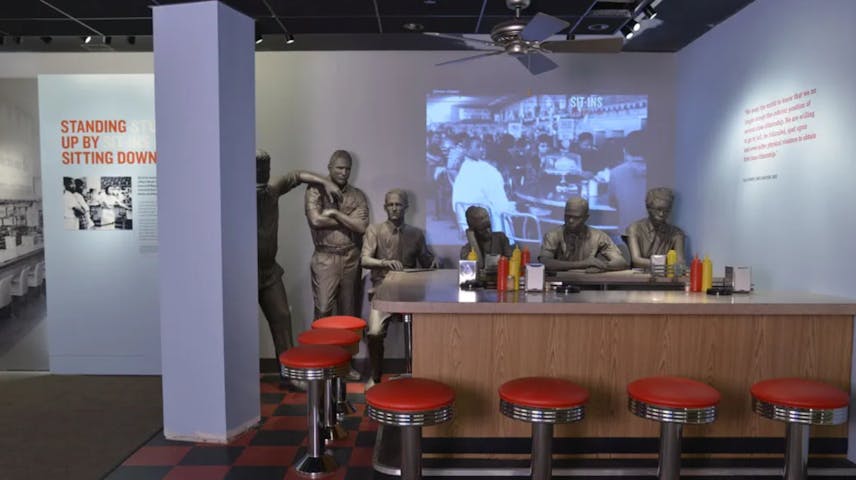
Student 1: “Standing Up by Sitting Down” (focus on social systems and resistance).
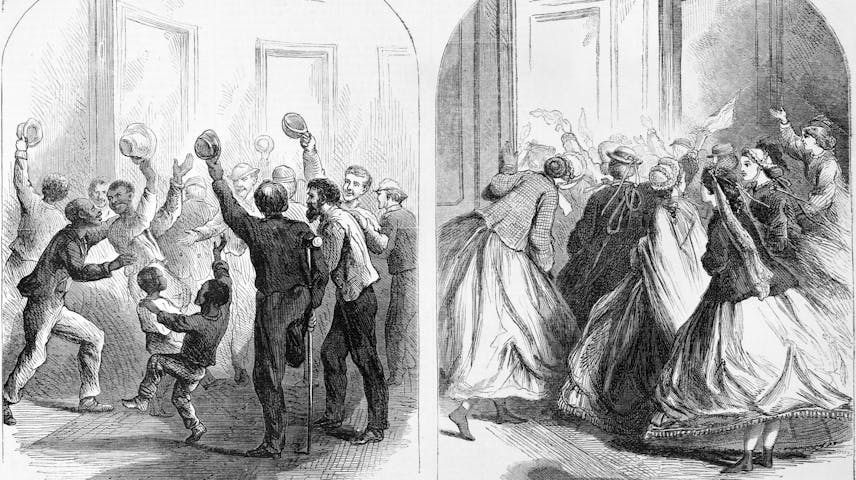
Student 2: “The Civil Rights Act of 1964: A Long Struggle for Freedom” (focus on political/legal systems).
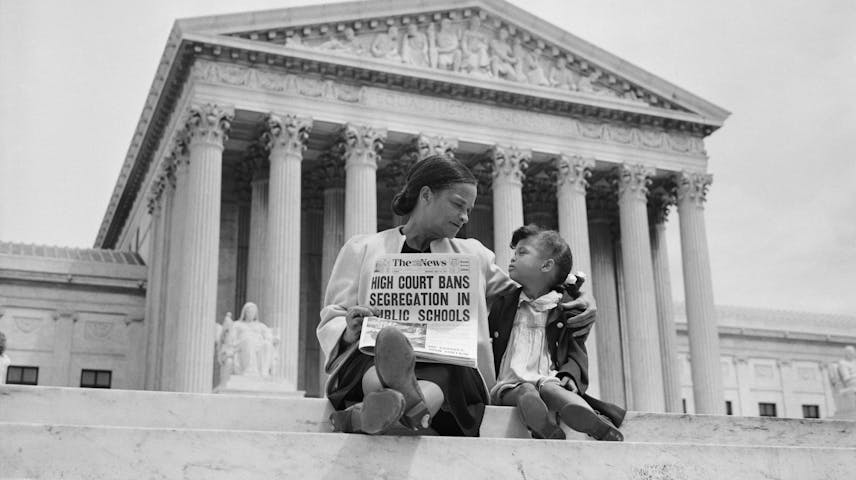
Student 3: “Brown v. Board of Education” (focus on legal systems/courts).
Jigsaw Reading: Expert Groups
After students have assigned resources, transition students into “expert groups” of three, reading the same resources. In these groups, use the following prompts to guide students as they read and discuss.
Say these Directions: Use the Jigsaw Worksheet graphic organizer to identify evidence showing how your assigned system operated. Record details from the text that explain how the system worked and what impact it had.
What laws, rules, or social customs are described?
How did these rules impact a person’s rights or responsibilities in public life?
“Standing Up by Sitting Down” | “The Civil Rights Act of 1964: A Long Struggle for Freedom” | “Brown v. Board of Education ” |
|---|---|---|
The exhibit shows a segregated lunch counter and explains that protestors needed nonviolent training because the system was enforced through rules and intimidation in public spaces. This shaped daily life by controlling where Black people could sit, eat, and be served—and by normalizing harassment when people challenged those rules. | The timeline shows how segregation was maintained through law and limited enforcement for decades: Court decisions upheld “separate but equal,” and later rulings and early civil rights laws often had weak enforcement, allowing segregation to continue in schools, voting, and public life. Daily life was shaped by restricted access and unequal treatment until stronger federal action culminated in the Civil Rights Act of 1964 banning discrimination in public accommodations and strengthening enforcement. | Brown v. Board of Education (1954) was a landmark U.S. Supreme Court case that declared racial segregation in public schools unconstitutional. The case was part of a broader strategy by the NAACP to challenge segregation and secure equal rights for African Americans. It originated in Topeka, Kansas, where families—organized by local activists like Lucinda Todd and supported by NAACP lawyers such as Thurgood Marshall—challenged laws forcing Black children to attend separate schools. Although earlier courts upheld segregation under the 1896 Plessy v. Ferguson “separate but equal” doctrine, the Supreme Court unanimously ruled that segregated schools were inherently unequal and violated the Fourteenth Amendment’s Equal Protection Clause. Despite the ruling, many states resisted integration, leading to continued legal battles and activism that helped spark the broader Civil Rights Movement. |
Teacher Tip |
|---|
There will be an empty box on the Jigsaw Worksheet graphic organizer. |
Part B: Jigsaw Deep Dive (RI.8.3, SL.8.1.c) (15 minutes)
Have students return to home groups to complete the Jigsaw Worksheet graphic organizer.
Jigsaw Reading: Home Group Share
Say these Directions: Return to your home group and share what you learned in your expert group. As you listen to each group member, use the information they share to complete the remaining sections of your Jigsaw Worksheet graphic organizer. Work together to identify the political, legal, and social systems that maintained segregation and answer the following question:
Ask: We looked at a timeline (Civil Rights Act), a legal history (Brown v. Board), and a narrative/visual account (“Standing Up by Sitting Down”). How does the format of your specific resource help you interpret the motives or the human impact of the system it describes differently from your partners’ resources?
The timeline shows the different events and how those events created the system and/or challenged the system. The visuals in the narrative or visual account show a graphic representation of the impact of the systems. And the legal history helps us understand how the system was established and how it affected many people through segregation in schools.
As students share in their home groups, circulate and look for evidence that students can accurately interpret the resources.
Think-Pair-Share
Say these Directions: In pairs, discuss the following closing question:
Based on what you’ve learned about segregation and the Civil Rights Era so far, what will you be looking for in March to help answer the Essential Question “How does storytelling become a tool for civic change?”
I will be looking in March for how segregation shows up as rules that control what people can do and where they can go. I will also look for moments where people challenge those systems through organized action. Finally, I will pay attention to how the memoir format—images, scenes, and personal perspective—helps readers understand how civic change occurs.
Instruct students to reflect on the following prompts in their Journal:
Write a short response to the following reflection prompts:
Based on today’s jigsaw reading, explain one way segregation was enforced as a system (legal, political, or social), and describe how that system affected people’s daily lives.
Why might it be important for stories and sources to show these effects, not just list events?