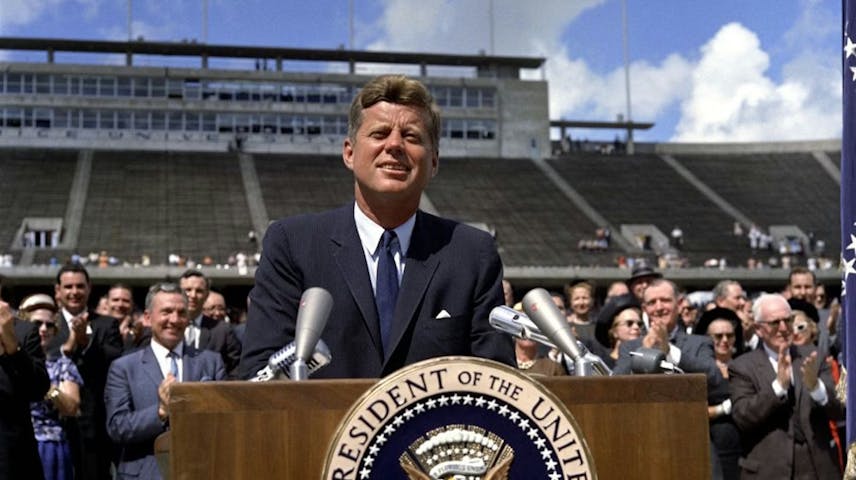
“First, I believe that this nation should commit itself to achieving the goal, before this decade is out, of landing a man on the moon and returning him safely to the Earth.”
In 1961, President John F. Kennedy made a bold promise to the American people. Speaking to Congress on May 25, he said the United States would land a man on the Moon—and bring him home safely—before the end of the 1960s. It sounded like something out of a science fiction story. But it actually happened.
Sputnik Starts the Race

The story really begins a few years earlier. On October 4, 1957, the Soviet Union launched Sputnik I, the world’s first artificial satellite. It was only about the size of a beach ball, weighing less than 185 pounds, and it circled the Earth every 98 minutes. Small as it was, it sent shockwaves through America. People were worried that the United States was falling behind the Soviet Union in science and technology.
There was also a scarier concern. The United States and the Soviet Union were rivals during a period called the Cold War (a time of extreme tension between the U.S. and the U.S.S.R. that lasted from approximately 1947 until 1991). If the Soviets could launch a satellite into space, people feared they might also use that technology to launch nuclear weapons.
The Sputnik launch pushed the U.S. government to act fast. In July 1958, Congress created a brand-new agency called NASA (the National Aeronautics and Space Administration) to lead America’s efforts in space.
Kennedy's Challenge
Three years later, President Kennedy gave NASA that enormous goal: put a person on the moon by 1969. It was an exciting but very difficult challenge. At the time, the Soviet Union was actually ahead in the space race—they had just sent the first human into space.
NASA worked hard to catch up, and slowly but surely, they did. In December 1968, astronauts on the spacecraft Apollo 8 became the first humans to orbit the moon. America was getting close.
One Giant Leap
Then came the moment the whole world had been waiting for. On July 20, 1969, the Apollo 11 mission landed on the moon. Astronauts Neil Armstrong and Buzz Aldrin became the first people in history to walk on the lunar surface, while their crewmate Mike Collins orbited above in the Command Module.
As Armstrong stepped onto the Moon, he spoke words that were heard by millions of people on Earth: “That’s one small step for man, one giant leap for mankind.”
The achievement was made possible by the hard work of hundreds of thousands of scientists, engineers, and other dedicated people. Eight years after Kennedy’s famous speech, America had done what once seemed impossible—and the world would never be the same.
After the Moon Landing
The Space Race kept going for about 30 more years, but it started to slow down in the 1970s and 1980s. NASA sent more missions to the moon during the 1970s, and space exploration continues today.
A major result of the Space Race was that people became much more interested in science and math. This helped create the field of study we now call STEM, which stands for science, technology, engineering and mathematics.
Many useful technologies we rely on today actually got their start during the Apollo missions. Innovations like water filters, computer chips and fireproof materials were all developed thanks to the space program.
The moon landing also gave people hope during a stressful time in history. While the U.S. and Soviet Union were locked in the tense rivalry of the Cold War, the moon landing was something the whole world could root for and celebrate together.