
By
Standard News Bureau
Recommended For
Upper Elementary School - Middle School
Words
240
Lexile
0L
Published
2026-05-01
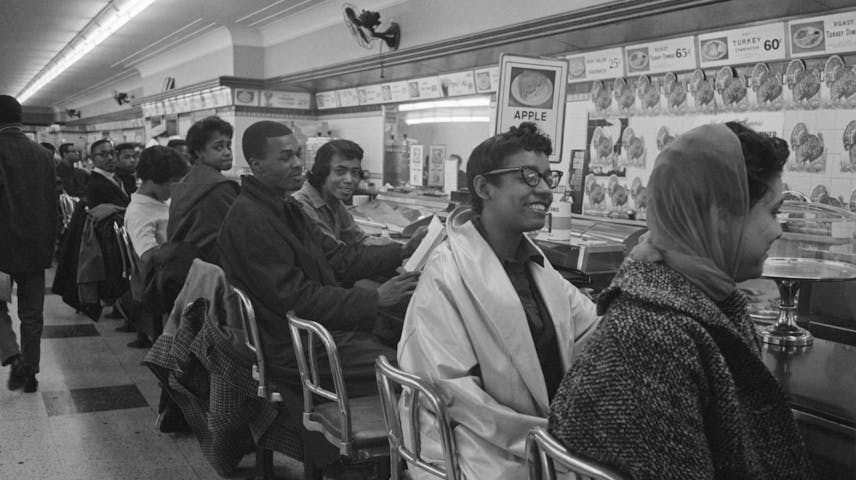
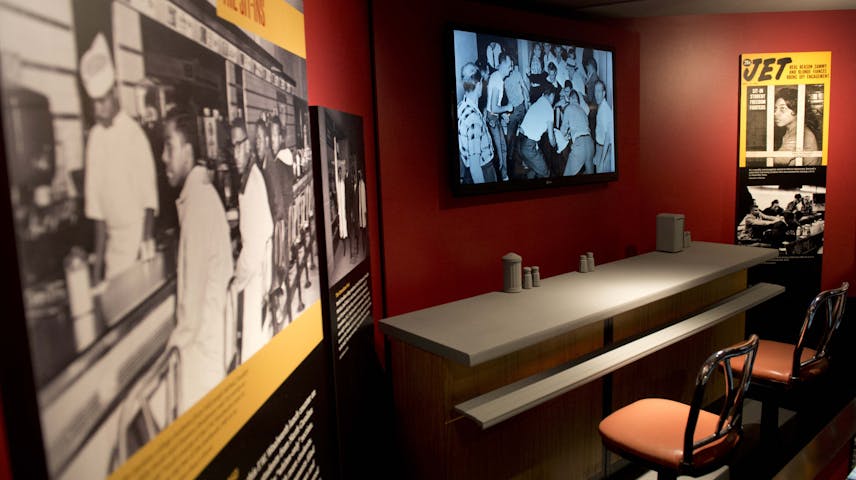
Place students in pairs. Display the Greensboro lunch counter images from the linked text set and give students a moment to observe before they speak.
Say these Directions: First, look closely at the image. Then turn to your partner and share one detail you notice and one idea you have about how this scene connects to the ideas you have been exploring in this unit.
Ask: What do you notice in this visual, and how might it connect to the Ideas we have been exploring in Hidden Figures?
I notice that the students are sitting close together and staying in place even though the setting looks tense. This connects to our unit because, like the women in Hidden Figures, they seem to be working together to challenge a boundary that is unjust.
Teacher Tip |
|---|
Give brief context before discussion: a sit-in was a nonviolent protest in which students sat at segregated lunch counters and refused to leave. For sixth graders, anchor the discussion in fairness, courage, and teamwork rather than assuming detailed prior knowledge of the civil rights timeline. |
Say: Now we will learn some key vocabulary that will help us integrate sources as we explain our ideas.
Target Word: monitor
Display the Key Sentences
In Chapter 20, the text explains, "Together these three computers would be able to monitor and analyze all aspects of the space flights, from launch to splashdown."
Say: This sentence includes a word we may not fully understand yet. Instead of looking them up right away, we’re going to use context clues—the words around them—to figure out what they most likely mean. Our focus word today is monitor.
Identify Context Clues
Say these Directions: With a partner, discuss: What is happening in the sentence? Which words or phrases help explain the meaning of monitor? Then, underline the clues in the displayed text.
“and analyze all aspects”
Infer a Meaning
Ask: Based on the clues, what does the word most likely mean?
Monitor means to watch or track something carefully over time.
Test the Meaning in Context
Ask: If we replace the word with our meaning, does the sentence still make sense?
Yes, when I replace monitor with “watch carefully,” the sentence still makes sense.
Verify Meaning
Say: Check your definition using a dictionary or other reference material. Does the definition match what we figured out? Revise as needed.
Quick Application
Ask: Did the context give us enough information to figure this word out? How might we confirm the meaning if we aren’t sure?
Say: Now that we have precise language for scientific tracking, we are ready to compare what each source contributes.
List the word monitor in your Personal Dictionary. After each word, write (1) the definition of the word and (2) the word in a sentence. |
Students work with a partner to integrate information across multiple formats (informational text and visual) to build a more complete understanding of a shared topic. Rather than evaluating sources, students identify what each source contributes and how the sources work together to develop ideas such as collaboration, coordination, and shared purpose.
Have students work in pairs with Chapter 20, one of the Sit-Ins texts from the linked set, and the Greensboro lunch counter images.
Say: We are going to compare how different types of sources help us understand the same idea. Each source adds something different. Your job is to figure out what each one contributes and how they work together to convey an idea about the power of collaboration.
Say these Directions: Using the 3-column chart to compare multiple sources. Label each column as indicated:
Column 1: Greensboro Lunch Counter (Visual)
Column 2: Sit-Ins Text (Informational)
Column 3: Chapter 20 (Narrative/Informational)
Say these Directions: In each column, write:
One important detail from that source (what it shows or explains)
What this helps you understand about collaboration or working together for shared purpose
Be sure to use information directly from each source.
Say: When I integrate sources, I think about what each one does best. The visual helps me see body language and group positioning. The informational text explains how actions were organized. Chapter 20 shows how collaboration can happen across different places within a scientific system. Then I ask: What do I understand better when I put these sources together?
Ask: What do the Greensboro lunch counter images add that the written Sit-Ins text does not add by itself?
The visual adds body language and group positioning. I can see students sitting shoulder to shoulder and staying calm, which helps me understand the courage and coordination behind the protest.
Ask: How does the section of Chapter 20 that explains the worldwide tracking network show collaboration in a different context?
Chapter 20 shows collaboration through a scientific system spread across many places. Workers in different tracking stations had to coordinate and monitor the capsule so the mission could succeed.
Sample Response for Chart
Column 1 (Greensboro Lunch Counter): Students sit together at a lunch counter while others stand behind them. This helps me understand organized protest and shared courage.
Column 2 (Sit-Ins Text): Students used sit-ins to challenge segregation. This helps me understand that change depended on planned group action.
Column 3 (Chapter 20): Tracking stations around the world worked together to follow the mission. This helps me understand scientific teamwork across a global network.
Which statement best integrates the Greensboro lunch counter and Chapter 20? A. The Greensboro lunch counter is about restaurants, while Chapter 20 is only about machines, so the sources do not really connect.
B. Both sources show people acting alone to solve private problems.
C. Both the sit-in movement and the tracking network depended on coordinated groups working toward greater access—civil rights in one case and space discovery in the other.
D. Chapter 20 is more useful than the Greensboro lunch counter because written texts always give more information than images.
|
Say: A synthesized response weaves together details from multiple sources to develop a single, connected idea; it is not the same as placing two separate source summaries back‑to‑back. I begin by identifying the shared idea that connects the sources; for our work today, that idea is collaboration. Then I select one specific detail from the sit‑ins source set and one from Chapter 20 that strongly support that idea. After that, I explain the common idea the two sources share. I also make sure my transitions actually do meaningful work—while helps to highlight differences, and both helps to emphasize similarities. Finally, I check that my response fully answers the question: How do these examples show people pushing for new freedoms and discovery? If any part is missing, I revise until the answer is complete and clear.
Display the following writing model if needed for support and guidance. Point out each RACE element if extra support is needed.
Both the student sit-ins and the global tracking system in Chapter 20 show people working together to push past limits. In the sit-in sources, students acted as a group to challenge segregation and demand equal treatment in public spaces. In Chapter 20, workers across multiple tracking stations monitored the mission together so NASA could follow the capsule and keep the project moving. This matters because one group was pushing for more social freedom, while the other was expanding scientific discovery. Together, the sources show that progress often depends on organized people who refuse to accept old boundaries.
Say these Directions: Use the RACE organizer to answer the text-dependent question in four to five sentences. Include at least one detail from the Sit-Ins visual or text and at least one detail from Chapter 20. Use one comparative transition from today’s lesson, such as both, similarly, while, or in contrast.
Ask: In Chapter 20, how do the student sit-ins and the development of global tracking systems both show people working together overcome limitations and boundaries?
Both examples show that progress happens when groups organize toward a common goal. In the sit-in sources, students worked together through demonstrations to challenge segregation and demand more freedom in everyday life. In Chapter 20, NASA depended on tracking stations around the world to monitor the mission, which shows scientific collaboration across long distances. While one group was pushing for civil rights and the other was supporting space exploration, both were expanding what people believed was possible. This is demonstrated in the text by, “In February 1960, four Black students from North Carolina A&T staged non-violent protests by sitting at a segregated lunch counter and refusing to leave.”
Reflect on your reading and writing abilities using the Reflection routine.
|
Transition students from drafting to reflection by reminding them that good readers learn not only from sources, but also from the tools they used to connect them.
Say these Directions: For your Quick Write, explain how today’s sit-ins sources changed or deepened your understanding of Chapter 20. Use two specific details—one from the civil rights source set and one from Chapter 20—and explain what those details show together. This is the same kind of source integration you will need for the Hidden Innovators performance task.
The Greensboro lunch counter images deepened my understanding of Chapter 20 because it made collaboration look more personal and brave. In the visual, the students stay seated together at the counter, which shows organized resistance. In Chapter 20, the tracking stations around the world had to monitor the mission together, which shows organized scientific teamwork. Together, these details show that people can work together to challenge unfair barriers and expand discovery at the same time. The text supports this response by stating, “Four Black students sat down at a whites‑only lunch counter . . . and asked to be served.”
Optional Sentence Starter:
Both the sit-ins sources and Chapter 20 show ___, but they do it in different ways.
Instruct students to:
Read and annotate Chapter 21 of Hidden Figures.
Read “Glenn Orbits the Earth” and annotate for details about collaboration, evidence, and mission success.