Long before your grandparents’ grandparents were born, before cities rose from the Earth and ships crossed the seas, the gods walked among the living world and watched everything that moved beneath the sky.
In those ancient days, the moon did not shine as it does now. It blazed just as fiercely as the sun, flooding the night with light so bright that the stars hid their faces in shame. The world knew no true darkness, and neither man nor beast could tell the difference between day and night.
The great god Quetzalcóatl—the Feathered Serpent, keeper of wind and wisdom—decided to walk the Earth in disguise. He wrapped himself in the worn clothes of a simple traveler and set off across the land, curious to see how the creatures of the world treated one another when no god was watching.
He had walked for many days when, exhausted and hollow with hunger, he arrived at the edge of a wide meadow just as the sun was sinking below the hills. The land around him was dry. His sandals were cracked. His stomach growled like a distant storm.
There, in the silver grass of the meadow, he found a small brown rabbit quietly nibbling on a few blades of grass.
“Little rabbit,” said Quetzalcóatl, lowering himself wearily onto a stone, “I have traveled far and I am terribly hungry. I don’t suppose you could find me something to eat?”
The rabbit looked up at the tired old man with wide, dark eyes. The rabbit considered Quetzalcóatl’s dusty face and thin shoulders, and he felt his heart pull tight with pity.
“I am only a rabbit,” he said honestly. “I have no corn, no fish, no fruit to offer you. All I have is the grass beneath my feet.” He paused, then sat up very straight and said with quiet courage: “But I am here. If you are truly starving, you may eat me.”
The meadow seemed to hold its breath.
Quetzalcóatl was still for a long moment. Then he rose to his full height, and he was no longer a tired old man. Light poured from his skin. His cloak became a cascade of shimmering green and gold feathers. The stars above leaned in, as if listening.
“Little one,” he said, his voice now deep as thunder and soft as wind, “no act of kindness this great should ever be forgotten.”
He reached down and lifted the rabbit gently in his hands. Then he raised the rabbit up—up past the treetops, up past the clouds, up past the very wind itself—and Quetzalcóatl pressed his image into the face of the moon, where it has remained ever since.
But he also did one more thing. He remembered that the moon burned too brightly, outshining even the night sky. And so he touched its blazing face—not to punish it, but to humble it—dimming its light just enough so that the stars could finally be seen, and so that the world could know the peace of a quiet, gentle night.
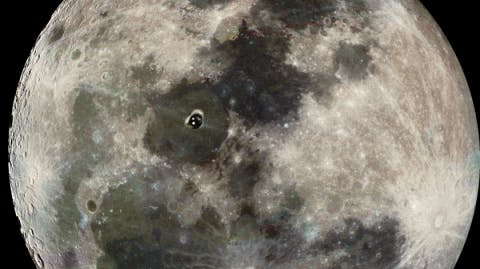
To this day, when you look up at the full moon, you can see the shape of a rabbit there in its silver surface: ears long, body curled, forever resting in the sky.
The Aztec people said it was a reminder from the gods: true greatness is not found in what you own, but in what you are willing to give. The rabbit had nothing, and because he offered everything, he was lifted higher than any eagle.
So the next time the moon rises full and bright, look closely. The rabbit is still there, patient and shining, teaching the same lesson he taught a god on a quiet evening long, long ago.
This legend comes from the traditions of the Nahua peoples of ancient Mesoamerica. Similar stories about a rabbit in the moon are also told across Asia and other parts of the Americas, suggesting that people all over the world have looked up at the same moon and found the same small, humble creature staring back.