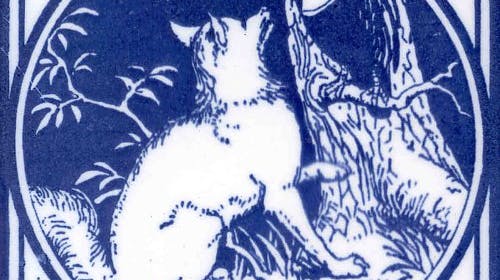
A Victorian ceramic tile illustrating the fable of The Fox and the Crow from Minton's Pottery. Date: 1880 Photo by: Minton's Pottery, Public Domain
By
The Æsop for Children
Text Type
Folk Tale
Words
282
Lexile
910L
Published
1919
One bright morning as the Fox was following his sharp nose through the wood in search of a bite to eat, he saw a Crow on the limb of a tree overhead. This was by no means the first Crow the Fox had ever seen. What caught his attention this time and made him stop for a second look, was that the lucky Crow held a bit of cheese in her beak.
"No need to search any farther," thought sly Master Fox. "Here is a dainty bite for my breakfast."
Up he trotted to the foot of the tree in which the Crow was sitting, and looking up admiringly, he cried, "Good-morning, beautiful creature!"
The Crow, her head cocked on one side, watched the Fox suspiciously. But she kept her beak tightly closed on the cheese and did not return his greeting.
"What a charming creature she is!" said the Fox. "How her feathers shine! What a beautiful form and what splendid wings! Such a wonderful Bird should have a very lovely voice, since everything else about her is so perfect. Could she sing just one song, I know I should hail her Queen of Birds."
Listening to these flattering words, the Crow forgot all her suspicion, and also her breakfast. She wanted very much to be called Queen of Birds. So she opened her beak wide to utter her loudest caw, and down fell the cheese straight into the Fox's open mouth.
"Thank you," said Master Fox sweetly, as he walked off. "Though it is cracked, you have a voice sure enough. But where are your wits?"
Moral
The flatterer lives at the expense of those who will listen to him.
Students discuss how stories can influence what people think or believe, or how they behave.
Think-Pair-Share
Prompt students to respond to the following question using the Think-Pair-Shareroutine.
Say these Directions: Follow the Think-Pair-Share routine and work with your partner to answer the questions:
How can a story influence what people believe or how they act, even if it never directly says, “This is the lesson of this story”?
What is an example of a story from your own background knowledge that might influence how people believe or act?
(Student responses may vary.) Stories can influence people by showing the consequences of certain choices instead of directly telling readers what to think or the lesson they should learn. For example, a character who ignores advice because they are overconfident and then fails might serve as a warning to readers not to act out of pride. For example, I think of Greek myths like the story of Icarus, who flies too close to the sun. It is a good example of a story that tries to influence people not to be overly ambitious. These kinds of stories help readers reflect on their behavior and consider how their own decisions might lead to certain outcomes.
Lead a whole-class discussion once partners have discussed the question. Explain that in this unit, students will learn that persuasion is not limited to speeches or posters. It can also happen through storytelling.
Introduce the word allegory and display the definition:
allegory: a text like a story or poem or a visual image in which the characters, objects, and events are symbolic and, together, represent an underlying message, idea, or lesson
Say: Sometimes authors tell stories that mean more than what happens on the surface. An allegory may seem like a simple story, but it communicates a universal message about human behavior or society. Instead of stating the message directly, the author uses characters, events, and conflicts to represent ideas about human behavior or society. When readers analyze allegory, they move from what happens in the story to what the characters, events, and conflicts represent. Like propaganda, allegories are intended to shape how people think, not by directly telling them what to believe, but by showing ideas and outcomes through story.
Say: Readers can analyze an allegory by asking themselves the following questions:
Who or what might these characters and events represent in the real world?
What larger idea or message is the author suggesting?
How does the conflict connect to real human behavior or how humans interact in society?
Introduce the word symbolism and display the definition:
symbolism: using objects, colors, or characters to represent abstract ideas or emotions that build theme; authors often do this through repetition and emphasis
Explain to students that symbolism shows up in their everyday lives all the time.
Say:Symbolism is all around us. How many of you send emojis when you text? Certain emojis convey certain ideas and emotions. For example, if you send a heart emoji to your friend, what do you mean? What about the emoji in which the smiley face has a closed zipper for lips? What does that emoji stand for or symbolize?
(Student responses may vary.) The heart emoji means you love your friend or are sending them love. The emoji with the zipper for lips means you are willing to keep a secret.
Say: Authors use symbolism when they write allegories. They use characters, events, and settings to symbolize specific messages, lessons, or ideas. Symbols help authors communicate deeper meanings, emotions, or themes.
Check for Understanding
List the words allegory and symbolism in your Personal Dictionary. Write the definition of each word.
Explain to students that in this lesson, they will analyze symbolism within allegories to determine the ideas or lessons the allegories are trying to convey.
🎯PURPOSE
Help students move from plot to symbolic meaning using evidence, language, and “stands for” comparisons.
“This event parallels ___ in real life because ___.”
“The conflict suggests ___ about power because ___.”
👁️WATCH FOR / SUPPORT IF NEEDED
If students stay literal → Prompt: “What behavior does this model in real life?”
If students give a symbol with no evidence → Prompt: “Name the evidence that proves your symbol means that.”
Students name one story element + one real-world idea.
Students use one comparative verb (represents/stands for).
Students point to symbols and how they represent an emotion or idea.
Teacher Tip
Encourage students to think of other simple allegories they may already know, such as “The Boy Who Cried Wolf” (which can represent the consequences of dishonesty) or stories in which animals act like humans to teach a lesson. Explain that some allegories communicate messages without stating them directly, while others, such as fables, often state the moral at the end.
Situation
Try this
Struggling with: Responding to partners
Provide sentence frames that help students connect story elements to influence and meaning. Ex: “One way a story can influence people is by showing ___.” Ex: “The character’s actions can suggest ___ because ___.” Ex: “This event might teach readers ___.” Ex: “The conflict represents ___, which could influence people to ___.” Ex: “The author might want readers to think about ___.”
Ready for extension
Invite students to explain what a story element might represent in the real world based on the stories they shared during the Launch. Ask: What real-life behavior or issue could the character, event, or conflict symbolize in the story you shared? How might that shape what readers believe? (Student responses will vary.) It could be that having too much pride can be your downfall, or lying will get you in trouble. Say: Today, you will practice identifying allegory and explaining the deeper meaning conveyed by it.
Part A: Analyze Theme Development in Allegory (RL.8.2, RL.8.3) (20 minutes)
Students work in small groups to read two fables by Aesop and discuss how the fables might represent real-life situations and how each has a message that might influence human behavior.
Table Talk
Divide students into small groups and provide each student within the group a copy of “The Hare and the Tortoise” and “The Fox and the Crow.”
Say these Directions: Work with your small group to read two fables, which are a type of allegory. Then discuss the following questions. Use evidence from the text to explain what the characters and events represent. Remember that in an allegory, the characters, plot, and settings can symbolize emotions and abstract ideas. Add your ideas to the chart paper or a digital board.
How do the characters act in “The Hare and the Tortoise”? What do their actions reveal about them? What kind of real-life person might each character represent? Give specific examples from the fable to support your ideas.
In “The Hare and the Tortoise,” the story begins with the Hare making fun of the Tortoise for being slow. He “was much amused” at the thought of racing the Tortoise. He takes the lead at first and, “to make the Tortoise feel deeply ridiculous,” the Hare decides to take a nap. But he does not awake in time and loses the race. His behavior shows that he is overconfident and arrogant about his abilities. The Tortoise, on the other hand, acts calm and takes his time to get to the finish line. He is not fazed by the Hare’s mockery. The story describes him “going slowly but steadily.” His character represents the benefits of being unaffected by taunts and by persisting in the face of a challenge. The Hare seems like a braggart and bully who thinks he is much better than he actually is.
How do the characters act in “The Fox and the Crow”? What kind of real-life person might each character represent? Give specific examples from the fable to support your ideas.
In “The Fox and the Crow,” the Fox sees the cheese that the Crow holds and flatters the Crow in order to get her to drop the cheese. He says, “No need to search any farther” for breakfast. He lies when he says how he feels about her. It is all a trick. At first, the Crow “watched the Fox suspiciously,” as she should, but she lets his flattery trick her. The Fox could represent a person who tries to persuade you to do something for nothing or wants to trick you. The Crow represents a person who is vain and naive, falling for a trick because she believed in false flattery.
What messages or lessons do these fables communicate about human behavior or actions? What details support this theme or message?
In “The Fox and the Crow,” the message is that flattery can be dangerous; the fox’s praise leads the crow to drop the cheese. If she didn’t fall for his trick, the Fox would be forced to work for his own food. The lesson about human behavior is that we need to be aware of our ego and not be blinded by flattery. In “The Hare and the Tortoise,” the lesson is that people should not be unkind and arrogant. The Tortoise can win the race because the Hare makes the mistake of taking a nap, because he truly believes he will win no matter what. The message to people is that being too prideful can cause you to fail.
Teacher Tip
If necessary, consider modeling a think-aloud of how to answer the text-dependent questions with one of the fables, and then provide the other fable to the small groups to practice analyzing independently.
Most students will have encountered these kinds of fables in elementary school; the purpose behind this analysis is to teach allegory and symbolism prior to reading and analyzing Animal Farm as a canonical allegory.
🎯PURPOSE
Support students in annotating for characters and actions and preparing an evidence-based explanation of how these elements convey a message or theme.
Language Focus
Symbol frames: symbolizes/represents/suggests
Cause/effect reasoning: because/so/therefore
Theme/message language: lesson, warning, claim
🗣️SAY / ASK
“C: When the character ___, it shows that s/he is ___.”
“E: When ___, it suggests ___ because ___.”
“M: The outcome suggests ___.”
👁️WATCH FOR / SUPPORT IF NEEDED
If annotations are only summary → Prompt: “Add one ‘represents’ sentence after the note.”
If students struggle to name an abstract idea → Prompt: “Choose one: trust, pride, persistence.”
At least one annotation includes a symbol claim (“represents ___”).
Students link an annotation to a message/theme.
Students use because/therefore once in discussion.
Instruct each small group to share their table talk ideas with another small group. After the small groups have shared their responses and ideas with each other, lead a whole-class discussion of the questions.
Part B: Evaluating Allegory as Persuasion (SL.8.1) (10 minutes)
Students participate in a Four Corners Debate to evaluate whether or not they believe that allegory is more influential than propaganda.
Four Corners Debate
Transition students into a whole-class discussion activity called Four Corners Debate. Post four signs in the corners of the classroom (Strongly Agree, Agree, Disagree, Strongly Disagree).
Say these Directions: A Four Corners Debate is a discussion activity where you take a position on a statement and support it with evidence. Each corner of the room represents a different viewpoint—Strongly Agree, Agree, Disagree, or Strongly Disagree. After choosing a corner, you will collaborate with peers to explain your reasoning, listen to other perspectives, and decide whether new evidence strengthens or changes your thinking.
Allegory can work like propaganda: it doesn’t just entertain. It pushes readers toward a belief about how people behave or how societies work. Choose a position on the following statement:
Allegories are more influential than direct propaganda.
Say: If I agreed, I would stand in the “Agree” corner because when a lesson is shown through characters and events, readers often reflect on the message more deeply than if they were simply told what to think.
Invite students to move to the corner that best represents their position - Strongly Agree, Agree, Disagree, Strongly Disagree.
Once groups are formed, have students collaborate to develop one clear, evidence-based statement explaining their position. Encourage them to reference the fables they read to provide concrete examples of what makes the allegory effective or ineffective as a tool of persuasion.
Provide sentence supports, such as:
“I chose this position because ___.”
“The fable ___ clearly shows ___, which is a convincing lesson.”
“Allegories can be ___, which makes them ___. For example, ___.”
“I disagree with that idea because ___.”
Circulate and listen for students connecting the characters and events in the fable to the themes they present. They should use textual evidence rather than personal preference. Invite one volunteer from each corner to present their position and evidence.
Ask: Which arguments were strongest, and why?
Ask: Did anyone hear evidence that made you reconsider your position?
Allow students to move corners if their thinking shifts. Emphasize that revising one’s view based on evidence is part of strong analytical thinking.
Say: In this unit, you will read another allegory—Animal Farm—that is much more complex than the fables you just read. In his allegorical novel, George Orwell comments on real-world systems of power and persuasion. As you begin Animal Farm, you will read on two levels—the literal story about the animals and the symbolic meaning that conveys important themes about humanity and society.
Provide students with a confidence continuum (i.e., 1–5). As needed, model how to demonstrate a level of confidence using the continuum.
Reflection (RL.8.2, RL.8.3)
Reflect on your ability to analyze the symbolic characters and events in an allegory using the Reflection routine.
How confident are you in your ability to explain how an allegory can influence what people believe and how they act through symbolism?
🎯PURPOSE
Help students defend a claim about allegory’s persuasive power using evidence + reasoning, and prepare them to read Animal Farm on two levels.
Claim language: I agree/disagree because . . .
Evidence language: In the allegory . . . , the character/event . . .
“I chose ___ because the allegory shows ___, which suggests ___.”
“A detail that supports our position is ___; this parallels ___ in real life.”
“This influences readers by making ___ seem ___.”
👁️WATCH FOR / SUPPORT IF NEEDED
If students argue from opinion only → Prompt: “Add one story detail: character action, event, or outcome.”
If students can’t link to belief/behavior → Prompt: “Finish: ‘This could influence people to ___ because ___.’”
Each corner statement includes claim + evidence + reasoning.
Students use at least one persuasive verb (influences/pushes).
Students use an abstract noun.
Quick Write
Transition students into reflecting on their learning from the lesson by completing a Quick Write response.
Say these Directions:Respond to the following prompt based on today’s lesson.
Identify one character or event from today’s allegories and explain in two to three sentences what real-world idea, issue, or type of person it might represent.
(Student responses may vary.) The hare could represent a person who relies on confidence and bullying instead of effort. The story suggests that pride can cause failure, which warns readers not to assume power or success is guaranteed.
Introduce the homework to complete before the next lesson:
Read Chapter I of Animal Farm (pp. 3–14) and annotate for key ideas that Old Major communicates in his speech.