Life Under the Tsars
For hundreds of years, Russia was ruled by powerful leaders called tsars. Most Russians had very little freedom and lived in poverty, while the tsars held almost total control. By the 1800s, many Russians were fed up and wanted change. This tension had been building for a long time — and eventually, it exploded.
Early Sparks: The First Revolts
The first major uprising happened in December 1825, when a group of soldiers and upper-class citizens tried to overthrow the government after Tsar Alexander I died. This was called the Decembrist Uprising. It failed, but it inspired future generations to keep fighting for change.
Then, in 1905, after Russia lost a war against Japan, public anger nearly forced Tsar Nicholas II to share his power. But neither the tsar nor his opponents were satisfied, and the conflict simmered on.
World War I Makes Everything Worse
When World War I began, Russia's military suffered devastating losses against Germany. The war drained the country of resources, and ordinary Russians were starving. Tsar Nicholas made things worse by personally taking command of the army in 1915, leaving a dangerous power vacuum back in the capital, Petrograd.
The March Revolution of 1917
By early 1917, Russians had reached their breaking point. Food riots and strikes turned into massive protests in the streets. Crucially, the army refused to shoot the protesters — a sign that the tsar's grip on power was slipping. A council of workers and soldiers quickly formed a new provisional (temporary) government, and on March 15, 1917, Tsar Nicholas II abdicated, giving up his throne.
A man named Aleksandr Kerensky took charge of the provisional government. But he made a critical mistake: he kept Russia in the war. This decision would cost him everything.
Lenin Arrives: The October Revolution
While all this was happening, a revolutionary named Vladimir Lenin had been living in exile in Switzerland. Germany secretly put him on a train back to Russia, hoping he would stir up trouble and knock Russia out of the war. It worked.
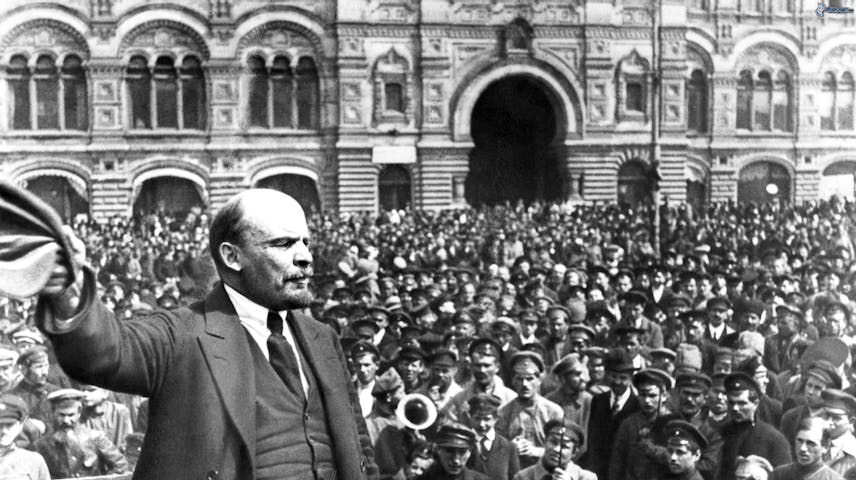
Lenin arrived with a powerful message: immediate peace, land for the peasants, and power to the workers. His party, the Bolsheviks, spread this message among soldiers and factory workers, rapidly gaining support. Lenin believed strongly in Communism and eventually wanted a classless society in which all people were equal, private property was eliminated, and resources were distributed based on need.
On the night of November 6–7, 1917, the Bolsheviks made their move. They seized control of Petrograd almost overnight. Kerensky's government collapsed, and Lenin's Bolsheviks took power. Because this happened in October on Russia's old calendar, it became known as the October Revolution.
Building a New Government — and a Civil War
Once in power, Lenin moved quickly. The new government abolished private land ownership, gave workers rights in factories, and signed a peace treaty with Germany to end Russia's involvement in World War I. That treaty, signed in March 1918, came at a huge cost; Russia gave up enormous amounts of territory, including Ukraine and Finland.
Not everyone accepted Bolshevik rule. Opponents known as the "Whites" fought against Lenin's "Red Army" in a brutal civil war that lasted until 1920. Lenin's military commander, Leon Trotsky, transformed the Red Army into a disciplined fighting force, and the Bolsheviks ultimately won.
Trotsky not only used his military intelligence to support the Communist cause, but he also proposed ideas for the rapid industrialization of Russia in an effort to boost the economy.
The Soviet Union Is Born
After the civil war, Lenin tried to stabilize the country by allowing some small economic freedoms — but politically, he allowed no opposition whatsoever. In 1922, the new nation was officially named the Union of Soviet Socialist Republics (USSR), or the Soviet Union.
When Lenin died in 1924, a power struggle emerged in the Communist Party. A ruthless politician named Joseph Stalin fought for control against Trotsky. Eventually, Stalin politically outmaneuvered Trotsky and expelled him from the Soviet Union in 1929. Under Stalin, the Soviet Union became one of the most oppressive dictatorships in history — ironically, far more tyrannical than the tsars the revolution had originally fought to overthrow. Stalin utilized the secret police to eliminate threats, created a vast network of forced labor camps, and controlled all aspects of citizens’ lives.
Additionally, Stalin used propaganda to paint himself as a kind and thoughtful leader; his images would appear everywhere, including on banners, in schools, and in art. This government propaganda would often make him seem wise, nurturing, and “godlike.” However, this propaganda did not match with Stalin’s totalitarian actions, as he politically repressed his opponents or anyone who would dissent against him. In 1936-1938, he carried out the Great Purge, or Great Terror, in which he eliminated his political opposition through mass executions and imprisonment.
Why Does It Matter?
The Russian Revolution reshaped the entire world. It created a communist superpower that would clash with the United States for decades during the Cold War. It also showed how quickly a government can fall when it ignores the needs of its people, a lesson that still resonates today.