Geography
South Korea is located on a peninsula—a piece of land surrounded by water on three sides—that sticks out from the eastern edge of Asia. The whole Korean peninsula is about 600 miles long and is roughly the same size as the state of Utah. South Korea shares the peninsula with North Korea. The two countries are separated by a narrow strip of land called the Demilitarized Zone, or DMZ.
Most of South Korea is covered by small mountains, with the biggest ones, the Taebaek Mountains, along the eastern coast. Most of the country’s cities and farms are found along the flatter western and southern coasts. Off the coast of South Korea, there are also about 3,000 small volcanic islands.
South Korea has four seasons, with cold winters and warm, rainy summers. The southern coast and the island of Jeju get more rain and stay warmer, so tropical forests grow there.
Nature
South Korea has around 4,500 types of plants, and most forests have a mix of trees like oaks, maples and pines. A few plants, like the Korean fir tree and a shrub called white forsythia, naturally grow only in South Korea and nowhere else on Earth.
Many wild animals that once lived in South Korea are now gone or very rare. Tigers used to roam the whole peninsula, but they were hunted nearly to extinction. Other large animals like leopards, bears and foxes have also mostly disappeared. South Korea now has 23 national parks to help protect the wild areas that remain.
In addition, the DMZ is one of the most unusual places in the world: it’s a 2.4-mile-wide strip of land where no people are allowed to live or travel. Because humans have stayed out for decades, wild animals like leopards, rare cranes and deer now live there safely.
History
People have lived on the Korean peninsula for at least 10,000 years. The earliest Koreans are thought to have migrated, or moved, from cold regions like Siberia to find a warmer place to live. They eventually formed small societies and built a kingdom called Gojoseon (which is sometimes called Old Choson).
Eventually, one kingdom called Silla unified most of the peninsula around 668 C.E. Korea later became known as Goryeo—which is where the word “Korea” comes from. A period called the Joseon dynasty came next and lasted from 1392 to 1910. During this time, Korean culture and identity grew stronger.
Because Korea sits between large, powerful neighbors, it has often been caught in the middle of their conflicts. China had the biggest influence on Korea for many centuries, and Japan ruled Korea from 1910 until 1945.
After World War II, Korea was split in two. The north was influenced by the Soviet Union and China, and the south was supported by the United Nations, led by the United States. In 1950, North Korea invaded the south, starting the Korean War. The war lasted until 1953 and caused enormous destruction, killing more than 2.5 million people. The war was never officially ended, and the two countries are still divided today.
People and Culture
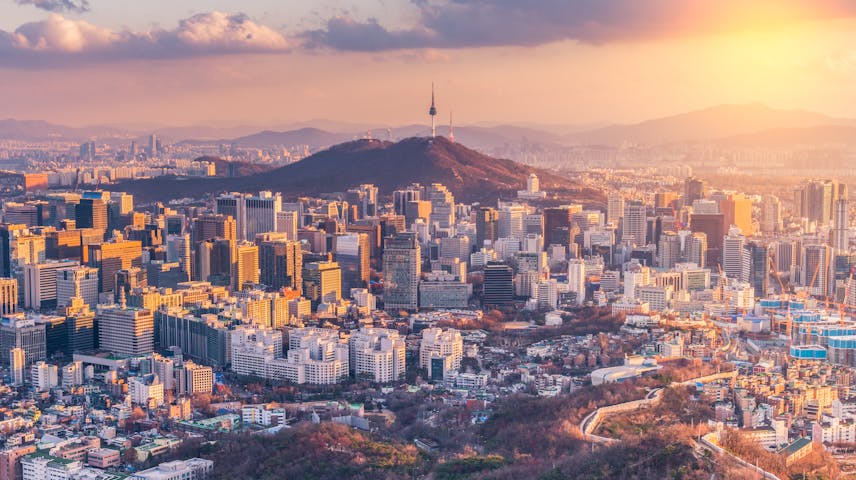
About 51 million people live in South Korea, making it one of the most crowded countries in the world. The capital city, Seoul, is home to nearly 10 million people. It is filled with skyscrapers, busy subways and apartment buildings.
Korean life has long been shaped by a philosophy called Confucianism. Founded in China by Confucius (551–479 B.C.E), it teaches respect for family, elders and community. These values are still important today. On holidays like the Lunar New Year and the Harvest Moon Festival, families honor their ancestors through special traditions. Korean religious life is diverse and pluralistic, characterized by a mix of traditional beliefs and organized religions. While about half of South Koreans have no official religious affiliation, the culture is deeply influenced by a blend of Buddhism, Confucianism, Christianity, and Korean shamanism.
Korean food is now popular all over the world. Popular dishes include bibimbap (rice with vegetables and spicy sauce), bulgogi (marinated grilled meat) and samgyetang (chicken soup with ginseng and rice). Kimchi—fermented cabbage made with salt and chili powder—is eaten at almost every meal and is one of the most important symbols of Korean culture. Every autumn, families and neighbors gather to make large batches of kimchi for the winter in a tradition called kimjang.
Government and Economy
South Korea’s official name is the Republic of Korea. It is a democracy, which means citizens vote for their leaders. The head of the government is the president, who is elected to a five-year term. The country’s constitution protects the rights and freedoms of its citizens.
South Korea has one of the strongest economies in Asia, and its rise from poverty is one of the most remarkable stories in modern history. After the Korean War, the country was one of the poorest in the world, with most of its factories destroyed. By the 1980s and 1990s, it had become a major industrial power.
Today, South Korea makes and exports ships, cars, computer chips and electronics. South Korea is also a leader in technology, and companies like Samsung and Hyundai are known around the world. It was one of the first countries to offer 5G internet and is a top producer of semiconductors, the tiny chips that power computers and phones.
South Korea and the Korean Wave
Beginning in the late 1990s and early 2000s, South Korean culture began to spread around the world in a movement known as the Korean Wave. K-pop music as well as Korean TV dramas, movies and video games have gained huge fan bases across Asia, North America, Europe and beyond. The group BTS became the first South Korean act to reach No. 1 on the U.S. Billboard Hot 100, and the movie Parasite won the 2020 Oscar for Best Picture. Korean food and fashion have become popular worldwide. South Korea also has 15 sites listed on UNESCO’s World Heritage list, making sure its ancient culture is preserved even as its modern culture continues to grow.