[image credit = NASA]
The Space Race Begins: The Story of Sputnik
On October 4, 1957, the Soviet Union made history by launching the world’s first artificial satellite into space. It was called Sputnik. Its launch started a fierce competition between the Soviet Union and the United States known as the Space Race.
What Was Sputnik?
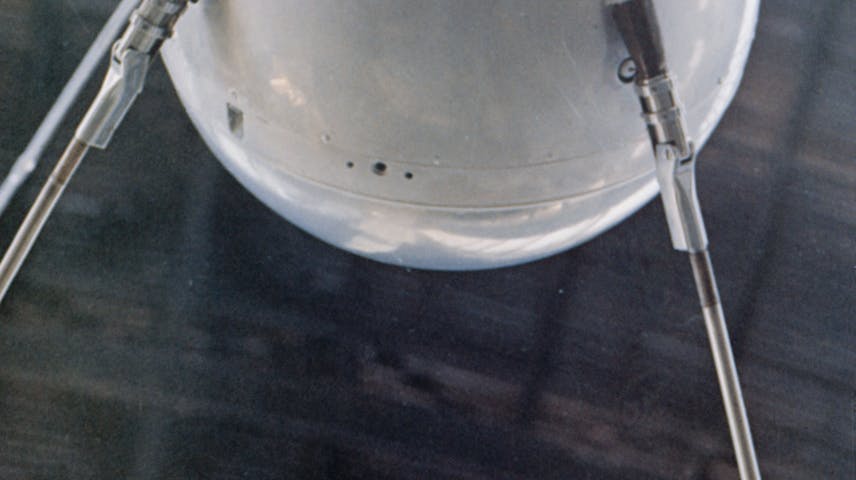
Sputnik was a metal sphere made of aluminum. It was about 22 inches wide—roughly the size of a beach ball—and weighed around 183 pounds. It had four long antennas protruding from it and orbited the Earth once every 96 minutes. Sputnik didn’t carry any scientific equipment. However, it did send out a “beep-beep” radio signal that people around the world could pick up with amateur radios. Sputnik used the radio beacon to verify exact locations on the Earth’s surface.
After about three months in orbit, Sputnik’s batteries died. It fell out of orbit and reentered Earth’s atmosphere in January 1958.
America’s Reaction
Americans were shocked by the news. Many people feared that if the Soviets could launch a satellite, they might also have powerful enough rockets to threaten the United States. Some Americans thought the Soviets were trying to find targets for their missiles. Congress held hearings about the situation, and in 1958 the U.S. government created NASA—the National Aeronautics and Space Administration—to coordinate and lead its space program.
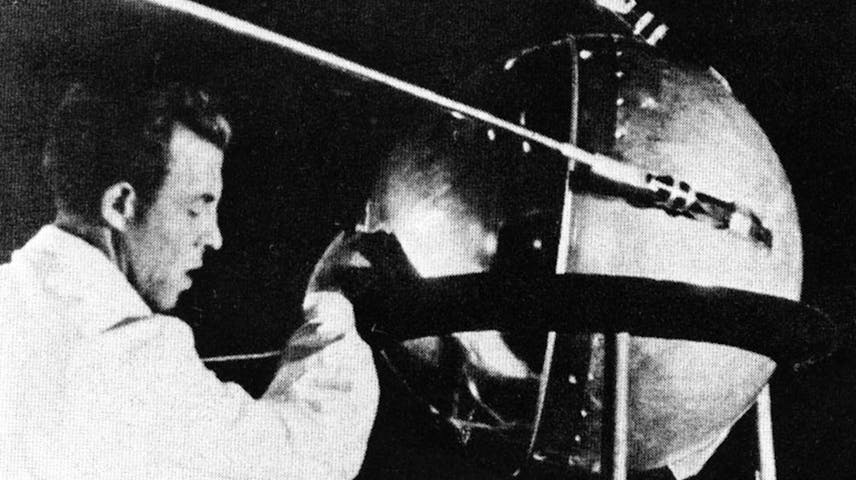
What made things even more alarming was the size of Sputnik. The U.S. had been planning to launch a satellite, but it weighed only 3.5 pounds, while Sputnik weighed nearly 200 pounds. Americans thought the size of Sputnik meant it was more advanced. They also thought Sputnik’s size meant it must have military purposes.
Then, just one month after launching Sputnik 1, the Soviet Union launched Sputnik 2. It was a much larger spacecraft weighing over 1,000 pounds, and it carried a dog named Laika into orbit. Laika was the first animal to orbit the Earth.
The Race Is On
The launch of Sputnik pushed both countries to develop their space programs rapidly. Within 12 years, all of that competition led to one of humanity’s greatest achievements—landing astronauts on the Moon in 1969.