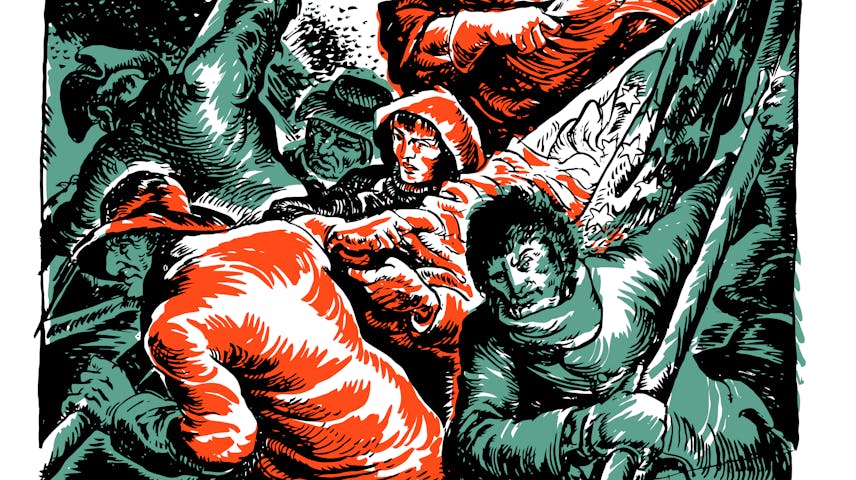
Soviet propaganda posters—artwork created and distributed with the intent to generate support for a cause, often through the use of misleading information—first appeared in 1917, during the Russian Revolution. Posters became one of the most powerful and effective tools the communists used during the civil war. Once in power, the Soviet government continued to use propaganda posters to shape what its people thought, believed and did.
Political Control and Ideology
The Soviet Union was built on communism, a political and economic system based on the ideas of Karl Marx. In this system, the government controls the economy and resources are meant to be shared equally among all people. In theory, the working class owns the means of producing all goods and they are no longer exploited by the upper class. There is also no religion, and, according to Marx, communist societies would eventually replace all other systems of economic and political organization. The official version practiced in the USSR was called Marxism-Leninism. It was named after Marx and the Soviet Union’s first leader, Vladimir Lenin.
Many Soviet citizens couldn’t read well. So the government used bold images and short, punchy slogans to spread these ideas to everyone, with little reading required. Thousands of unique posters were created to share communist ideology far and wide, uniting art and design with the Soviet government..
Mobilizing the Workforce
Posters regularly celebrated factory workers, farmers and laborers as national heroes. They were used to promote massive economic programs, such as Stalin’s Five-Year Plans, ambitious government campaigns that set strict production goals for workers and factories. The message was clear: work hard, meet your quota and serve your country.
Military Recruitment and Morale
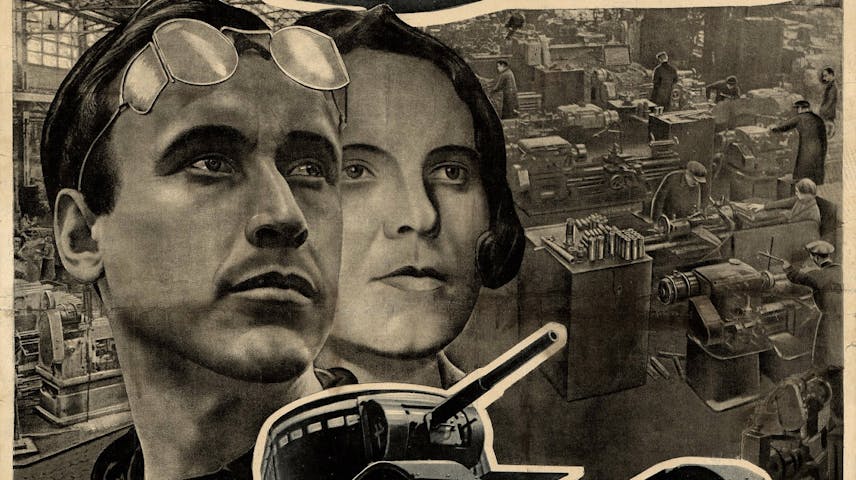
During the Russian Civil War, and especially during World War II—which Soviet citizens called the Great Patriotic War—posters were everywhere. They encouraged men to enlist, kept spirits high on the home front and portrayed enemies like Nazi Germany as pure evil.
Building a Cult of Personality
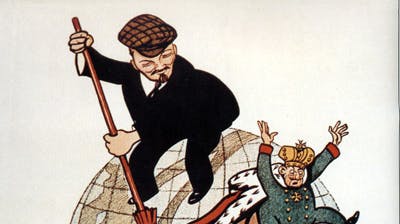
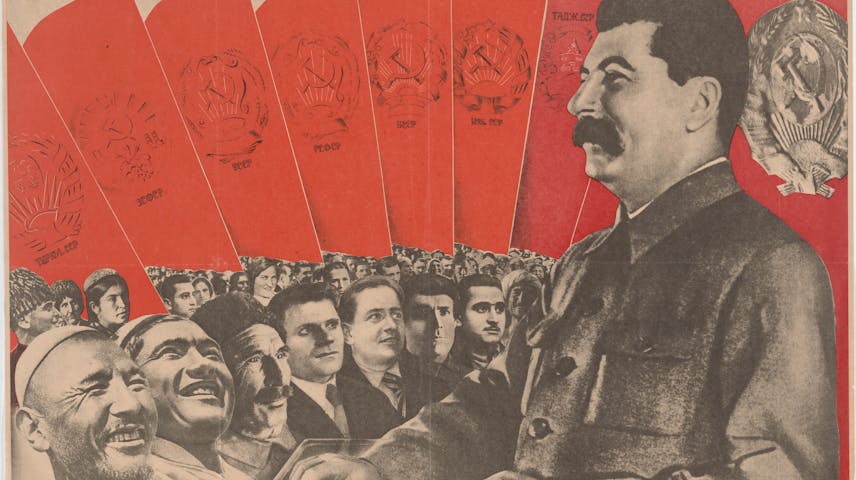
Leaders such as Lenin and Stalin were shown in posters as wise, powerful, almost superhuman figures. This was deliberate. The government wanted citizens to admire and obey these men without question. This was a tactic known as building a cult of personality, or a cult of the leader, which used propaganda to make one leader seem more like a celebrity or a deity (god) than a regular person.
Social Engineering
The Soviet state also used posters to encourage specific behaviors. They promoted reading and education, personal hygiene and getting women into the workforce. They also pushed atheism—the belief that there is no God—because the government wanted citizens to place their loyalty in the state rather than in religion.
Anti-Western and Anti-Capitalist Messaging
Many posters portrayed the United States and other Western, capitalist countries as greedy, corrupt and dangerous. (In a capitalist system, businesses are privately owned and driven by profit.) The goal of these posters was to convince Soviet citizens that their system was better and that the West was the enemy.
Youth Indoctrination
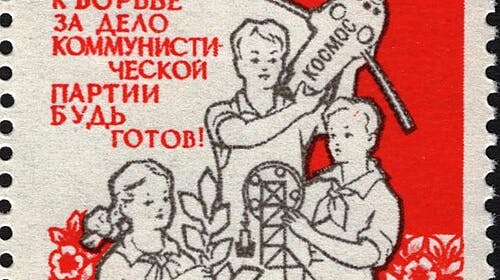
The government knew that winning over young people was key to the future of communism. Organizations like the Young Pioneers (similar to Boy Scouts, but focused on communist values) and the Komsomol (the Communist Youth League, for teenagers and young adults) were heavily promoted through posters aimed specifically at kids and teens.
The Art Style
Soviet propaganda posters were also notable for their striking and distinctive artistic style. They were heavily influenced by cartoons and the constructivist art movement, which was characterized by bold geometric shapes, vivid colors and dynamic compositions. Artists like El Lissitzky, Viktor Deni and Alexander Rodchenko helped shape this iconic visual language.
The End of an Era
Not all of the Soviet propaganda posters were negative. Some encouraged literacy, equality for women and physical fitness, and others celebrated family life, national achievements and the work of laborers. The USSR continued its use of propaganda posters—trying to instill desired behaviors, to depict capitalism and the West as evil, and to inspire patriotism—right up until its demise in 1991.