
After the Japanese bombed Pearl Harbor, the U.S. War Relocation Authority made a decision it would soon regret. It hired famed photographer Dorothea Lange to take pictures as 110,000 Japanese and Japanese-Americans were removed from their homes on the West Coast and interned at remote military-style camps throughout the interior.
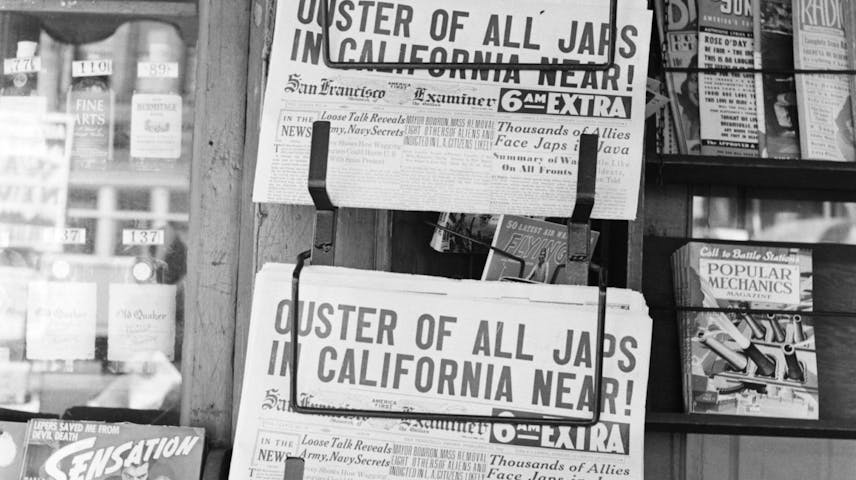
The agency had hoped Lange's photos would depict the process as orderly and humane.
But the hundreds of photos that Lange turned over did the opposite. She considered internment a grave injustice, and her photos depict it that way. She captured the confused and chaotic scenes of Japanese-Americans crowding onto buses and trains, the stressed and confused looks on their faces, their shuttered businesses, the threadbare barracks that would become their homes for months or years.
Instead of allowing Lange to publish her photos, the government seized them.
In 2016, some of them went on display at the Skirball Cultural Center in Los Angeles. They were part of an exhibit that tells the story of Japanese internment through the pictures of three photographers: Lange; the equally renowned landscape photographer Ansel Adams, whose photos from California's Manzanar internment camp anchored the exhibit; and Toyo Miyatake, a Japanese-American photographer who was interned at Manzanar but smuggled in a camera.
The stories that photos tell depend so much on who's snapping the shutter, and Manzanar: The Wartime Photographs of Ansel Adams illustrates that in dramatic fashion. Each photographer offers a vastly different perspective on what Japanese internment was like, their photos reflecting differences not only in style, but in the relationship each photographer had to this shameful chapter of U.S. history.
Dorothea Lange
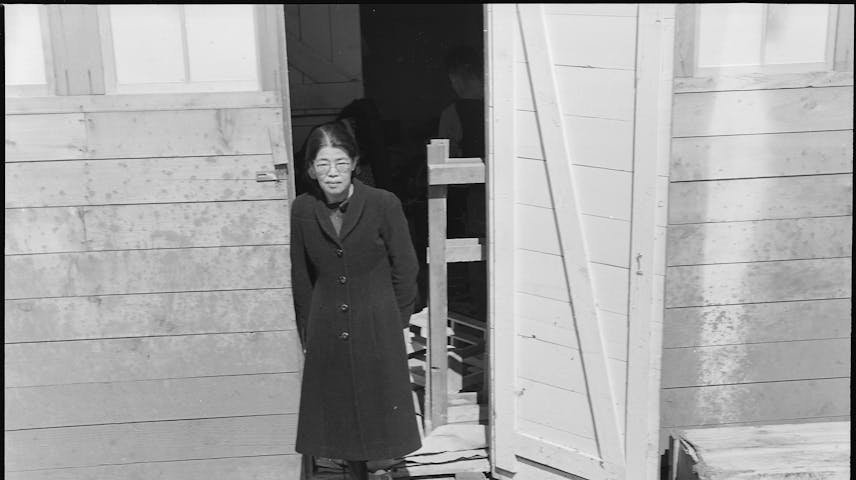
The photo below, showing a Japanese woman recently arrived at her living quarters, was among the hundreds of Lange's photos that were seized by government censors. On this original proof, the word "Impounded" is handwritten in the lower margin.
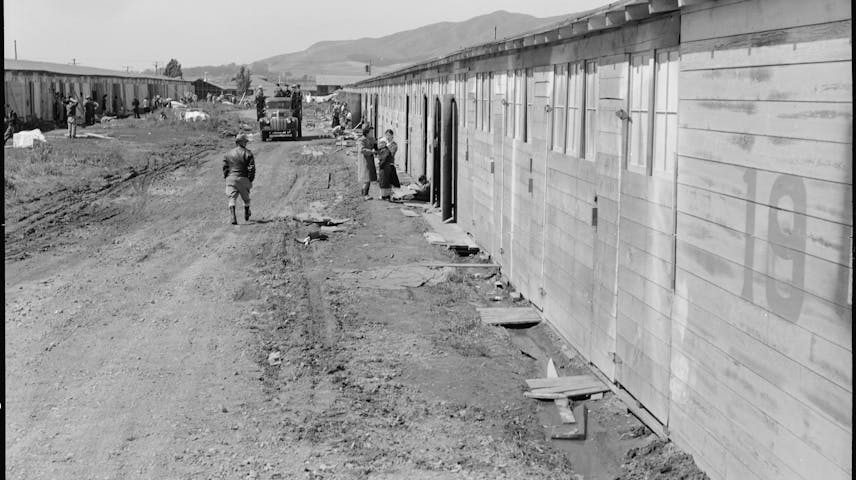
This next photo is of a converted racetrack in San Bruno, Calif., where Japanese-American families were temporarily housed in horse stalls while they awaited transport to camps.
Lange's photo of the Manzanar internment camp during a dust storm highlights the camp's remote desert location.
Caption: Manzanar Relocation Center, Manzanar, California. Scene of barrack homes at this War Relocation Authority Center for evacuees of Japanese ancestry. A hot windstorm brings dust from the surrounding desert. The windstorm has subsided and the dust has settled. July 3, 1942]
[image alt text = A black-and-white photograph showing rows of plain, identical wooden barracks stretching into the distance on both sides of a flat, dusty open space. An American flag flies from a tall flagpole in the center of the image. In the background, a rugged mountain range with snow on its peaks rises against a cloudy sky. A few small figures of people can be seen walking between the buildings. This is a photograph of a Japanese American incarceration camp during World War II, where tens of thousands of Japanese Americans were forced to live after the U.S. government removed them from their homes following the attack on Pearl Harbor in 1941.]
[image credit = Photographer: Lange, Dorothea. Central Photographic File of the War Relocation Authority, National Archives]
Ansel Adams
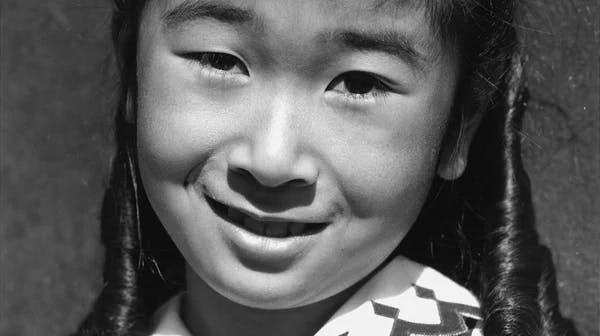
Adams visited Manzanar to take photos in 1943 at the request of camp director Ralph Merritt, who was a personal friend.
"They don't look quite as dusty and quite as forbidding as Dorothea Lange's photos," Robert Kirschner, the Skirball's director, told me as we walked through the exhibit recently.
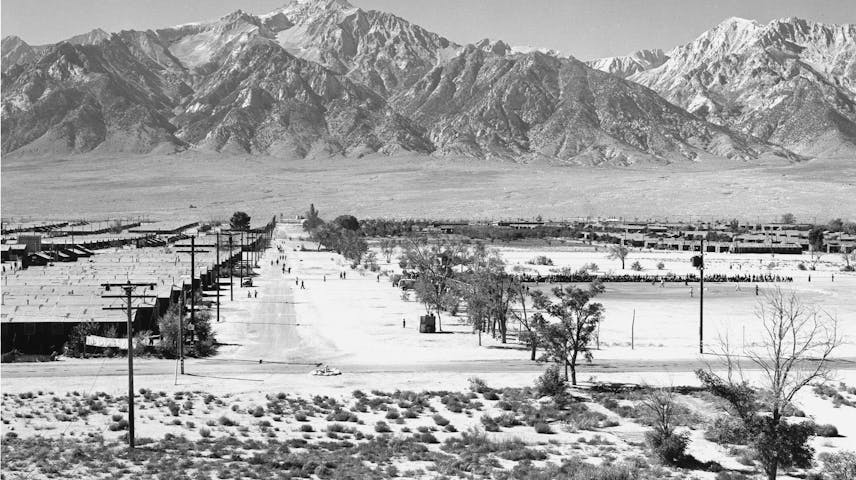
Indeed, the place that looks barren and depressing in Lange's pictures manages to look beautiful in Adams'. You get little sense that it was even a detention center, in part because Adams, like other photographers, was not allowed to shoot the guard towers or barbed wire. This photo, though, was taken from a guard tower:
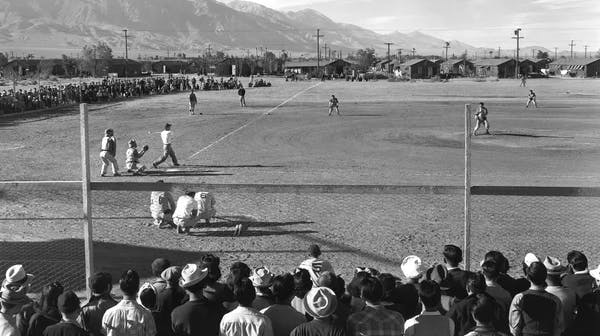
There are scenes from a baseball game, kids walking to school, a gathering outside a chapel. Lots of smiles, too, and portraits of camp residents cropped so close, you can see every blemish and stray hair. In Adams' vision, Manzanar comes off as a place where Japanese-Americans, dignified, resilient and optimistic in spite of their circumstances, built a temporary community in the desert.
Kirschner said that if Adams' photos appear to sugarcoat the indignities of life in an internment camp, it is because he did not see himself as a social activist the way Lange did. Still, Kirscher says, Adams was challenging internment in his own way, by depicting its victims as patriotic, law-abiding Americans.
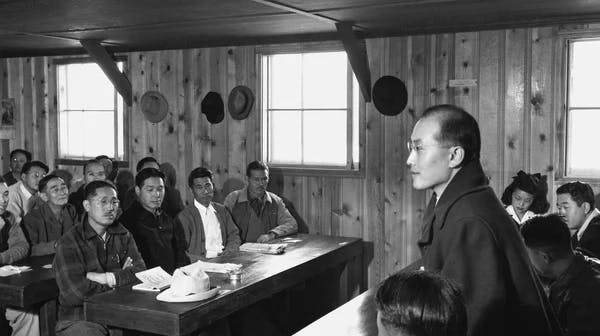
Unlike Lange, Adams was given permission to publish his photos. Before the war ended, he did so in a book called Born Free and Equal: The Story of Loyal Japanese-Americans, in which he warned about the dangers of letting wartime hysteria justify depriving U.S. citizens of their freedom.
Toyo Miyatake
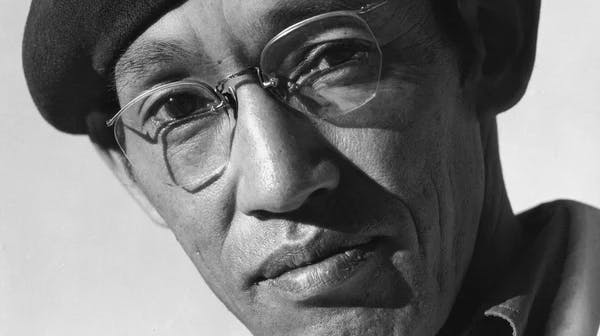
Before World War II, Miyatake had a photo studio in Los Angeles' Little Tokyo. When he learned he would be interned at Manzanar, he asked a carpenter to build him a wooden box with a hole carved out at one end to accommodate a lens. He turned this box into a makeshift camera that he snuck around the camp, as his grandson Alan Miyatake explains in a video, which was featured in the exhibit.
Fearful of being discovered, Miyatake at first only took pictures at dusk or dawn, usually without people in them. Camp director Merritt eventually caught Miyatake, but instead of punishing him, allowed him to take pictures openly. Miyatake later became the camp's official photographer.
His photos, some of which are featured in the video, convey an intimacy with camp life absent in the pictures that Adams and Lange took. He captured laughter at a picnic and men delivering vegetables to the mess hall.
His photos also had moments of silent protest. In one picture, three boys peer through the camp's barbed wire fence to the outside world. And in another, Miyatake's son, Archie, holds a pair of clippers against the fence, "to show," Kirschner said, "that at some point, the barbed wire has to come down."’
Credit: ©2016 National Public Radio, Inc. News report titled “Photos: 3 Very Different Views Of Japanese Internment” by Adrian Florido was originally published on NPR.org on February 17, 2016, and is used with the permission of NPR. Any unauthorized duplication is strictly prohibited.