
By
Standard News Bureau
Recommended For
Upper Elementary School - Middle School
Words
221
Lexile
0L
Published
2026-05-01
Directions: Read the article “Confrontations for Justice.” As you read, annotate the text for new information about Bloody Sunday. After reading, turn and talk with a partner about one or two new details you learned from the article about Bloody Sunday.
How might other informational sources, like articles or photographs, help us build our knowledge of Bloody Sunday?
Target Words:demonstration, escalation, and disperse
Directions: We’re learning about the words demonstration, escalation, and disperse today
Target Word: demonstration
Have you seen this word before? Where?
Identify the Roots:
Do you know any other words with either of these roots? (demonstrate; dispersion)
Identify Affixes:
What do you think the prefix dis- might mean based on words you know, like disagree? (apart/not)
Show the Text Excerpt:
"With Hosea Williams of the Southern Christian Leadership Conference (SCLC) leading the demonstration, ... some 150 Alabama state troopers, sheriff’s deputies, and possemen, . . . ordered the demonstrators to disperse.”
Verify Meaning Using Context Clues:
What context clues in this sentence help you figure out what a demonstration might be?
Based on context clues, what do you think disperse means?
Encoding Practice:
Now write two of the additional morpheme examples from memory. Use the spelling of the shared morpheme as your anchor — if you know how to spell the affix, that part of the word stays the same across all the examples.
Target Word: escalation
Have you seen the word escalation before? Where?
Identify the Root:
Do you know any other words connected to scal? (scale, escalator)
Identify Affixes:
What other words do you know that use the suffix -ation?
Determine Meaning:
Using what we know about scal and -ation, what do you think escalation means?
Verify Meaning:
“Use a dictionary, thesaurus or other reference material to review and verify the meaning of the word constructed using morphemes. “
Encoding Practice:
Now write two of the additional morpheme examples from memory. Use the spelling of the shared morpheme as your anchor — if you know how to spell the affix, that part of the word stays the same across all the examples
Build Word Relationships:
What is the relationship between escalate and escalation? (Escalate is the verb (to increase); escalation is the noun (the process of increasing).
Target Word: disperse
Introduce the Word:
Have you seen this word before? Where?
Identify the Root:
Do you know any other words with this root? (dispersion, dispersed)
Identify Affixes:
What do you think the prefix dis- might mean based on words you know, like disagree or disconnect?
Verify Meaning Using Context Clues:
What context clues in this sentence help you figure out what disperse might mean?
Encoding Practice:
Now write two of the additional morpheme examples from memory. Use the spelling of the shared morpheme as your anchor — if you know how to spell the affix, that part of the word stays the same across all the examples
Add the words demonstration, escalation, and disperse to your Personal Dictionary. For each word, underline the root, circle the prefix and suffix. After each word, write (1) the definition of the word and (2) the definition of each focus morpheme. |
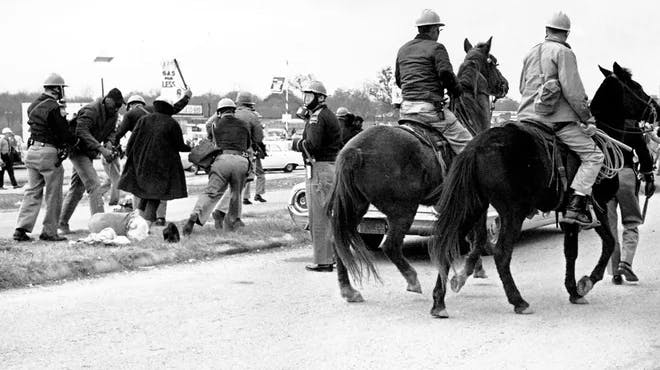
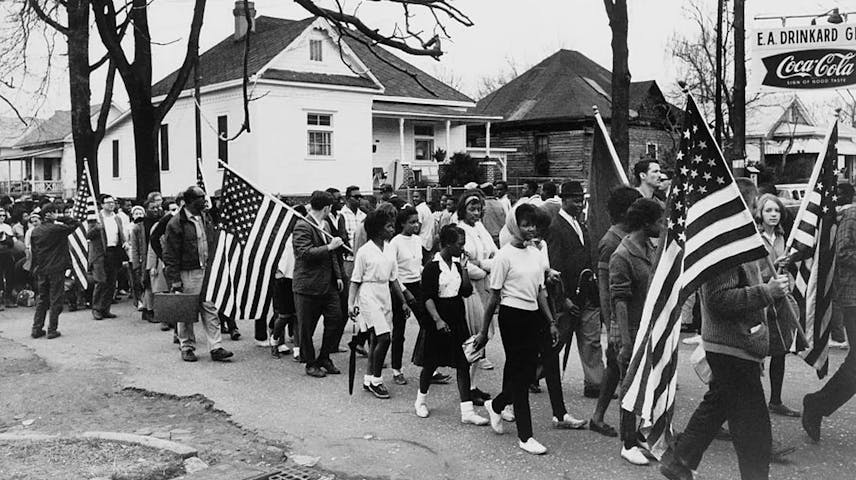
Directions: Work with your small group to analyze the photographs and captions in the Bloody Sunday gallery and reread the article “Confrontations for Justice”. As you discuss and write about what you notice, think about the vocabulary words demonstration, disperse, and escalation. Use these words to explain what happened and why the events unfolded the way they did. Record your group’s ideas on chart paper so you can share them during the gallery walk. As a group, discuss and write your responses to the following questions:
What new information do you learn about the events of Bloody Sunday from the photographs and captions in the Bloody Sunday gallery?
How does the information you learned from the Bloody Sunday gallery (photographs and captions) connect to the information you learned about Bloody Sunday in the article “Confrontations for Justice”?
Read the following question and write a sentence or two explaining your thinking.
|
Directions: Post your group’s chart paper around the classroom to begin a Gallery Walk. Move around the room with your group to read and discuss the ideas your classmates recorded. As you view each group’s responses, think about both what the marchers endured and what they were trying to accomplish during the events of Bloody Sunday. Read the ideas from your peers and discuss the following questions in your small groups. After your group has reviewed and discussed each question, we will come together for a whole-group discussion to share and compare ideas.
How do the photographs and captions and the article further develop your understanding of Bloody Sunday?
The marchers knew that law enforcement might use violence to stop them. Why do you think they chose to march anyway?
Read the following question and write a sentence or two explaining your thinking.
|
Directions: Self-reflect on your ability to gather new background information to gain a better understanding from the text using the Reflection protocol.
Think about the reading and gallery walk from today. How confident are you in gathering new background information to help you better understand a text like March? |