Loading...
Spark
Lesson 1: Building Background Knowledge: Looking Closely at the South Side of Chicago
California CCSS: Focus Standards
California CCSS: Supporting Standards
ELD Standards
In this lesson
Today you will
Analyze historical photographs to describe what is happening, support ideas with visual evidence, and learn about daily life on the South Side of Chicago in the 1940s.
Use precise observation language and cause-thinking words such as because, so, and this suggests to explain how visual details support their ideas.
Essential Questions
How do our dreams shape who we are, and how do historical circumstances shape what becomes possible?
How can understanding the experiences of others help us think critically about fairness and opportunity?
Texts used in this lesson
Short-Form Text
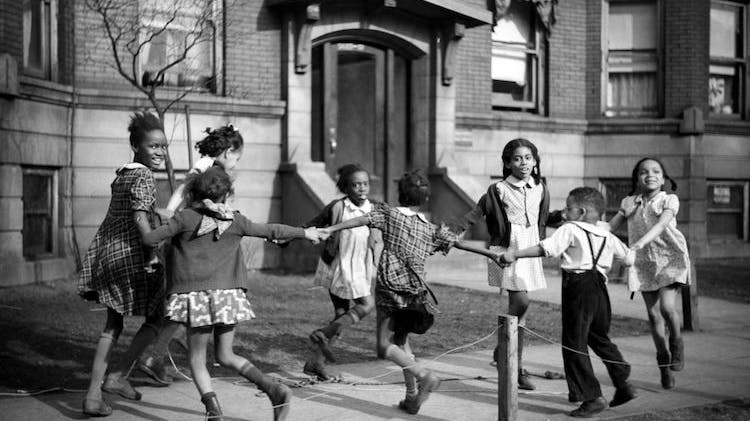
Striking Black and White Photos Capture the Black Experience in 1940s South Side Chicago
Edwin Rosskam, Library of Congress
Read text
Lesson Sequence
Think-Pair-Share
Directions: First, take a moment to think quietly about the following prompt and to write down some initial ideas. Then turn to your partner and share one observation each. Make sure your idea is based on what a photograph can actually show (an observation), not just on a guess (an inference). Once Partner A has shared their observation, Partner B will share.
What can a photograph teach us about a community that a list of facts might miss?
How to Analyze an Image
Directions: Edwin Rosskam spent three weeks in 1941 documenting daily life on the South Side of Chicago during the Great Migration. Let’s look at this image together, and practice distinguishing between what we can see and what we think it might mean.
What is one thing you notice first in this image?
What makes you say that?
What question does this image raise for you?
What can this photograph show us, and what can it not tell us?
Group Accountability Share
Directions: Each of you will receive one photograph from Rosskam’s South Side Chicago collection. First, look at your photograph silently and use your Notice, Wonder, Connect organizer as you study it. In the Notice section, describe only what you can point to (observations). In the Wonder section, write questions the image raises. In the Connect section, note one idea about daily life, community, or opportunity that this image might help us explore. Then meet with classmates who studied the same image to build a stronger group explanation using evidence from the photograph. Choose one speaker to present for your group, but everyone should be ready to elaborate if needed.
What is one specific detail in your photograph that you can point to exactly?
What might that detail suggest about the moment in the photograph?
Directions: Now meet with classmates who studied the same image. As a group, decide on one strong claim about what is happening, two details that support that claim, and one question the image raises.
What’s going on in this picture?
What makes you say that?
What else do you see?
What details in this image show routine, care, work, style, or community?
What in the image makes you think something may have happened right before or right after this moment?
Whole Class Discussion
Directions: As each group presents, listen for one new detail or one new question that helps you understand the image more clearly.
Which group helped you see its photograph more clearly, and what detail made their explanation stronger?
After hearing several groups, what patterns do you notice across the full set of images?
Reflection |
|---|
Reflect on your ability to analyze images and develop evidence-based claims using the Reflection routine. |
Quick Write
Directions: Choose the image that interests you most. It can be your own image or one another group presented. Write a 4-6 sentence response that clearly describes the image and answers the following prompt:
Which image interests you the most, and why? Explain what draws you to the image using at least two specific visual details, and end with one genuine question about the people, place, or moment. Then add one final sentence explaining what helped you move from inference to observation today.