Loading...
Spark
Lesson 2: Artisans in Tree-ear's World
California CCSS: Focus Standards
California CCSS: Supporting Standards
ELD Standards
In this lesson
Today you will
Watch a video and explore a photo gallery of Goryeo celadon pottery to help visualize what makes Tree-ear curious.
Describe and interpret skilled actions shown in visual media using action verbs, expanded noun phrases, and interpretive phrases (e.g., this shows . . . , this requires . . .) to explain how curiosity connects to craft and tradition.
Essential Questions
What does it take to learn something difficult?
How does art connect people to their history and community?
Texts used in this lesson
Novel
A Single Shard
Linda Sue Park
Short-Form Text
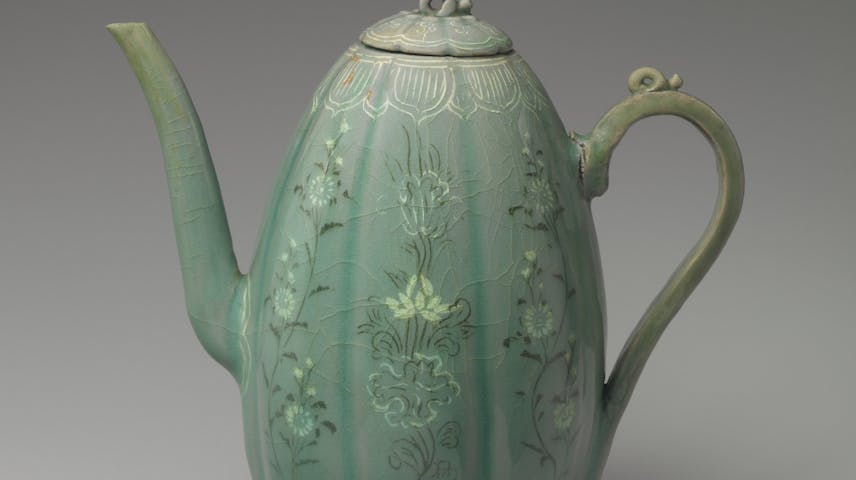
Korean Ceramics of the Goryeo Period
Standard News Bureau
Read text
Lesson Sequence
Turn and Talk
Directions: Use the Turn and Talk routine to discuss your definitions and examples of curiosity recorded in your Reflection Journal for your Lesson 1 homework assignment.
Discuss these questions as a class.
What are some characteristics of curious people?
What piques your curiosity?
How can we combine our responses into a single definition of curiosity?
Consider the words tradition and celadon. As a class, discuss their meanings by connecting them to what you are learning in this unit.
Tradition: the beliefs and customs of a culture that are handed down from one generation to the next
Celadon: a type of pottery known for its smooth surface and pale green glaze
Part A: Introducing Korean Pottery
As you watch “Korean Pottery: A Story of a Thousand Years,” take notes about what you notice, think, and wonder about the materials, shapes, tools, and how the potters work.
Directions: Record your observations about the pottery video using the I See, I Think, I Wonder graphic organizer.
Turn and Talk
Use the Turn and Talk routine to discuss the prompt:
Based on the video, why might Tree-ear be curious about making pottery?
Pulse Check |
|---|
How do the video and the three informational texts from the previous lesson together deepen your understanding of the importance of pottery in Korea during the Goryeo period?
|
Part B: Examining Goryeo Pottery
Graffiti / Table Talk
Directions: In small groups, look closely at the images in the article “Korean Ceramics of the Goryeo Period”. As you examine each image, think about the shapes, designs, and colors you see. As a group, respond to the following prompts by writing your ideas on the shared chart or digital board:
What did you notice about the Goryeo pottery from the images?
After you share your ideas on the board, summarize the patterns you notice with your group, then share your responses with the class.
What patterns do you see in the responses? What stands out and why?
What new ideas resulted from viewing your classmates' observations?
Class Discussion
Respond to these questions.
Based on the images and video, what makes Goryeo celadon pottery unique?
What evidence from the visuals reveals the skill, effort, and tradition behind this art form?
How might the video and images connect to the story, A Single Shard?
Reflection |
|---|
How confident do you feel identifying and summarizing patterns using the Graffiti / Table Talk protocol? Choose a number between 1 and 5, with 1 being the least confident and 5 being the most confident, to rate your confidence level. Then write a few sentences that show how you go about identifying and summarizing patterns using the Graffiti / Table Talk protocol. |
Quick Write
Write your responses to the prompts below:
How do the articles, visuals, and video together help you develop a clearer understanding of the significance of celadon pottery in Korea during the Goryeo period? What do these sources make you curious about as you begin A Single Shard, especially about Tree-ear’s life and community?