Loading...
Reading
Lesson 5: Seen and Unseen, Part 1
California CCSS: Focus Standards
California CCSS: Supporting Standards
ELD Standards
In this lesson
Today you will
Identify roots and analyze how known roots combine to create words with inferable meanings.
Read an illustrated nonfiction description of the events leading to Japanese American incarceration and discuss how the author and illustrator offer a specific perspective on these events.
Summarize key events and explain their impact by using sequencing language, academic explanation verbs, and time/place phrases, while referencing both text and illustrations.
Essential Question
How do historical records (texts, images, and testimony) shape what is remembered about the past?
Texts used in this lesson
Novel
Seen and Unseen
Elizabeth Partridge & Lauren Tamaki
Short-Form Text
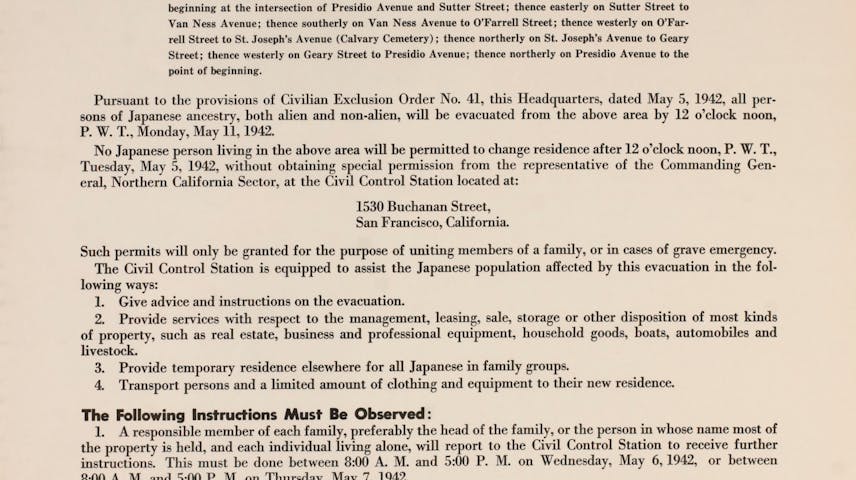
Instructions to All Persons of Japanese Ancestry and Glossary of Terms
National Parks Service
Read text
Lesson Sequence
Turn and Talk
Directions: Take out your copy of Seen and Unseen with your annotations. Turn and talk with a partner about the question to prepare for reading. As you discuss, jot down notes.
What have you learned so far about the policies and events that led to the incarceration of Japanese Americans? What questions do you have as we begin reading Seen and Unseen?
Morphology & Vocabulary
Target Word: contraband
Directions: We’re learning about the word contraband today. Take out your Key Terms and Topics graphic organizer as we explore the word more deeply. This word will be important for understanding Japanese Americans’ experiences and status in the United States during incarceration.
Have you seen this word before? Where?
What does it mean to ban something?
Identify Affixes:
Have you seen other words that begin with contra- before? What do they mean?
Determine Meaning:
Using what we know about contra-/band, what do you think contraband means?
Check for Understanding |
|---|
List the word contraband in your Personal Dictionaries and then underline each root and circle each prefix and suffix. After each word, write the definition of that word and each focus morpheme. |
Part A: Identify Purpose
Turn and Talk
Directions: Take a moment to look at the different locations marked on the map from the inside cover of your book, Seen and Unseen. These are the places where Japanese Americans were imprisoned during World War II.
As a class, begin creating a timeline using the Timeline graphic organizer to plot four key events you will learn about. Then, begin reading Seen and Unseen from “Early in the morning . . .” on p. 1 to “. . . declared war on Japan” on p. 5. As you read, use the Turn and Talk routine to summarize events and locations—who is involved, where the events are taking place, and what is happening and connect your thinking to what you have already learned about Japanese American identity and public perception.
Pearl Harbor attack (Dec. 1941)
Executive Order 9066 (Feb. 1942)
Forced removal (1942–1945)
End of incarceration/camp closures (1945)
Respond to questions that will help you put these background pages in context and deepen your understanding. Record your responses on a collaborative idea board.
Ask: Look at pages 1–5. What colors does the illustrator use? Where do you see them, and what feeling does the illustrator create?
What opinion do you think the author and illustrator want to convey about Japanese American incarceration? How do you know?
How does the author’s perspective on these events differ from the perspective of the U.S. government at the time?
Pulse Check |
|---|
Which statement BEST explains the author’s perspective on Japanese American incarceration in Seen and Unseen?
|
Part B: Compare Media
Turn and Talk
Directions: Stay with your partner and read pp. 6–7 of Seen and Unseen together. As you read, think about whether you recognize the photo from Spark Lesson 2 and answer the following questions.
The “I Am an American” photograph is a real historical photograph, while the surrounding images are Tamaki’s illustrations. Why do you think Partridge and Tamaki chose to place an actual photograph here rather than another illustration? What does the photograph do that an illustration couldn’t?
The text on page 7 describes fear and rumors spreading. The photograph on pages 6–7 shows a sign reading “I Am an American.” What is the relationship between those two things — the text’s account of fear and the image of that sign? Does the photograph confirm the text, complicate it, or add something new?
How might public perception, fear, or bias influence these experiences?
Reflection |
|---|
Reflect on your ability to compare how text and images present the same events and explain how they work together to shape your understanding using the Reflection routine.
|
Quick Write
Directions: Choose one choice the author or illustrator made in pages 1–7 — a color, a layout decision, a sentence that stands alone, or a choice about what to show or hide. In two or three sentences, explain what that choice does to a reader that a different choice would not have done.