Loading...
Spark
Lesson 2: Jim Crow Laws: A Dark Chapter in American History
California CCSS: Focus Standards
California CCSS: Supporting Standards
ELD Standards
In this lesson
Today you will
Analyze how text features organize ideas in an informational text.
Explain inequity using causal and contrastive language in discussion and a short paragraph.
Use context clues to determine the meaning of domain-specific words in an informational text.
Essential Questions
How do curiosity, evidence, and collaboration lead to discovery?
How can research help us uncover lesser-known contributions and tell a more complete story?
Texts used in this lesson
Short-Form Text
Jim Crow Laws: A Dark Chapter in American History
Library of Congress, adapted by Newsela
Read text
Lesson Sequence
Think-Pair-Share
In Lesson 1, we learned that NASA needed mathematicians, engineers, and other experts during the Space Race. Today, we examine a harder truth: unfair Jim Crow laws shaped who could access those opportunities. These laws enforced segregation and treated Black Americans as second-class citizens, denying them equal rights and opportunities. Understanding these barriers helps us make hidden stories visible and recognize why many talented people were excluded.
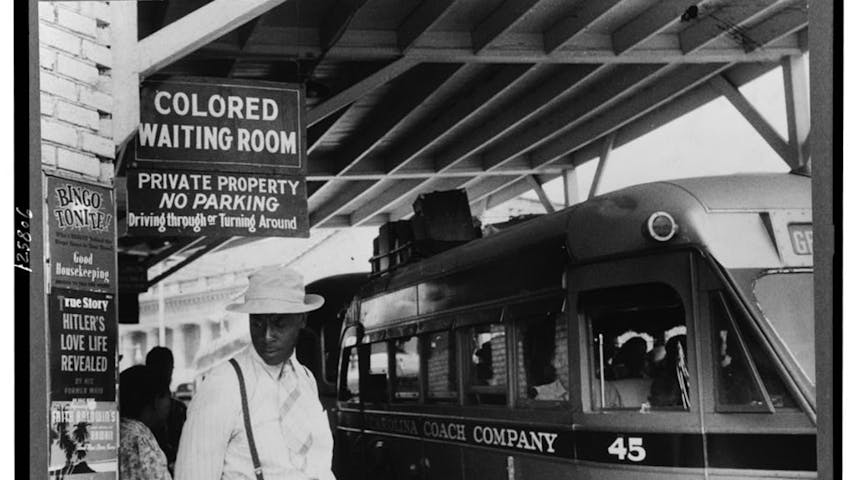
Directions: Take a few silent moments to observe the image and skim the article before discussing the questions with a partner.
What details do you notice in this image, and how might rules like these affect who gets opportunities to learn, work, or use public spaces?
If a country says it needs the best problem-solvers but its laws treat some people unfairly, what problem does that create?
Part A: Explore How the Article Is Organized
Directions: We will study how the article’s structure conveys information about how Jim Crow laws created barriers to opportunity. As you read, pause to notice the structure and organization of the text. In the 3-column chart, record each type of text feature you come across in the article, your observations and the purpose it serves. Then answer the questions below.
What text feature first grabbed your attention, and what did it help you predict or understand?
How does one heading or section in the article help organize the information for readers?
What context clues in the article help you understand a word like segregation or discrimination?
Based on the article, how could Jim Crow laws limit the opportunities of Black women who wanted to work in math, engineering, or science?
Pulse Check |
|---|
Which statement best explains how the article’s text features help develop its ideas? A. They mostly make the article longer by adding extra information that is not important. B. They help to group ideas, signal importance, and help readers follow how the topic develops. C. They mainly entertain the reader with dramatic details instead of teaching information. D. They prove that every reader must agree with the author’s opinion. |
Part B: Explain Barriers to Opportunity
Structured Discussion
Directions: You explored several text features in the article such as the title, headings, bold words, images and captions. Now, we will look more closely at how the author organized information and how those choices help readers understand the topic.
In the Structure column of your graphic organizer, record a specific structure the author uses. This could be:
a heading
a section of text
a paragraph
a bold vocabulary word
an image or caption
In the Purpose column, explain why the author included that structure and how it helps readers understand the history of Jim Crow.
Which structure in the article helped you understand the topic most clearly?
How do headings and sections help organize the information in this article?
How does a photograph or caption contribute to the article’s message?
Reflection |
|---|
Reflect on your understanding of text features using the Reflection routine.
|
Quick Write
Directions: In three to four sentences, explain how the article’s structure and text features helped you understand the barriers created by Jim Crow laws. Use key details and specific examples from the article to support your response.