Through Her Grief, an Indian American Photographer Rediscovers Her Heritage
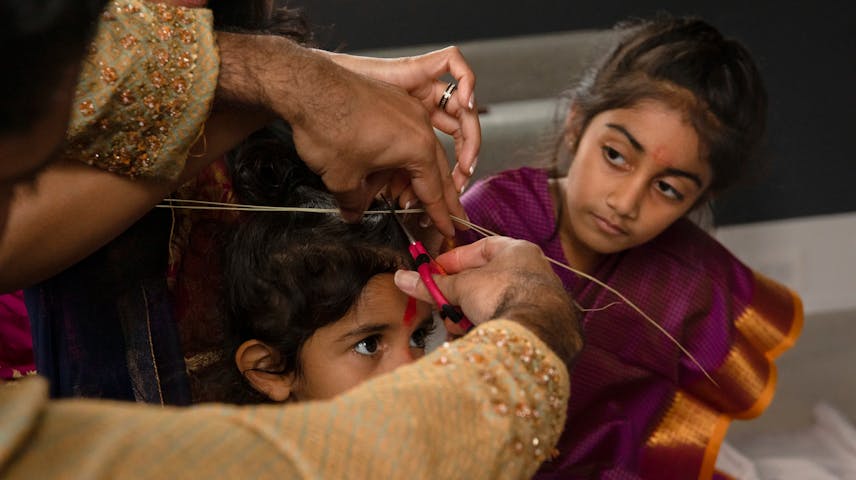
Fig. 1. Kayla Patil, 7, watches her 3-year-old brother Eshaan’s haircutting ceremony. In a traditional Hindu mundan ceremony, a priest cuts a child’s first hairs off to symbolize letting go of their past life. Photo by: Maansi Srivastava
By
Maansi Srivastava, NPR
Text Type
Photo Essay
Words
570
Lexile
1100L
Published
05/09/2023
I developed this photo essay, “Roots Hanging from the Banyan Tree,” over the past three years. Photography became my therapy as I grappled with loss, grief and racial reckoning over the course of the pandemic. Searching for my identity as an Indian American woman became intertwined with the struggle to ground myself after losing my grandmother to COVID-19.
After her passing, my understanding of life and death shifted. In conversations with my mother, I learned that we both felt a sudden severance of our roots. In my grief, I grasped for memories of a simpler time. I connected with the Patil family, hoping to find a semblance of my childhood in their homes. Through documenting their daily lives, recollections of cultural rituals from my childhood began to flood back in. I also found that I was not alone in my experiences and fears of losing my connection with my heritage.
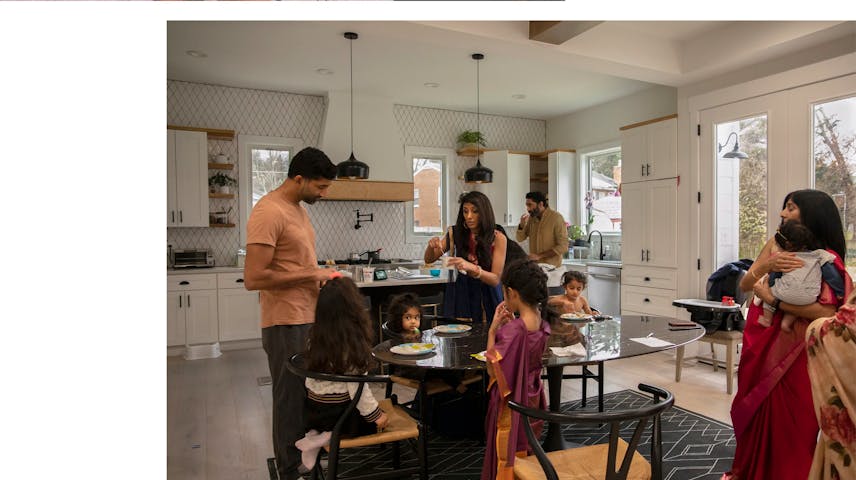
Fig. 2b. Three generations of the Patil family gather for a meal after Eshaan's haircutting ceremony. Photo by: Maansi Srivastava
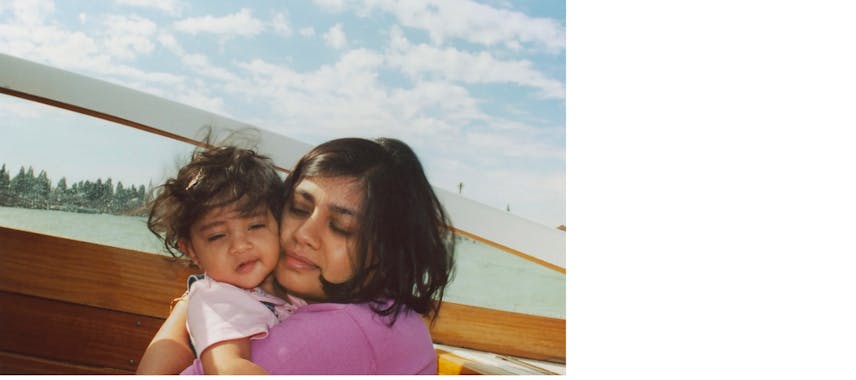
These images represent my experiences growing up between two cultures while navigating girlhood and early adulthood. I saw myself in the Patil family’s young children. While looking back through my old family albums, I found that our shared rituals and experiences were nearly identical. I suddenly felt less isolated in my experience as an Indian American and as a third-culture woman.
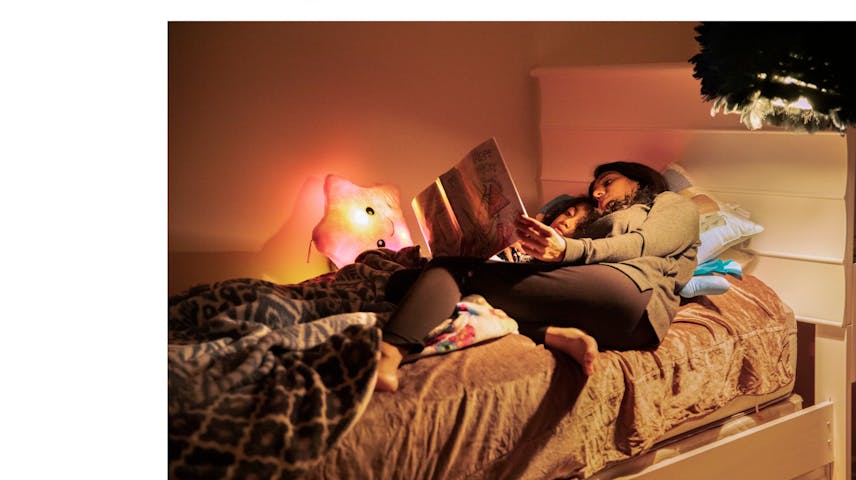
Fig. 3b. Tina Patil holds her daughter, Kayla, while reading her a bedtime story. Photo by: Maansi Srivastava
In their home, I was able to revisit memories as a young adult and recognize the beautiful aspects of the Indian American experience. What began as my thesis work grew into a labor of love that has shown me that my roots and cultural connection have been with me all along. As children of a diaspora, our cultural roots continue to grow and spread, but the soil is ours—we flourish where we are planted.
Maansi Srivastava (she/they) is an Indian American documentary photographer and photo editor focusing on widespread social issues through a lens of family and community. She previously worked at the Washington Post and NPR. Shortly after publication, she began a yearlong photography fellowship at the New York Times.
Display and invite students to take out their Lesson 34 draft and the poem and image they used as evidence.
Say: In the previous lesson, we matched a photograph and a poem to answer the unit question about culture and belonging. Today, we are making that writing stronger by checking whether our claim really answers the question and whether our evidence is specific and clearly explained. This matters because the final performance task asks students to write insightful literary analysis, not just collect interesting details. As you revise today, check: Does your claim show a clear idea about identity? Or does it also show something more complex, like tension, change, or multiple perspectives?
Think-Pair-Share
Keep students with the same partners they worked with in the previous lesson so they can build from their earlier cross-text thinking.
Say these Directions: Stay with the same partner from the previous lesson so you can build on your earlier cross-text thinking.
Take 20 seconds to reread your draft silently and find a place that seems effective and a place that needs some improvement. Then turn to your partner and share both parts. Partner A shares first for 30 seconds, then Partner B.
Prompt students to review their drafts and respond in writing to the question:
Ask: Which part of your draft best responds to the essential question, and which part still needs more explanation?
The strongest part of my draft is my sentence about how the image shows heritage through clothing and pose because it starts to answer the question about identity. The unfinished part is my ending because right now it mostly repeats my evidence instead of explaining how belonging is shaped.
Connection to Today's Learning:
Now that students have named a strength and an area to improve, they are ready to learn a quick way to test whether a sentence is truly making a claim. Today we are going to strengthen our writing in three ways: make our claim clear and arguable, make our evidence specific, and explain what our evidence shows.
Explain that writers do not improve a draft by changing random words. Strong revision starts by checking whether the paragraph actually answers the question, then explaining the evidence in a way that connects back to the claim.
Language Study
Say these Directions: Review the claim with a partner.
“The photo and the poem both show identity and belonging. The photo shows cultural clothing and the poem talks about how much people care about each other. Identity and belonging are very important and both the image and the poem convey these ideas.”
Say: Evaluate the claim using the questions to guide your partner discussion.
Is there a clear claim that responds to the essential question?
Are there specific details included from both the image and the poem?
Did I explain how the two pieces of evidence work together to support the claim?
After analyzing the example paragraph, work with your partner to revise the paragraph. Be sure that your revised paragraph has a clear claim, details or evidence from both the poem and image, and an explanation that connects the details or evidence to the claim.
Prompt students to review their drafts and respond in writing to the question:
Review your draft and consider the questions. Mark the claim, details and explanation.
Does your draft:
Include a clear claim that responds to the essential question?
Underline the claim
Include specific details included from both the image and the poem?
Put a star next to each detail.
Include an explanation of how the evidence works together to support the claim?
Circle the explanation.
Teach: Precision and Concision: Two-Pass Revision
Say: I’m looking at the sentence "The photo and the poem both show identity and belonging," and I notice that it sounds true, but it is still too general. It names big ideas, but it does not yet answer what the texts suggest about culture or belonging.
Say: I want to revise it into a claim that is stronger, so I might say, “The photo and the poem suggest that cultural connection helps a person hold on to belonging during grief.”
Say: That version is stronger because it answers the question and gives me something specific to prove. A strong claim doesn’t just name a topic; it takes a stand. Now I check my evidence: if I just write "The photo shows culture," that is vague, so I need to name what is actually visible in the image. When I bring in the poem line "Because you are here, I must stay," I should not drop it and move on; I need to explain that the line shows belonging as a force that keeps the speaker connected and grounded.
Ask: Is the sentence “The photo shows culture” a claim or a description? How would you revise it to be more precise?
Ask: What makes the revised claim stronger than the first sentence?
The revised claim is stronger because it does more than list topics. It actually answers the essential question by saying that cultural connection can help someone keep a sense of belonging during grief.
Say: When you sharpen your claim and revise your sentences, you are practicing two related but distinct skills: precision and concision. Both are part of L.7.3.a — choosing language that expresses ideas precisely and concisely. Use these two passes on every claim and explanation sentence you revise today.
Display the following explanation of the two passes:
Pass 1 — PRECISION: Replace vague nouns and verbs with precise ones. Ask: what exact word names this idea? Examples: things → cultural traditions; shows → reveals; the photo → the photograph of the author’s mother applying tika.
Pass 2 — CONCISION: Cut wordy phrases and redundancy. Ask: can I say this in fewer words without losing meaning? Examples: in order to → to; due to the fact that → because. Also check for redundancy — if two adjacent sentences say the same idea, cut one or combine them.
Ask: Why is the sentence "The photo shows culture" too general for literary analysis?
It is too general because it does not tell the reader what is in the image. A stronger sentence would name the clothing, pose, expression, or another focal detail and explain how that detail connects to identity.
🎯PURPOSE
Support students in distinguishing between general description and precise analytical language.
Language Focus:
Claim language
Precise nouns and adjectives
Explanation frames using because, which shows, and this suggests
Before Activity (preparation step—optional)
Invite students to orally complete the frame “This claim is stronger because ___” before sharing aloud.
🗣️SAY / ASK
Model the difference between a topic word like identity and an analytical idea like “cultural connection shapes belonging.”
Draw attention to the language move “which shows” as a bridge from evidence to explanation.
You said "It says more"—we can explain that by saying "It more directly answers the essential question."
That idea connects to precise evidence because a reader needs to know exactly which image detail or poem phrase supports the claim.
This claim is stronger because it argues that ___.
The image detail that matters most is ___.
The quote ___ shows ___ because ___.
Encourage students to connect the word culture to examples from their own lives and communities so the abstract term becomes more concrete during revision.
👁️WATCH FOR / SUPPORT IF NEEDED
If students keep repeating topic words without making a claim → Prompt: "What is the writer saying about identity or belonging, not just naming?"
If students quote the poem but stop there → Prompt: "Finish the thought with 'which shows' or 'this suggests.'"
Students can explain why one sentence is a claim and another is only a topic statement.
Students begin using precise evidence language instead of broad generalities.
Teacher Feedback Look-Fors
Activity: Claim Test
Instruction: Circulate as students point to one sentence in their draft and test it against the two revision questions. Listen and look for the following:
Target 1 (W.7.5): The student can identify one sentence as the current claim or recognize that the draft needs a new claim.
Target 2 (L.7.3.a): The student can explain why a sentence is too general and name a more precise revision.
Target 3 (Language Use): The student uses language such as “answers the question,” “specific detail,” “embed the quote,” or “explain the effect.”
Connection to Today's Learning:
Students will now test their own claim sentences and use partner feedback to decide what needs revision first. Strong writers don’t just add more—they make their thinking clearer, more specific, and more precise.
Situation
Try this
Struggling with: Identifying a Claim
Have students cover the rest of the paragraph and read only the underlined sentence aloud. Then ask, “Does this sentence answer the question by itself?” If not, help them revise using the frame “The photo and poem suggest that ___.” Moving from Vague to Specific Evidence: Invite students to point directly to one visible detail in the image and say it aloud before writing it into the sentence.
Ready for extension
Challenge students to revise a claim so it includes a qualifying word such as often, sometimes, or especially to make the idea more nuanced. Invite students to strengthen one explanation sentence by adding a second layer of commentary about why the evidence matters in the whole unit theme of blood, culture, and belonging. Allow students to provide an oral recording of their revised claim and commentary or use speech-to-text tools before copying the revision into their draft.
Part A: Claim Check and Partner Feedback (W.7.5) (12 minutes)
Students remain in pairs with drafts, poem, and image visible.
Iterative Conversation Exchange
Say these Directions: Underline the sentence in your draft that most directly answers the essential question. If you cannot find one sentence that does that, make that your first revision step. Then share your underlined sentence with your partner. Your partner will say one of two things: “This answers the question because ___” or “This mostly describes the texts because ___.” After you get feedback, revise the sentence immediately before switching roles. Partner A begins. As you listen, check: Does the sentence answer the essential question, and does it make a clear, arguable claim?
Encourage partners to point to the exact words in the claim that make it descriptive or analytical.
Ask: Does your partner’s underlined sentence answer the question, or does it mostly describe the texts?
This mostly describes the texts because it says the photo and poem both show culture, but it does not yet explain what they suggest about belonging. A stronger claim would say that the two texts show how heritage can make someone feel more connected during grief.
Ask: What one revision would make the claim clearer, more specific, and more arguable?
I would revise the claim by adding what the writer thinks the two texts reveal. For example, instead of saying they both show identity, I would say they suggest that cultural traditions help people hold on to identity when life feels uncertain.
🎯PURPOSE
Support students in giving concise, evidence-based peer feedback about whether a claim answers the essential question.
Language Focus:
Evaluative language
Feedback stems
Cause-and-effect language for explaining why a revision is needed
Before Activity (preparation step—optional)
Have pairs rehearse one feedback sentence aloud before beginning the exchange.
🗣️SAY / ASK
Remind students that helpful feedback names one strength or one need, not many unrelated comments at once.
Encourage partners to point to exact words in the claim that make it descriptive or analytical.
You said "This is kind of broad"—we can say "This claim is too broad to fully answer the essential question."
You said "Add more"—we can make that useful by saying "Add what the texts suggest about belonging."
This sentence answers the question because ___.
This sentence is mostly descriptive because ___.
One clear revision would be to ___.
Invite students to test their claim idea in everyday language first and then reshape it into academic language with a partner.
👁️WATCH FOR / SUPPORT IF NEEDED
If students give praise only and avoid revision language → Prompt: "What is one specific change that would make the sentence stronger?"
If students confuse a topic with a claim → Prompt: "Can someone disagree with this sentence? If not, it may still be too general."
Students use feedback stems to explain whether a claim answers the question.
Students revise immediately based on peer feedback rather than leaving comments unaddressed.
Pulse Check (W.7.5)
Which revised claim best answers the essential question instead of only describing the texts?
The photo and poem are both about identity and culture.
Incorrect: This choice names the topic, but it stays too broad and descriptive. It does not make a clear claim about what the texts reveal.
The writer uses a photo and a poem to show different details.
Incorrect: This choice points out a text difference, but it avoids the deeper idea about belonging and identity that the paragraph needs to answer.
The photo and poem suggest that cultural connection can help a person feel less alone during grief.
Correct: This choice makes an arguable claim that answers the essential question and gives the writer a clear idea to prove with evidence.
The photo has important details, and the poem has an important quote.
Incorrect: This choice previews evidence, but it does not explain the meaning of that evidence or answer the essential question.
Provide students with a confidence continuum (i.e., 1–5). As needed, model how to demonstrate a level of confidence using the continuum.
Reflection (W.7.5)
Reflect on your ability to revise your claim using feedback with the Reflection routine.
How confident are you in your ability to revise your claim so that it clearly answers the essential question and is specific and arguable?
Connection to Today's Learning:
Once the claim is doing its job, students are ready to strengthen the evidence that supports it.
Situation
Try this
Struggling with: Turning a Topic into a Claim
Give the frame “The photo and poem suggest that ___,” and then have students add an idea about identity, belonging, or culture. Peer Feedback Language: Let partners choose from two prepared stems and practice orally before giving feedback.
Ready for extension
Invite students to revise their claim twice and decide which version is more nuanced. Challenge students to make the claim more precise by naming the exact kind of connection they see, such as family memory, cultural tradition, or emotional belonging. Allow students to record their claim aloud first or use speech-to-text before writing the final revision.
Part B: Specificity, Embedded Evidence, and Final Revision (L.7.3.a, W.7.5) (18 minutes)
Guide students through focused revision by strengthening specificity, embedding evidence, and refining sentence clarity.
Revision Sprint
Say these Directions: You are going to revise your writing to make your ideas clearer and stronger. Effective writers revise by improving specificity, embedding evidence, and sentence clarity, not by adding more ideas right away.
Focus on revising your existing sentences. Do not add new ideas yet. Instead, look closely at what you already wrote and make it more precise, clearer, and more developed by strengthening your evidence and explanations.
Display the following writing model if needed for support and guidance:
Writing Model:
Culture shapes identity and belonging because the way a person is raised—including their language, traditions, and family values—is part of who they are and how they see the world. The photograph of the author’s mother holding her shows one way that culture can be seen. The poem “Bindi” explores when Amma was asked to remove her bindi at work. These details complement one another because the photograph shows a visual representation of culture, while the poem adds another layer about the feeling of living between two cultures. Together, they show that culture can be a source of pride and connection, but it can also make belonging feel complicated.
Ask: What makes this paragraph effective?
The writer uses precise nouns and verbs instead of vague ones. They say "the photograph of the author's mother holding her" instead of just "the photo," so the reader knows exactly which image. Strong verbs like shapes, explores, and complement name exactly what's happening. The word complement tells us the photograph and poem complete each other, not just that they "go together."
Teach: Two Editing Moves for Stronger Analysis
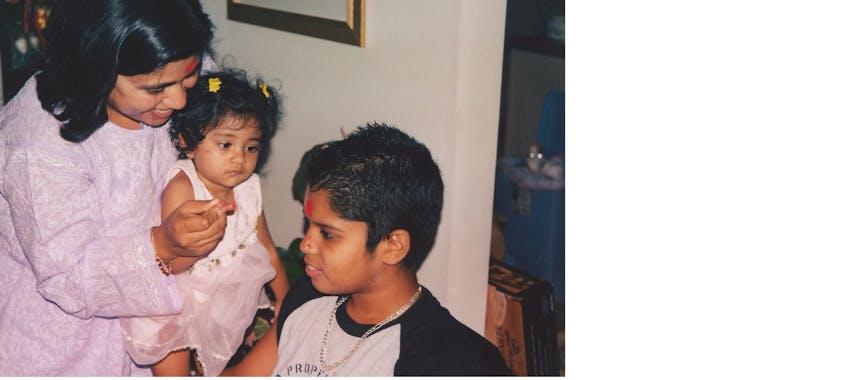
Say: I’m reading this anonymous draft sentence, and right away, I see two places to revise. First, the photo evidence is too general, so I want to ask, “What exactly is in the image that helps the reader see culture or identity?” I can revise that to name a focal detail, like clothing, expression, objects, or composition. I can build that sentence to say: “The photograph of the author’s mother holding her up so she can place tika on her cousin's head shows one way that culture can be seen on the outside.” Second, the poem detail is dropped in and left alone, so I need to build it into my sentence and explain it: “The poem ‘Bindi’ explores Amma’s sadness when she was asked to remove her bindi at work, as if she had to hide part of herself. ” After that, I do one more read for sentence boundaries, punctuation, and word choice so the paragraph sounds clear and finished. Strong writers revise by making details visible and explaining what those details mean.
Say: Keep your revised claim from the previous step, and now strengthen the evidence and explanation that supports it. Focus on revising existing sentences, not adding new ones.
Now you will revise your own paragraph in three passes.
First, revise one sentence so your evidence from the photograph names an exact focal detail instead of general description.
Second, revise one sentence so your poem evidence is embedded and explained.
Third, read the whole paragraph once for punctuation around quotations, sentence boundaries, and precise word choice. After your own revision, exchange drafts for one final partner read.
🎯PURPOSE
Support students in revising analytical writing so evidence is specific, integrated, and stylistically clear.
Language Focus:
Precise descriptive language
Embedded quotation structures
Explanation language using “which shows,” “this matters because,” and “together”
Before Activity (preparation step—optional)
Ask students to star one image sentence and one poem sentence before revising so they know exactly where to work.
🗣️SAY / ASK
During conferences, prompt students to replace broad words like thing, nice, or culture with visible, text-based details.
When students edit quotations, coach them to read the whole sentence aloud to hear where punctuation and explanation belong.
You said "The picture has stuff around her"—we can say "The composition includes visible objects around the subject that connect to heritage."
You said "The quote means belonging"—we can make that stronger by saying "The line suggests that connection becomes a reason to stay."
The focal detail that matters most is ___ because ___.
LaRocca writes ___, which shows ___.
This matters because ___.
Encourage students to talk through the image in everyday language first, including in a shared home language if helpful, and then revise that oral noticing into precise academic writing.
👁️WATCH FOR / SUPPORT IF NEEDED
If students keep adding new evidence instead of revising existing sentences → Prompt: "Choose one sentence to strengthen first; make one detail clearer before adding more."
If students punctuate quotations incorrectly or create fragments → Prompt: "Read the sentence aloud from the beginning. Where does your own sentence end, and where does the quoted language fit inside it?"
Students replace vague image references with specific focal details from the selected photograph.
Students embed a poem quote into a full sentence and add commentary that explains its significance.
Say: As you revise, check your work for these things:
Did I state a claim?
Did I name a real detail from the image?
Did I embed and explain my poem quote? Is the quotation punctuated correctly?
Did I fix punctuation, sentence boundaries, and word choice before I hand it to my partner?
Do a final read of your paragraph and check: Is your quotation punctuated correctly?
Are my sentences complete and clearly written?
Did I replace any vague words with more precise language?
Writing prompt: Revise a literary analysis paragraph to strengthen the claim about symbolism, sharpen image-based evidence, and embed and explain poem evidence to deepen analysis. Then edit for precise word choice, sentence boundaries, and punctuation around quotations.
Criteria
1 — Beginning
2 — Developing
3 — Proficient
Thesis & Claim Clarity
(W.7.2.a)
Claim That Stays Visible
Revision does not strengthen the claim. The claim remains vague or gets lost in the evidence.
The claim is revised to be clearer, but it still disappears in body sentences or does not connect forward to the evidence.
Revision strengthens the claim so that it is specific and arguable, and remains visible throughout the paragraph. Each sentence in the revised paragraph connects back to the claim.
Evidence & Commentary
(W.7.2.b)
Embed Evidence + Explain
Evidence is still dropped in without signal phrases or commentary in the revised paragraph.
Evidence is embedded with signal phrases in the revision, but commentary is brief or paraphrases the line rather than explaining what the image or symbol reveals.
Evidence is embedded with a signal phrase and followed by commentary that explains what the imagery or symbolism reveals — not just what the line says. The commentary connects evidence to the claim using precise analytical language.
Misplaced Modifiers & Sentence Clarity
(L.7.3.a)
Modifier Placement for Precision
Misplaced or dangling modifiers remain in the revised paragraph, creating sentences that are confusing or ambiguous.
Most modifiers are correctly placed in the revision, but one sentence is still awkward or unclear.
All modifiers are correctly placed in the revised paragraph. Sentence boundaries are clear, and punctuation around quotations follows conventions. The revision demonstrates precise, unambiguous prose.
Checklist (W.7.5, L.7.3.a)
As you revise, make sure you have:
Revised at least one existing claim, evidence, or explanation sentence.
Introduced each piece of evidence with a text landmark.
Named an exact focal detail from the image.
Embedded and explained at least one poem quote using explanation language.
Revised at least 2 vague words to precise ones.
Revised at least 2 wordy or redundant phrases, or cut one sentence that repeated an idea already stated.
Connection to Today's Learning:
Today, you revised your writing at three levels: claim, evidence, and sentence clarity. These moves help your ideas become more precise, more convincing, and easier for a reader to understand.
Situation
Try this
Struggling with: Making Image Evidence Specific Enough
Have students point to one area of the image and orally complete the frame “In the selected photo, I notice ___, which suggests ___” before writing. Embedding Poem Evidence: Give the frame “LaRocca writes ‘___,’ which shows ___” and have students plug in their own quote and explanation. Sentence-Level Editing: Ask students to read each sentence aloud softly and mark where their voice naturally stops to check for run-ons or fragments.
Ready for extension
Invite students to revise one sentence for style by varying sentence length or replacing a repeated word with stronger academic language. Challenge students to add one final sentence that links their paragraph back to the unit idea that identity is shaped by many kinds of connections. Allow students to give their final partner feedback orally, record it, or use speech-to-text to note revision ideas before rewriting.
Have students reflect on which revision move most improved their paragraph using specific examples.
Quick Write
Say these Directions: In 2–4 sentences, explain which revision move most improved your paragraph today. Cite two specific places from your draft in your response: one revised photograph detail and one revised poem quote or explanation.
Ask: Which revision move—strengthening your claim, making evidence more specific, or explaining your evidence—made your paragraph stronger, and how can you tell?
The biggest revision move for me was making my evidence more specific. I changed a general sentence about the photograph into one that named the subject’s clothing and pose, and I revised my poem evidence so the line "Because you are here, I must stay" was embedded and explained instead of just dropped in. Those two changes made my paragraph sound more like analysis and less like a list.
Optional Sentence Starter:
The revision move that helped my paragraph most was ___ because ___.
Say: These revision moves (strengthening your claim, making evidence precise, and explaining clearly) are the same moves you will use in your final literary analysis for the performance task.
Instruct students to review their draft one more time and be ready to display it. Students should come prepared to the next lesson with the following:
One question you still have about your own writing (something you were not sure about or want feedback on). Write it on a sticky note or a small slip of paper to post with your draft.