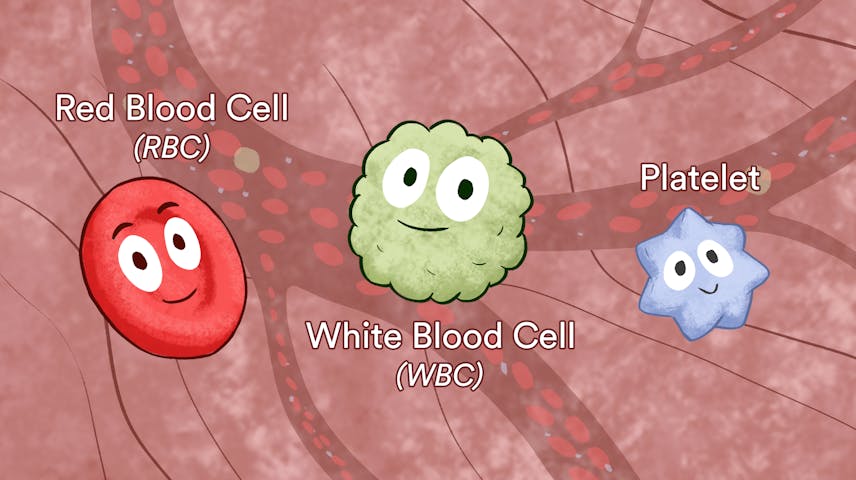
Fig. 1. There are three types of blood cells: red blood cells, white blood cells, and platelets. Photo by: Newsela staff
By
National Institutes of Health (NIH) and Centers for Disease Control (CDC), adapted by Newsela
Text Type
Informational Text
Words
880
Lexile
1030L
Published
05/11/2023
Your blood is made up of liquid and solids. The liquid part, called plasma, is made of water, salts and protein. Over half of your blood is plasma. The solid part of your blood contains red blood cells, white blood cells, and platelets.
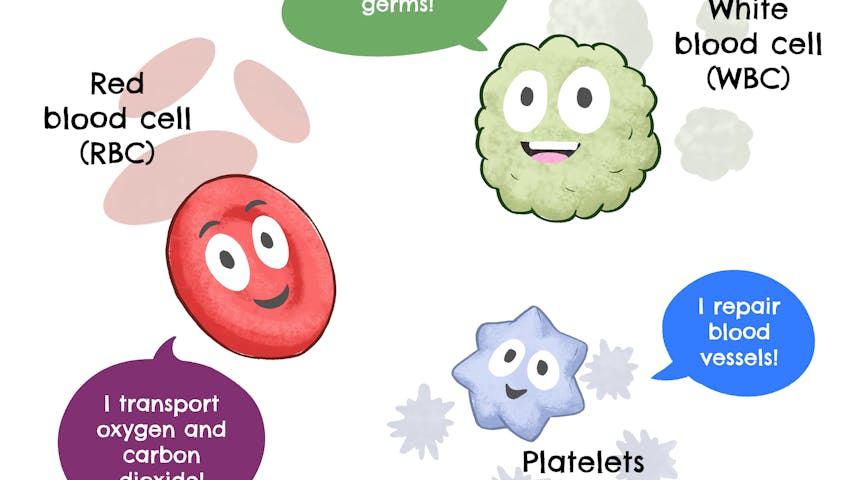
Red blood cells (RBC) deliver oxygen from your lungs to your tissues and organs. White blood cells (WBC) fight infection and are part of your immune system. Platelets help blood to clot when you have a cut or wound.
Fig. 2. There are three main types of blood cells and they are suspended in plasma: red blood cells for oxygen transport, white blood cells for immune defense and platelets for blood clotting. Photo by: Newsela staff
Bone marrow, the spongy material inside your bones, makes new blood cells. Blood cells constantly die and your body makes new ones. Red blood cells live about 120 days, and platelets live about six days. Some white blood cells live less than a day, but others live much longer.
How Does Blood Travel in the Body?
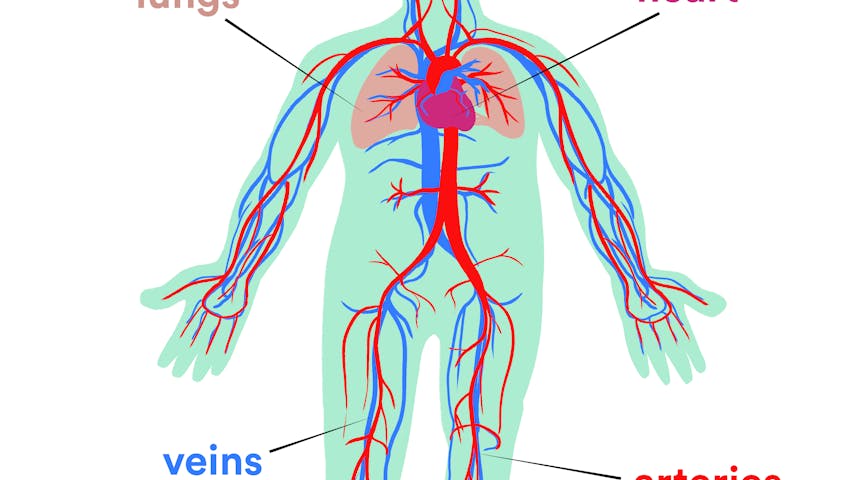
Fig. 3. Every time your heart beats, it pushes blood around your body. Arteries carry oxygen-filled blood away from your heart. Veins take oxygen-poor blood back to your heart and lungs. Photo by: Newsela staff
The heart is a large muscular organ which constantly pumps blood to all parts of the body. Arteries and veins go into and out of the heart. Arteries carry blood away from the heart and veins carry blood to the heart. The flow of blood through the vessels and chambers of the heart is controlled by valves.
Blood provides oxygen and nutrients to the body and removes carbon dioxide and waste. As blood travels through the body, the oxygen is used up. When the blood becomes oxygen-poor, it travels back to the heart and lungs to gain oxygen. So, basically, oxygen-rich blood enters the heart from the lungs and goes out to the body. Oxygen-poor blood enters the heart from the body and goes out to the lungs.
How Does Blood Travel in the Heart?
Blood comes into the right atrium from the body, moves into the right ventricle and is pushed into the pulmonary arteries in the lungs. After picking up oxygen, the blood travels back to the heart through the pulmonary veins into the left atrium, to the left ventricle and out to the body’s tissues through the aorta.
What Are Blood Types?
Blood is often grouped according to the ABO blood typing system. The four major blood types are:
A
B
AB
O
In addition, your blood is also either Rh-positive or Rh-negative. So, for example, if you have type A blood, it’s either A positive or A negative. Which type you are is important if you need a blood transfusion.
Therefore, because there are four main types and each one can be positive or negative, there are eight blood types in total:
A negative
A positive
B negative
B positive
O negative
O positive
AB negative
AB positive
Your blood type is based on whether or not certain proteins are on your red blood cells. These proteins are called antigens. Your blood type (or blood group) depends on what types of blood your parents passed down to you.
Blood typing is a way to tell what type of blood you have. Blood typing is done so you can safely donate your blood or receive a blood transfusion. It is also done to see if you have a substance called Rh factor on the surface of your red blood cells.
Blood tests such as blood count tests help doctors check for certain diseases and conditions. They also help check the function of your organs and show how well treatments are working. Problems with your blood may include bleeding disorders, excessive clotting (clotting helps your body control bleeding) and platelet disorders. If you lose too much blood, you may need a transfusion.
What Is the Importance of Blood?
Blood acts as the body’s main transportation system, keeping us alive by delivering essential oxygen and nutrients to every cell while carrying away waste products to be removed. It works around the clock to protect us by using white blood cells to fight infections and platelets to seal up cuts and wounds. Additionally, blood helps regulate our body temperature, ensuring we stay warm or cool off as needed. Without blood constantly circulating, our organs could not function, and we could not fight off sickness, making it absolutely crucial for maintaining a healthy, working body.
Today is a Flex Day, so students will pause and strengthen the reading moves that have helped them analyze blood, identity, and culture across the unit. This matters because the unit performance task asks students to choose strong evidence and explain how language and structure reveal a meaningful connection.
Say: Today is a Flex Day. Your self-assessment and your recent classwork will help me decide which small-group session you’ll join. Based on your self-assessment and your recent work, I'll be meeting with small groups for a quick skill session while others work independently. Let's start by rating your confidence.
Instruct students to reflect on their ability to do each of the following using the Reflection routine. Provide students with a confidence continuum (i.e., 1–5). As needed, model how to demonstrate a level of confidence using the continuum.
Reflection
RL.7.1 (Citing Text Evidence): "I can choose specific details from a text and explain how they support my thinking."
RL.7.4 (Understanding Connotative Words and Phrases): "I can explain how a word or phrase shapes meaning or tone."
RL.7.5 (Analyzing Text Structure): "I can explain how a writer’s line breaks, repetition, or organization affect meaning."
Connection to Today's Learning:
Say: Using your confidence ratings in addition to how you've demonstrated your understanding in recent work, you'll get individualized learning sessions so you get what you need today.
Collect a quick visual of ratings by having students hold up fingers or record their ratings on paper.
Explain the plan:
Three 10–15-minute teacher huddles:
Huddle 1: RL.7.1 (Citing Strong Text Evidence)
Huddle 2: RL.7.4 (Understanding Connotative Words and Phrases)
Huddle 3: RL.7.5 (Analyzing Text Structure)
Students not in a huddle work independently with a choice of independent reading or knowledge-building.
Then sort students using:
1. their Reflection responses, and
2. recent formative data from Quick Writes, annotations, 3-column charts, and paragraph writing.
Teacher Tip
Because Flex Days are meant to be responsive to your students' needs, you may find that you do not need to complete all three huddles suggested in this lesson, or you may find that there is a more appropriate target to focus on during this time. Feel free to focus this lesson on the skills or concepts your students need the most support with.
Flex Day huddles are meant to work best for both you and your students. In order to ensure that you can place these huddles anywhere within a unit, texts have not been selected for these huddles. You can use any text that your students are currently working with, or you can bring in outside texts that add to the knowledge-building for this unit.
Huddle 1 (RL.7.1) + Independent Choice Work (10–15 minutes total)
Explain that you are first going to pull students for additional work on RL.7.1 (Citing Text Evidence). Pull students who rated 1–3 on RL.7.1 and/or have shown difficulty with choosing relevant evidence and explaining how it supports an idea based on recent work. All other students begin independent work (see “Independent Choice Work” below).
Pull this group when students paraphrase ideas instead of selecting a precise piece of text, choose details that are related but not the strongest support, or give an explanation that does not clearly connect the evidence to their inference.
Independent Choice Work
Students not in responsive huddles choose one task and write a brief response.
Option 1: Independent Reading
How does choosing several pieces of text evidence help you understand your independent reading today? Cite one example.
Choosing the strongest evidence helps me focus on the most important part instead of focusing on every detail. In the text, the line “[quoted phrase]” shows [key inference or idea]. The line “[quoted phrase]” provides additional support for this inference by [explanation of how this illustrates idea or inference].
Option 2: Knowledge-Building
How does your reading today connect to the idea that people are shaped by biological, cultural, or emotional connections? Cite one example.
My reading connects to the unit because it shows that relationships can shape identity. One example is “[quoted phrase],” which shows a family connection affecting the character’s choices.
Huddle 1—Citing Text Evidence (RL.7.1)
Use any short passage from Red, White, and Whole or other teacher-selected unit text for this huddle. Students should have the text in front of them.
Reteach
Strong evidence includes the details that most directly support your idea, not just any interesting line.
Applying text evidence does two jobs: it cites specific details and explains how each detail supports the inference or claim.
By citing several pieces of evidence that support the same inference, readers can improve their analysis of the text.
Say: We are going to look back at how strong readers move from noticing a detail to choosing several pieces of strong evidence. As we reread this short passage, we are looking for the lines that give the clearest support for an idea we can defend.
Guided Practice
Have students reread the short passage and bracket one line or sentence they think is especially important.
Ask: Which line or sentence stands out as especially important, and what does it literally say?
The line “[quoted words]” stands out because it directly states that something important changes or is revealed in the passage.
Have students turn that noticed detail into an inference about the speaker, narrator, author, or situation.
Ask: What idea does that line support about the speaker, narrator, author, or situation?
That line supports the idea that the speaker is conflicted because the wording shows two feelings happening at the same time.
Have students identify a second detail or piece of evidence from the same passage that supports or develops this inference.
Ask: What additional information does this second detail provide to support your inference?
The first piece of evidence I chose helps me understand and visualize the moment, and “[second piece of evidence]” gives clearer proof of the conflict I am explaining.
Quick Check
Say: Now you are going to do this on your own. Look back at the passage we just read and identify one other inference you can make.
Ask: Choose one piece of evidence from the passage and write one to three sentences explaining what inference it supports about the speaker, narrator, author, or situation. Then add a second piece of evidence that strengthens or supports the same inference. Be sure to explain what the evidence literally says and what idea it helps you understand.
The line “[quoted words]” supports the inference that [stated inference]. It is supported by “[additional quoted detail].” Both pieces of evidence taken together help me understand that [key idea].
🎯PURPOSE
Support students in using precise evidence-and-explanation language to select several pieces of strong textual support for an inference.
🗣️SAY / ASK
Prompt students to say their inference first and then return to the text to test whether the detail truly matches that idea.
When students choose a broad or weak detail, ask them to compare it with a second line and name which one is more direct.
“You said ‘This part kinda shows it’—we can say: ‘This line directly supports the inference that . . .’”
“You said ‘This quote says the same thing’—we can say: ‘This piece of evidence supports my inference because it clearly reveals . . .’”
The line “[quoted words]” supports my inference that . . .
This evidence helps develop the idea that ___ from the first piece of evidence because . . .
This detail matters because it directly shows . . .
Invite students to rehearse their explanation in a shared home language with a partner before restating it in English.
Validate multiple ways of making an inference as long as students can point to specific evidence in the text.
👁️WATCH FOR / SUPPORT IF NEEDED
If students choose a detail that is interesting but not closely connected to their inference → Prompt: “Which line gives the clearest proof, not just another example?”
If students explain the event but not the evidence-text connection → Prompt: “Finish this sentence: ‘This evidence supports my idea because . . .’”
Students name one specific line or sentence and connect it to a clear inference.
Students avoid summary-only responses and explain how two details both connect to one clear idea.
Check for Understanding
Circulate and spot-check:
Students select a specific line or sentence rather than referencing the passage generally.
Students state an inference and link the evidence to that inference with “because” or another explanation phrase.
Students’ sentences show two pieces of evidence that support, connect, or build on the same idea.
Situation
Try this
Struggling with: Finding strong evidence
Offer this prompt: “My idea is ____. Which lines prove it most clearly?”
Struggling with: Locating multiple pieces of evidence
Read the short passage aloud once more and have students put a star next to multiple possible details before choosing the strongest two.
Ready for extension
Ask students to revise a weak evidence-based response by replacing a general detail or weak piece of evidence with more precise quotations.
Huddle 2 (RL.7.4) + Independent Choice Work (10–15 minutes total)
Explain that you are next going to pull students for additional work on RL.7.4 (Understanding Connotative Words and Phrases). Pull students who rated 1–3 on RL.7.4 and/or have shown difficulty with explaining how specific words shape meaning or tone based on recent work. All other students begin independent work (see “Independent Choice Work” below).
Pull this group when students can paraphrase what a passage says but cannot explain why a particular word matters, define all words in literal terms, or identify a figurative phrase without explaining its effect.
Independent Choice Work
Students not in responsive huddles choose one task and write a brief response.
Option 1: Independent Reading
Choose one word or phrase from your independent reading that feels important. How does it shape the meaning or mood of the passage?
The phrase “[quoted phrase]” feels important because it adds a worried mood. It helps me understand that the character is not calm, even if the text never directly says that.
Option 2: Knowledge-Building
Examine the words and phrases in a unit text that connect to blood, culture, or belonging. How do they connect to or help you understand this topic?
The phrase “[quoted phrase]” connects to belonging because it makes the relationship feel close and emotional, not just factual. That helps build the unit idea that identity is shaped by connection.
Huddle 2—Interpret Connotative Words + Phrases (RL.7.4)
Use any short passage from Red, White, and Whole or other teacher-selected unit text for this huddle. Students should have the text in front of them.
Reteach
Important words do more than give information; they can create feeling, emphasis, and tone.
Connotation is the feeling or idea a word carries beyond its dictionary meaning.
Figurative language is a descriptive phrase used in an imaginative, non-literal way to convey imagery, emphasize a point, or create a comparison/connection (simile, metaphor, alliteration, hyperbole).
Say: We are going to slow down and look at one word or phrase that carries extra meaning. As we read, we are listening for language that feels loaded, vivid, repeated, or surprising.
Guided Practice
Have students circle one word or phrase in the passage that stands out to them because it feels especially strong or conveys a powerful image or idea.
Ask: Which word or phrase feels most important in this passage?
The phrase “[quoted phrase]” feels most important because it stands out and seems to carry more emotion than the other words around it.
Have students describe the feeling, image, or idea that the word or phrase suggests beyond the basic meaning.
Ask: What feeling or idea does this word or phrase suggest?
This phrase suggests tension and discomfort, not just the event itself. It makes the moment feel heavier and more emotional.
Have students connect the word choice to the overall meaning or tone of the passage.
Ask: How does this word or phrase help shape the meaning or tone of the passage?
This word choice shapes the tone by using [connotation, alliteration, repetition, or other figure of speech] to make the passage feel more uneasy. It also helps me understand that the speaker is reacting strongly, even if they do not say that directly.
Quick Check
Say: Now you will show how one important word can unlock a bigger idea in a text. Choose one word or phrase from the text and explain what it adds.
Ask: In one to three sentences, identify one important word or phrase from the text and explain how it shapes meaning or tone.
The phrase “[quoted phrase]” is important because it suggests more than its basic meaning. It creates a tense tone and helps show that this moment matters emotionally.
🎯PURPOSE
Support students in moving from basic paraphrasing and literal definitions to precise explanations of how words and phrases shape meaning and tone.
🗣️SAY / ASK
Prompt students to separate dictionary meaning from connotation by asking what the word means first and what it suggests second.
Encourage students to use tone words only after pointing to the exact language that creates that tone.
“You said ‘That word sounds bad’—we can say: ‘That word has a negative connotation that creates an uneasy tone.’”
“You said ‘It makes it feel stronger’—we can say: ‘This phrase intensifies the emotion of the passage by . . .’”
The word/phrase “[quoted words]” suggests . . .
Beyond its basic meaning, this word makes the passage feel . . .
This word choice shapes the tone by . . .
Invite students to compare the English word or phrase to a similar word in another language that carries a stronger or softer feeling.
Affirm student noticing of emotional language even when they first explain it in everyday words before refining it into academic language.
👁️WATCH FOR / SUPPORT IF NEEDED
If students only define the word and stop there → Prompt: “What feeling, image, or attitude comes with that word in this passage?”
If students name a tone word without evidence → Prompt: “Which exact word made you think the tone is ___?”
Students identify one specific word or phrase and explain both meaning and effect.
Students connect language choices and tone to the rest of the passage.
Check for Understanding
Circulate and spot-check:
Students identify a specific word or phrase that is significant to the larger section of text.
Students explain connotation, tone, or effect using evidence from the text.
Students name what the language adds to meaning, not just what happens.
Situation
Try this
Struggling with: Identifying connotation
Offer this prompt: “The basic meaning is ____, but in this passage it also makes me think of ____.”
Give students two possible tone words and ask which one better matches the quoted phrase and why.
Ready for extension
Ask students to compare two different word choices in the passage and explain which one has the stronger effect.
Ask students how the passage would change if the author replaced the key word with a more neutral one.
Huddle 3 (RL.7.5) + Independent Choice Work (10–15 minutes total)
Explain that you are next going to pull students for additional work on RL.7.5 (Analyzing Text Structure). Pull students who rated 1–3 on RL.7.5 and/or have shown difficulty with explaining how line breaks, repetition, or organization affect meaning based on recent work. All other students begin independent work (see “Independent Choice Work” below).
Pull this group when students summarize what the passage says but do not comment on how it is organized, notice a repeated line or break without explaining its purpose, or discuss structure only as a text feature rather than as a meaning-making choice.
Independent Choice Work
Students not in responsive huddles choose one task and write a brief response.
Option 1: Independent Reading
What is one specific text structure used in your independent reading today? Explain how it helps develop an idea or guide the reader.
One structure choice is that the author repeats the same phrase more than once. That helps guide the reader to the main idea because it keeps bringing attention back to the same feeling.
Option 2: Knowledge-Building
How do the choices an author makes about structure in a unit text help reveal a connection to blood, culture, or belonging? Cite one example.
A structure choice in a unit text is the short final line after a longer section. That choice makes the idea about belonging hit harder because it isolates the feeling and makes it stand out.
Huddle 3—Analyze Text Structure (RL.7.5)
Use any short passage from Red, White, and Whole or other teacher-selected unit text for this huddle. Students should have the text in front of them.
Reteach
Structure is how a writer arranges ideas, lines, stanzas, punctuation, or sections.
Structure matters because it controls pace, emphasis, and what readers notice.
Analyzing the structure of a text means both identifying the form or structure the author uses and how it contributes to meaning.
Say: We are going to look not just at what the text says, but at how it is built. As we read, we are looking for a choice in organization that changes what we notice or feel.
Guided Practice
Have students mark one structure choice they notice in the passage, such as a line break, rhyme or repetition, short sentence, stanza shift, or paragraph shift.
Ask: What structure choice do you notice first?
I notice that the writer breaks the second line with “[word or punctuation]” and then follows it with a longer line or sentence.
Have students describe what that choice does to the reader’s attention or the pace of the passage.
Ask: How does that structure choice guide what the reader notices or feels?
That structure choice slows me down and makes the word at the end of the line stand out. It feels like the writer wants the reader to pause on that moment.
Have students connect the structure choice to meaning.
Ask: Why might the writer have organized the passage this way instead of choosing a different structure?
The writer may have organized it this way to emphasize the emotional shift. If the passage were more even with lines all the same length, that important moment would not stand out as much.
Quick Check
Say: Now you will explain one structure choice on your own. Name the choice and tell what it does for the meaning of the passage.
Ask: In 1–3 sentences, identify one structure choice in the text and explain how it helps emphasize meaning.
One structure choice is the use of lines ending with dashes. This helps force the reader to pause, builds rhythm and draws attention to the most important ideas.
🎯PURPOSE
Support students in using structure-effect language to explain how a writer’s organization shapes emphasis, pacing, and meaning.
🗣️SAY / ASK
Prompt students to point to a visible text feature first and then explain its effect, rather than beginning with a vague statement.
Model structure-effect sentences that include both the choice and the reason it matters.
“You said ‘The author put this part by itself’—we can say: ‘The isolated line creates emphasis on . . .’”
“You said ‘It makes you stop’—we can say: ‘The break slows the pace and directs the reader’s attention to . . .’”
One structure choice I notice is . . .
This choice affects the reader by . . .
The writer organizes the passage this way to emphasize . . .
Connect structure to oral storytelling traditions students may know, where pauses, repetition, and emphasis also shape meaning.
Encourage students to gesture or tap the rhythm of repeated lines or short sentences before describing the effect in words.
👁️WATCH FOR / SUPPORT IF NEEDED
If students point out a structure feature but cannot explain its effect → Prompt: “What does this choice make the reader notice, feel, or pause on?”
If students use the word structure too generally → Prompt: “Can you name the exact choice: line break, rhyme, repetition, short sentence, stanza shift, or paragraph shift?”
Students name a specific structure choice and explain its effect on emphasis, pacing, or meaning.
Students move beyond labeling features and avoid responses that only summarize the content.
Check for Understanding
Circulate and spot-check:
Students identify a visible structure feature in the passage.
Students explain what that structure does to the reader’s attention, pace, or understanding.
Students connect structure to meaning rather than only naming the feature.
Situation
Try this
Struggling with: Explaining the impact or contribution of a structural choice
Offer this prompt: “The writer uses ____ to make the reader notice ____.”
Read the passage aloud with pauses so students can hear the break, repetition, or shift before naming its effect.
Ready for extension
Ask students to explain how a different structure would change the passage’s impact. Challenge them to rewrite the passage using a different structure or form.
Ask students to compare two structure choices in the passage and decide which one does more work.
Students complete a brief reflection based on what they did today. Invite two or three students to share.
Quick Write
Option A (students who attended one or more huddles):
Re-rate your confidence for RL.7.1, RL.7.4, and RL.7.5. What specifically improved?
Before this lesson, I was a 2 on RL.7.4 because I could find a strong word but not explain what it did. Now I am a 4 because I can say what a word suggests and how it changes the tone. I also got better at RL.7.1 because I practiced choosing the strongest line instead of just the first detail I noticed.
Option B (students who did independent reading/knowledge-building):
What are you learning about on the unit topic from today's reading or work? Cite one detail.
I am learning that identity can be shaped by relationships and culture at the same time. One detail from my reading was “[quoted phrase],” and that helped me see how a connection to family affects the character’s choices.
Scoring Rubric (Quick Write Reflection)
Score
Criteria
3
Clearly states growth or learning, names the specific skill or unit idea, and includes text-based evidence or a clear example.
2
States growth or learning and names a skill or idea, but evidence or specificity is limited.
1
Gives a general statement with minimal connection to today’s skill, text, or unit topic.
Students read their independent reading book for 20 minutes and complete a reading log entry.