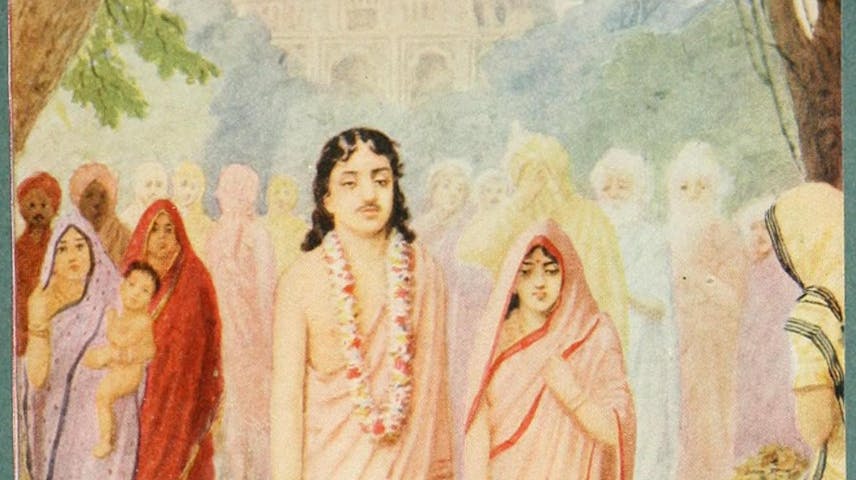
Some stories are told once and then forgotten. Others are told for thousands of years because they capture something so powerful about love, cleverness and courage that people keep coming back to them. The story of Savitri (SAH-vi-tree) is one of those. In India, her name has been a symbol of devotion and determination for millennia, and she remains one of the most celebrated heroines in all of Hindu literature.
The World of the Mahabharata
To understand Savitri, it helps to know where her story comes from. The Mahabharata (mah-HAH-BAH-rah-tah) is one of the longest and most important epic poems ever written and an important text in the Hindu religion. An ancient Sanskrit text from India containing over 100,000 verses, it is roughly seven times longer than the Iliad and the Odyssey combined. Think of it as a massive novel packed with royal families, warriors, gods, sages and moral dilemmas, all woven together around a central conflict between two related families, the Pandavas and the Kauravas, who are battling over a kingdom.
But the Mahabharata is much more than a war story. Along the way, storytellers pause to share dozens of smaller tales—legends within the legend. Savitri’s story, a reminder that true dedication can accomplish the impossible, is one of these.
Background—The Hindu Religion
Hinduism is one of the world’s oldest religions, and it features many gods and goddesses. Among the most important is Yama (YAH-mah), the god of death and the underworld. Yama is not evil—he is simply the one responsible for collecting the souls of mortals when their time is up and escorting them to the afterlife. He is often depicted riding a water buffalo, carrying a noose and wearing dark robes. He is powerful and fair (but not particularly used to being argued with, as the story of Savitri will show).
Another key concept in Hinduism is dharma (DAR-mah)—a word that roughly means duty, righteousness and the moral order of the universe. Following one’s dharma means living with integrity and fulfilling your responsibilities, whatever they may be. In the Mahabharata, characters are constantly wrestling with what dharma requires of them.
Here’s a very condensed version of the story of Savitri:
A Princess, a Prophecy and a Promise
Savitri was a princess of the Madra Kingdom, and she was so radiant and formidable (and picky) that no man dared court her, so her father eventually sent her to choose a husband herself. She returned with her choice: Satyavan, an exiled prince living humbly in the forest with his parents and known for his truth, righteousness and generosity.
There was one problem. The sage (wise man) Narada gravely informed her that Satyavan was fated to die exactly one year from that day. Her father begged her to reconsider. She refused. A husband’s worth, she argued, is not measured by how long he lives.
They married and settled contentedly in the forest, where Savitri shed her jewels and dressed as a hermit, devoted to her new family. But she never forgot the prophecy. As the fateful day drew near, she insisted on accompanying Satyavan into the forest, where he soon grew dizzy and rested his head in her lap. Moments later, a dark figure appeared.
It was Yama, the god of death, who had come to collect Satyavan’s soul. Most people would have stepped aside.
Savitri was not most people. She followed Yama, walking for miles and miles, pressing through the heat and her exhaustion. Exasperated by her persistence, Yama granted her three wishes to try to get rid of her, although she was not allowed to ask for her husband’s life. Savitri used her wits to trick Yama into not only restoring her husband’s parents to their rightful place in their kingdom, but also into giving Satyavan back to her.
Savitri’s Story Still Resonates
Savitri’s show of dedication, love, persistence and wits has made her one of the most enduring figures in world religion. Across India, she is invoked as the ultimate symbol of devotion and cleverness working together. Festivals are held in her honor each year, during which married women offer prayers for the well-being of their husbands. Countless Indian plays, operas and poems have retold her tale, and there have been over thirty film versions of the Savitri and Satyavan story produced in India alone. Even the English composer Gustav Holst was so moved by the legend that he wrote an opera based on it in 1916.
When you encounter the name Savitri in literature or history, you can expect it to carry weight. It calls to mind a woman who refused to accept an outcome simply because it had been declared inevitable—and who had the intelligence, the patience and the courage to do something about it.