Exposing Injustice: Incarceration of Japanese Americans
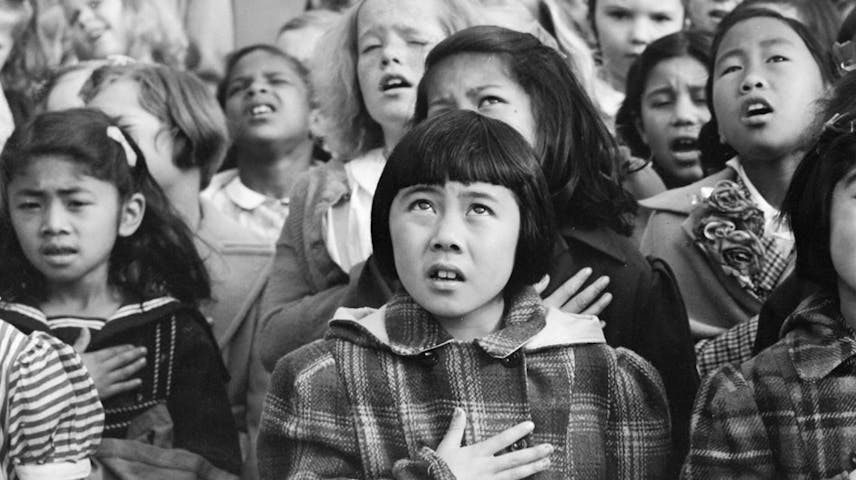
A few weeks prior to relocation, in San Francisco, California, April 20, 1942. “Allegiance pledge by fifth-grade pupils at Raphael Weill Public School, Geary and Buchanan Streets. Children in families of Japanese ancestry were evacuated with their parents and will be housed for the duration in War Relocation Authority centers.” from Dorothea Lange’s Field Notes. Photo by: Dorothea Lange Digital Archive at the Oakland Museum of California
By
Dorothea Lange Digital Archive at the Oakland Museum of California
Text Type
Photo Essay
Words
581
Lexile
1060L
Published
05/01/2026
In the months after the Japanese attack on Pearl Harbor, President Franklin Roosevelt issued an executive order calling for the forced removal and imprisonment of Japanese Americans on the West Coast. The War Department hired Dorothea Lange to photograph the process. During the Depression, Lange had shared the government’s desire to help refugees. Now that same government was rounding up American citizens on the basis of their race. At odds with her employers, Lange’s instincts led her to photograph the tragic and disgraceful effects of the order. In response, many of her photographs were censored and remained unseen for decades.
“We have a disease. It’s Jap-baiting and hatred. I went through an experience I’ll never forget when I was working on it and learned a lot, even if I accomplished nothing.” — Dorothea Lange
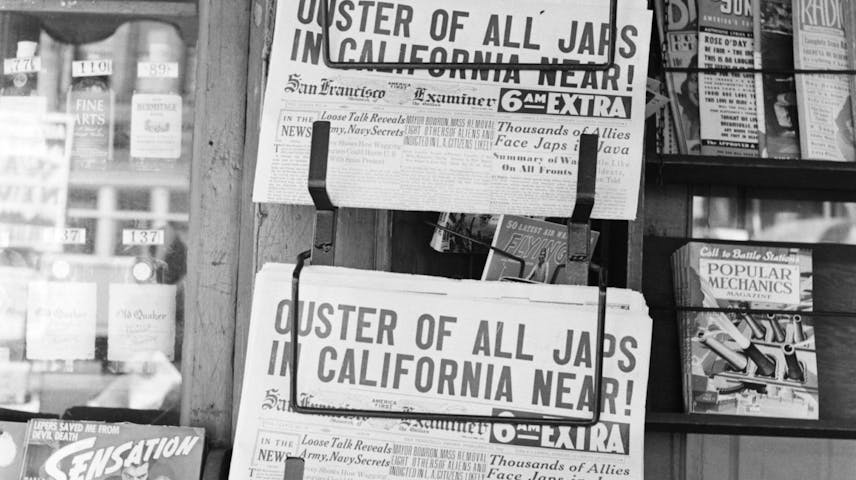
Headlines: “Ouster of all Japs in California Near!”Oakland, CA, February 1942. The word "Japs" was a derogatory slur used against Japanese Americans at the time. Photo by: Dorothea Lange Digital Archive at the Oakland Museum of California
“On February 19, President Roosevelt delegated to the Secretary of War the power to exclude any person, alien or citizen, from any area which might be required, on the grounds of military necessity.” — Dorothea Lange Field Notes
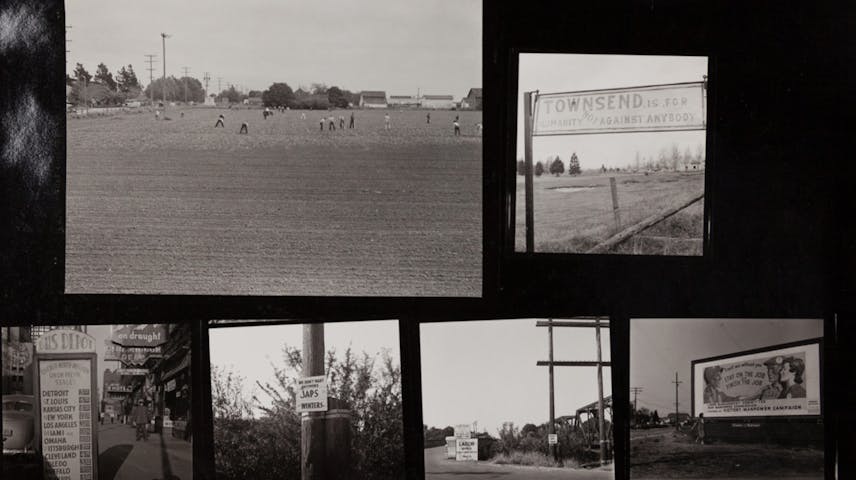
New signposts in Winters, California, in August 1943. Photo by: Dorothea Lange Digital Archive at the Oakland Museum of California
“Entering Town, More than a Year After Evacuation of Japanese.” — Dorothea Lange
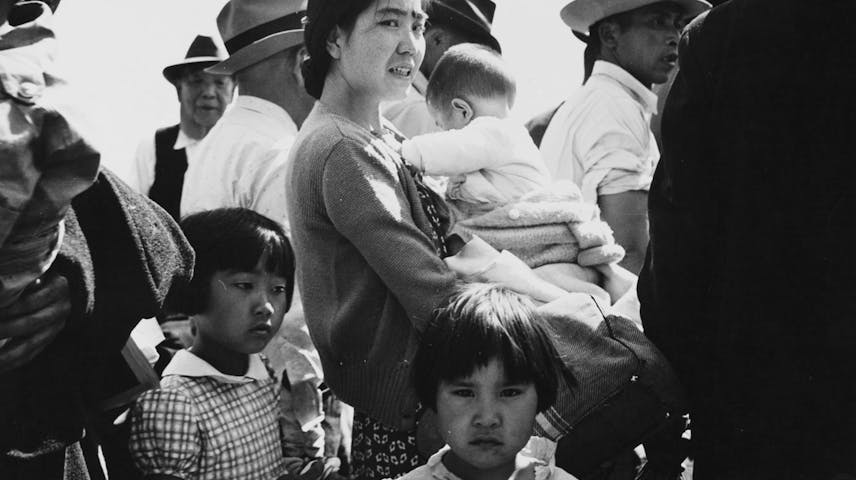
Turlock, California. Families of Japanese ancestry arrive at Turlock Assembly Center on May 2, 1942. Photo by: Dorothea Lange Digital Archive at the Oakland Museum of California
A caption for the original negative at the National Archives reads, "Turlock, California. Families of Japanese ancestry arrive at Turlock Assembly Center. Evacuees will be housed later at War Relocation Authority centers for the duration."
Explain that historical records shape what is remembered about the past, but understanding can change over time. Revisiting events helps bear witness to injustices and ensures they are not forgotten.
Say these Directions: Think about the question: What does it mean to bear witness? Today, you will compare a short poem about Executive Order 9066 with images showing the forced removal of Japanese Americans.
First, brainstorm different meanings of the word witness. Share as many ideas as you can, and we will record them together.
(n.) a person who observes a crime taking place
(n.) a person who officially observes an important event, such as a wedding
(n.) a person who testifies in court
(n.) proof or evidence
(v.) to see or experience something important
(v.) to express an important truth or idea
Next, think about which meanings connect to historical injustices, like the incarceration of Japanese Americans. Then, work with a partner or small group to discuss and answer the following questions.
Ask: What does it mean to bear witness?
To bear witness is to say, or show, that something is true or that something really happened. A person could bear witness by testifying in court or by writing a book or sharing their experiences publicly in some other way. We bear witness to things that are important to establish as facts and that we feel should not be forgotten.
Ask: How can people bear witness to a historic injustice?
People can bear witness to injustice by recording it in pictures or video when they see it happening or by writing about it. They can share what they have recorded or written down with the public or with people who have the power to stop the injustice.
Ask: Whose responsibility is it to bear witness, and why?
I think it is everyone’s responsibility to bear witness when something seriously unjust is happening. The people actually suffering from the injustice should be given a chance to share their firsthand experience. However, observers and onlookers should also bear witness as they are able since they may be in a better position to do so safely or to get the message out to a wider public.
Reconvene the class and, as time permits, have pairs/groups share their answers to the above questions.
Connection to Today’s Learning
Say: Today, we will be looking at two different types of media that bear witness to the injustices of Japanese American incarceration during World War II. One is a poem written by a Japanese American many years after the war; the other is a collection of photographs taken during the war by someone who wanted to show that the incarceration policy was cruel and unfair.
Part A: Executive Order 9066 (RL.7.7, RI.7.6) (20 minutes)
Define incarceration for students based on the definition provided in the Lesson Vocabulary section.
Teacher Tip
The quotation from Dorothea Lange at the beginning of the photo series contains a slur referring to people of Japanese ancestry. Emphasize to students that this term was dehumanizing when it was used, and it remains so today. When historical documents contain slurs, we examine them as evidence of the racism that was part of the historical record, not as language that was ever acceptable. When you address this page with students, keep the focus on why the authors used this terminology, even when advocating for the civil and human rights of people of Japanese ancestry. What do they want readers to understand about the experience of Japanese Americans in this period?
Turn and Talk
Say these Directions: Based on our discussion, turn and talk to your partner to create a clear definition of bear witness, or use the definition provided. Add this term to your Key Terms and Topics graphic organizer.
Next, listen as we review key information about Executive Order 9066. As you listen, think about its impact and be ready to connect it to what you are learning.
Executive Order 9066 was issued by President Franklin D. Roosevelt on February 19, 1942, about 10 weeks after the Pearl Harbor attack that brought the United States into World War II.
The order authorized the Department of Defense to designate “military areas” from which it could forcibly evacuate or exclude people deemed a threat to national security.
The order did not mention Japanese Americans or the West Coast, but its immediate effect was to have much of the West Coast designated as a military area and people of Japanese descent as the ones to be excluded.
Although Executive Order 9066 cited national security reasons for relocating Japanese Americans, it was supported by people who had ulterior motives. Some resented competition from successful Japanese American farmers, and others were part of nativist (anti-immigrant) groups who wanted to drive away Japanese immigrants and their descendants and discourage further settlement.
Even at the time, some in the government believed that Executive Order 9066 was neither morally nor legally defensible. When the Department of Justice questioned the ethics and legality of such an order, the military was authorized to carry it out via the War Relocation Authority.
Ultimately, about 122,000 people were forced to relocate to internment camps, which were euphemistically known as “assembly centers” or “relocation centers.” Today, it is increasingly common to use the more accurate term concentration camp for reasons discussed in the anchor text Seen and Unseen.
Share that students will read the full text of the order in an upcoming lesson and will have a chance to analyze its claims about Japanese Americans.
Say: As a class, we will explore the poem, "In Response to Executive Order 9066" by Dwight Okita and the photo series “Exposing Injustice: Incarceration of Japanese Americans” by Dorothea Lange.
Say: Follow along as the poem is read aloud. As you listen, pay attention to important details that show the harm caused by Executive Order 9066 and how it affected Japanese American individuals and families.
For example,I notice that the speaker in Okita’s poem says she “always felt funny using chopsticks / and [her] favorite food is hot dogs.” I know that chopsticks are a traditional utensil in Japanese food culture, and hot dogs are a symbolically American food. This makes me think that the girl in the poem wanted to show how American she was and to distance herself from Japanese culture because people were being persecuted for their Japanese heritage. Okita must have wanted to show us how young Japanese Americans felt caught between Japanese and American cultures.
First, identify additional details from the poem and explain what they reveal about Executive Order 9066.
Next, look at the “Exposing Injustice” photo set. Use the same process to identify important details and explain what they show. As you work, focus on one or more of the photos that are closely connected to the poem’s topic.
“One Nation Indivisible, San Francisco”
“Two Children of the Mochida Family...Awaiting Evacuation Bus”
“Turlock, California. Families of Japanese ancestry arrive at Turlock Assembly Center”
If you choose to focus on other photos, note that some may include the term “Jap,” an anti-Japanese slur whose use was widespread during World War II. Consider acknowledging this term and explaining its derogatory nature.
Make sure you identify specific details that show:
how Japanese Americans—particularly Japanese American children—lived before the incarceration policy went into effect
The children in “One Nation” are saying the Pledge of Allegiance in a classroom with a diverse student population. They are attending the same public school as their Black and white peers.
how the incarceration policy affected children and families
The family in “Turlock, California” looks worried and confused. The woman holding the baby in the center of the photograph looks like she is anxious about what will happen next. Even the very young children seem to know something is wrong.
🎯PURPOSE
Support students in connecting imagery in the poem and visual details in photographs to historic facts about Executive Order 9066, using source-based language and interpretation verbs.
🗣️SAY / ASK
Encourage students to use bilingual/cultural knowledge to interpret objects and practices (e.g., chopsticks vs. hot dogs) as identity signals—then connect to pressure to “prove” Americanness.
Require students to name the source each time: “In the poem . . .”/“In the photo . . .”
Push for evidence precision: quote a phrase from the poem OR name a specific visible photo detail (who/where/what).
Upgrade “shows” to “reveals/highlights/emphasizes.”
Add an explicit bridge to history: “This image connects to Executive Order 9066 because ___.”
Model comparison starters even before Part B: “Similarly . . .” “Unlike . . .”
“In the poem, the image of ___ reveals ___ about ___.”
“In the photograph, the detail ___ highlights ___ because ___.”
“This connects to Executive Order 9066 because ___.”
“Similarly/Unlike the poem, the photo emphasizes ___.”
👁️WATCH FOR / SUPPORT IF NEEDED
Teach a consistent three-step routine students repeat for poem AND photos: Detail → What it shows → What it reveals about impact.
If student summarizes without interpreting → Prompt: “What does that detail reveal about fear, loyalty, family, or exclusion?”
If student interprets without evidence → Prompt: “Point to the exact phrase or visible detail that supports your claim.”
Student uses “In the poem . . .” or “In the photo . . .” to anchor evidence.
Student provides one precise poem phrase OR one precise photo detail.
Student uses an interpretation verb (reveals/highlights/emphasizes) and links to Executive Order 9066.
Teacher Tip
To help students more deeply consider who all is involved in bearing witness, share brief biographical details about poet Dwight Okita. Explain that Okita (b. 1958) is a third-generation Japanese American who published this poem as part of a collection in 1992. Share that he is writing in a persona, a character different from the author who speaks in the first person, that draws upon the experiences of Japanese American children during World War II.
Check for Understanding (RL.7.7, RI.7.6)
As you respond to the questions, make sure you:
Analyze the poem and photographs in light of Executive Order 9066 and Japanese American incarceration.
Identify specific details in the poem and photographs to support your analysis.
Explain clearly how these details contribute to your understanding of Japanese Americans’ wartime experiences.
Situation
Try this
Struggling with: Identifying Relevant Details
Guide students’ attention to specific details of Okita’s poem that reveal aspects of Japanese American incarceration and reward closer analysis. For example, encourage them to focus on these lines: “where we’re going / [tomatoes] won’t grow” (ll. 4–5, reveals harsh climate expected in internment camps) “a fourteen-year-old girl with bad spelling / and a messy room” (ll. 6–7, depicts the speaker as a typical young teenager, not “different” or “other”) “You’re trying to start a war [. . .] keep your big / mouth shut?” (ll. 18–20, shows how wartime fear and bias turned friends against each other)
Ready for extension: Explore Poetic Conventions
Ask: How can writing in a persona help to bear witness to historic events?
Although the stories of many incarcerated Japanese Americans survive, many more were never recorded or are lost to time. By writing in a persona, a poet can give a sense of what forced forced removal was like for people whose individual stories may not have survived. The author can take general facts about incarceration (e.g., it was fueled by fear and bias) and make them concrete by imagining them through the eyes of a specific person.
Part B: Compare Media (RI.7.6, RL.7.7) (15 minutes)
Guide students in comparing the poem and photographs to analyze perspectives and central ideas. Facilitate partner discussion to connect how each medium reveals “seen and unseen” experiences.
Turn and Talk
Say these Directions: After reading the poem and looking at the photographs, turn and talk with a partner about how the two are connected. Use the guiding questions to help you explain how each source relates to the unit’s main ideas and themes.
Ask: How do the photos and poem affect your understanding of who is “seen and unseen”?
The poem is a way of showing us an otherwise “unseen” part of the experience of incarceration—the many Japanese American children who were taken out of school and separated from their friends but who did not necessarily write down or otherwise record their experiences. The photos ensure that we can see specific people undergoing forced removal and being excluded from the places they had called home. Even so, the people pictured are only a small minority of those who were affected.
Ask: What is one central idea about “seen and unseen” that both the poem and photos develop?
One central idea is that many experiences of Japanese Americans during incarceration were hidden or “unseen,” but both the poem and the photos work to reveal these experiences. The poem shows the personal feelings of a young girl, while the photos make visible the reality of families being removed from their homes.
Ask: Whose perspective does the poem show? Whose perspective is evident in the photos?
The poem is written from the perspective of a 14-year-old girl in the early 1940s, who is about to be removed from school and sent off to a camp under Executive Order 9066. The photos are from the perspective of Dorothea Lange: both her physical and visual perspective from behind the camera and her moral perspective that the incarceration policy was wrong.
Ask: What purpose do you think the author and photographer had in creating these works?
I think even though Dwight Okita and Dorothea Lange created these works at different times, they had a similar purpose. Lange wanted to show how cruel the forced removal policy was while it was happening. Okita wants us to remember what happened to this girl and thousands of others like her. Both the poet and the photographer seem to be saying that these events should not be forgotten and should not happen again.
Ask: How do the poem and photos portray the experience similarly and differently?
Both the poem and the photos portray the experience of Japanese American incarceration as painful and unjust. The poem shows the internal emotions and personal perspective of a young girl, while the photos show the external reality of families being forcibly removed.
Say: Discuss the question and add any helpful information to your ongoing notes.
Ask: Whose stories are told in the text and images we examined today?
Have students add any helpful information to their notes.
🎯PURPOSE
Help students compare how the poem and photos bear witness by naming whose perspective is visible, what each medium emphasizes, and what remains unseen, using comparative connectors and source-transition language.
🗣️SAY / ASK
Invite students to use the “inside/outside” lens: poem persona as “inside feelings,” photos as “outside evidence” and then evaluate what each adds.
Require pairs to produce one both/however comparison sentence before sharing out.
Prompt students to separate perspective (whose view) from purpose (why created).
During share-out, ask: “What does each medium make easier to understand—facts, feelings, or both?”
Model comparative sentence structures: “Both sources ___; however, ___.”
Model emphasis language: “The poem emphasizes ___, while the photos emphasize ___.”
Push “unseen” reasoning: “What is not shown/said, and why might that matter?”
“Both the poem and the photos reveal ___; however, they differ because ___.”
“In the poem, ___ is emphasized; in the image, ___ is emphasized.”
“Unlike the photos, the poem highlights ___ (feelings/thoughts), which suggests ___.”
“One perspective that remains unseen is ___.”
👁️WATCH FOR / SUPPORT IF NEEDED
If students list similarities only → Prompt: “Add one difference using however/unlike.”
If students say “unseen” vaguely → Prompt: “Name a specific missing voice (children’s friends/teachers, officials, guards, etc.) or missing moment.”
Student uses at least one comparative connector (both/similarly/unlike/however).
Student uses at least one academic verb (reveals/highlights/emphasizes).
Student identifies one shared idea and one difference in emphasis or perspective.
Situation
Try this
Struggling with: Comparing Images to Text
Invite students to concentrate on a single photograph, even if multiple photos were discussed in Part A. Have them create a Venn diagram to identify specific details that the photo and the poem have in common before answering the turn-and-talk discussion questions. [PDF Title = Venn Diagram][PDF URL = https://media.newsela.com/article_media/extra/2017-10-Venn-Diagram.pdf] Ex. Both the “One Nation Indivisible” photo and the poem show Japanese American schoolchildren doing things that would be normal in an American school of the time: saying the Pledge of Allegiance (photo), attending geography class (poem). Both depict these children shortly before they were removed from their schools and communities as part of the incarceration policy.
Ready for extension: Writing in Persona
Have students write a short first-person account in prose or verse based on one of the photos. Encourage them to identify particular details and imagine how the person’s life has changed, or is about to change, in response to Executive Order 9066. (“Turlock, CA”) Last night, my mom told me to help pack for a trip in the morning. At first, I was excited to have the day off school. But they didn’t say where we were going, and I still don’t know where we are. I heard someone say this place is a camp, though to me it looks like a jail. The air is hot and dusty even though it is still spring. Mom keeps telling me not to be scared, but I can tell that she is worried.
Provide students with a confidence continuum (i.e., 1–5). As needed, model how to demonstrate a level of confidence using the continuum.
Reflection (RL.7.7, RI.7.6)
Reflect on your understanding of the poem and photographs using the Reflection routine.
How confident are you in your ability to:
compare texts like poems with photographs on related topics?
identify a central idea about “seen and unseen” across both sources,
explain how each source shows a perspective or purpose, and
compare how the poem and photos portray the experience similarly and differently?
Have students write a brief response explaining what it means to witness someone’s story. Use responses to assess understanding of perspective and purpose.
Quick Write
Say these Directions: Write two to three sentences to answer the question. As you write, think about how words and images can reveal things we might otherwise overlook.
What does it mean to witness someone’s story?
To witness someone’s story means paying attention and remembering. It can mean writing the story down, taking pictures, or making art to help show what happened and keep it from being forgotten. Witnessing includes choosing the most important details to remember and share.
Students read their independent reading book for 20 minutes and complete a reading log entry.
Read your independent reading book for 20 minutes. In your reading log, record the date and pages you read, write 1–2 sentences about what happened or what you learned, and respond to this week’s prompt using evidence from the text.