What Is It?
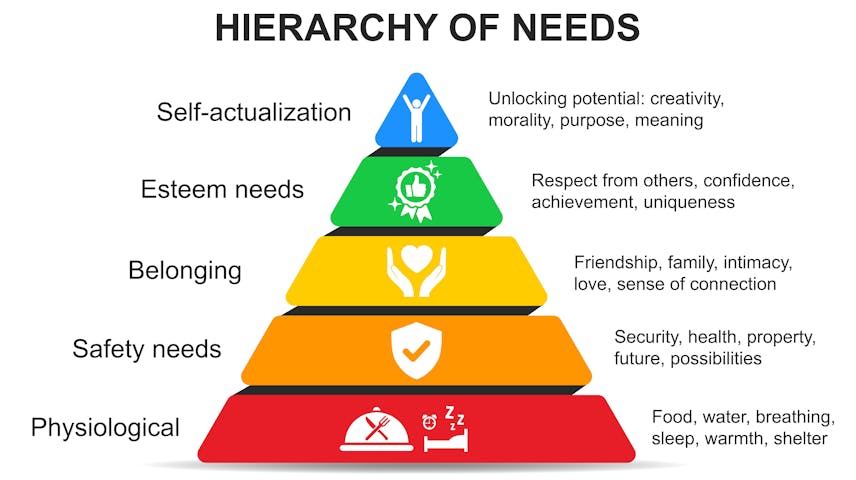
In 1943, a psychologist—someone who studies how people think, behave and feel—named Abraham Maslow published a theory about what motivates people. He proposed that all humans have five basic requirements that must be met to live happy, satisfying lives. He believed that these needs build on one another, with the more basic ones generally taking priority. Maslow’s “Hierarchy of Needs” is usually organized into a pyramid to show this relationship, with the most essential needs at the bottom and the more complex in layers above.
Maslow suggested that as people meet the needs shown at the bottom of the pyramid, they become free to pursue the ones above them.
What Are the Five Needs?
1. Physiological (The Basics)
These are your body’s most basic needs—air, food, water, sleep, staying warm and shelter. Maslow said these are the most important because without them, nothing else matters. If you’re starving, for example, it’s really hard to think about anything other than finding food.
2. Safety
Once you have the basics like food and water, next you need to feel safe. This means having a stable home, good health and no fear of danger. People are addressing these needs when they save money, lock their doors and plan for emergencies.
3. Belonging
After you feel safe, you next need to feel loved and accepted. This comes from friendships, family, romantic relationships and feeling like you are part of a group. Studies show that having strong connections with others can even make you physically healthier.
4. Esteem
This need has two parts: feeling good about yourself and feeling respected by others. You could get this feeling through achievements like doing well on a test, getting a compliment or winning a game. When this need for esteem is met, you feel confident and proud of what you do.
5. Self-Actualization
This is the top of the pyramid. It means becoming the best version of yourself, whatever that looks like for you. For one person, it might mean creating art or pursuing their dream career. For another, it might mean helping others. Maslow believed very few people ever fully reach this level, but he thought Abraham Lincoln and Albert Einstein were good examples of people who had.
Does It Always Work in Order?
Maslow initially thought that people moved up the pyramid step-by-step as their needs were met, but later research by Maslow and others showed that it’s not that simple. In a 2011 study, researchers studied data from over 60,000 people in more than 120 countries and found that “humans can derive ‘happiness’ from simultaneously working on a number of needs regardless of the fulfillment of other needs”.
People often pursue multiple needs at the same time. For instance, striving for a new job would address the safety, esteem and possibly the actualization layers of the pyramid. Sometimes people fall backwards on the pyramid, as a result of big life changes like death or divorce, and then regain that lost ground.
Maslow and other researchers have redrawn the pyramid over the years to reflect new findings and modern approaches, but his initial pyramid remains famous.
Why Does It Matter?
Maslow’s ideas have been hugely influential. Other scientists have built on his work to study things like purpose, meaning, motivation and the importance of friendship. Even if his pyramid isn’t perfect, it’s a useful visual model to use to begin a conversation about what humans need to live happy and fulfilling lives.