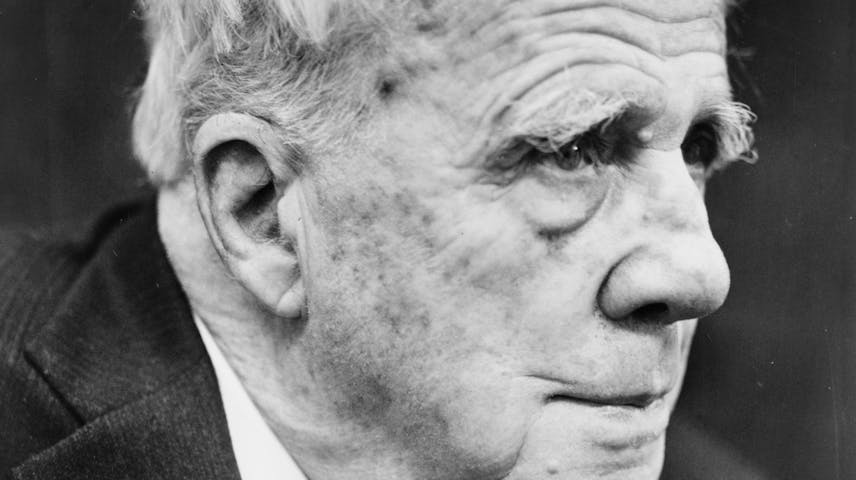
Robert Frost in 1949. Photo by: Walter Albertin/NY World Telegram/Library of Congress.
By
Robert Frost
Text Type
Poem
Words
95
Published
1923
Editor's Note: "Nothing Gold Can Stay" by Robert Frost appears in his poetry collection, "New Hampshire: A Poem with Notes and Grace Notes," which was first published in 1923. The eight-line poem consists of four couplets. Couplets are two lines of verse, usually in the same meter and joined by rhyme to form a unit.
Nature's first green is gold,
Her hardest hue to hold.
Her early leaf's a flower;
But only so an hour.
Then leaf subsides to leaf.
So Eden sank to grief,
So dawn goes down to day.
Nothing gold can stay.
Turn and Talk
Say these Directions: Discuss your response to the Lesson 13 homework assignment prompt with a partner.
Based on your knowledge of the plot and characters, what do you think will happen next to Ponyboy and Johnny? What do you think they might learn about each other and themselves?
I think Ponyboy and Johnny will hide in the church until members of their gang come to find them. Their friends seem to care about them and will probably want to make sure they are okay. I think they might learn more about who they are as individuals rather than as members of the group. They might also learn more about each other’s strengths under pressure.
Connection to Today’s Learning
Say: Today, we’ll read and discuss a poem that can thematically relate to the characters Ponyboy and Johnny. Though the poem is not about Ponyboy and Johnny themselves, its images and symbols can shed light on how these characters evolve and see themselves.
Guide students in reviewing the word subsides using morphology and examples/non-examples. Facilitate partner discussion to deepen understanding and apply the word to different contexts.
Morphology & Vocabulary
Target Word:subsides
Introduce the Word: Present the word subsides to students and pronounce it. Guide students to pronounce the word.
Ask: Have you seen the word subsides before? Where?
Identify the Roots: Underline the root sid in subsides. Explain that the sid (to settle down, to sink) is related to the Latin word sedere, meaning “to sit”.
Ask: Do you know any other words with the root sid?
reside, resident, preside, president
Language Connection: The Spanish word residente, meaning “one who lives/settles in a place” comes from the same Latin root.
Identify Affixes: Explain that the prefix sub- means “under,” “beneath,” “behind,” or “below.”
Ask: Do you know any words with the prefix sub-?
subtract, substitute, submarine
Ask: How do you think the prefix sub- applies to the meaning of subtract?
When you subtract, you form a number that decreases, or “goes below,” the first number.
Ask: How do you think the prefix applies to the meaning of submarine?
A submarine goes under or beneath the surface of the water.
Determine Meaning: Direct students to use the roots and affixes to find the meaning of the word.
Ask: Given what we know about the Latin root sid and the prefix sub-, what might the word subsides mean?
becomes less strong, severe, or intense; decreases or sinks to a lower level
Introduce Activity: Present each scenario orally and/or project on a board.
Scenarios
You have had a toothache all morning. In the afternoon, your toothache goes away, and you feel better.
At first, you are excited to play a sport; later in the season, you lose interest in it.
The sound is very quiet, and you have to listen carefully to hear it.
A bright light in a room becomes less bright as the light bulb dims.
You don’t like watching television because you feel you can never find anything good to watch.
A strong rainstorm lasts for several hours without stopping.
Say these Directions: With a partner, discuss and determine why each scenario is an example or a non-example of something that subsides, and why.
Subsides
Examples:
You have had a toothache all morning. In the afternoon, your toothache goes away, and you feel better.
At first, you are excited to play a sport; later in the season, you lose interest in it.
A bright light in a room becomes less bright as the light bulb dims.
Non-examples:
The sound is very quiet, and you have to listen carefully to hear it.
You don’t like watching television because you feel you can never find anything good to watch.
A strong rainstorm lasts for several hours without stopping.
Share student thinking: Invite partnerships to share their examples and non-examples. As students share their thinking, prompt students to share their rationale and explain their connections. For example:
Ask: Why is the second choice an example of something that subsides when the third choice is not?
In the third choice, you start out interested, but your interest becomes less strong and intense. In the fourth choice, you aren’t interested in the first place, so your interest does not become less strong.
Ask: What makes something that subsides different from something that is not strong, severe, or intense?
Something that subsides decreases, or becomes less, over time. This shows a change, and it is different from something that is already “less than” something else and does not change.
🎯PURPOSE
Help students use the new vocabulary word subsides accurately in discussion and writing by distinguishing examples vs. non-examples and explaining the “change over time” meaning that will matter for interpreting the poem.
🗣️SAY / ASK
Emphasize the shift in meaning: subsides = becomes less intense over time (not “is already small”).
Require students to use a cause/effect connector in their explanation: “It subsides because/as a result . . .”
Bridge to the poem: preview that subsides will describe how something fades or doesn’t last.
Refine student definitions to include time: “It gets smaller” → “It becomes less intense over time.”
Press for precision: “goes away” → “decreases/fades/weakens.”
Contrast with non-example language: “It stays the same/continues/increases.”
“This is an example of subsides because it starts ___ and then becomes ___.”
“This is not subsides because it does not ___ over time.”
“In the poem, subsides might suggest that ___ becomes less ___.”
👁️WATCH FOR / SUPPORT IF NEEDED
If students confuse “quiet” with “subsides” → Prompt: “Was it ever loud/strong first? What changed?”
If students only label example/non-example → Prompt: “Add one sentence explaining the change.”
Invite multilingual connections (e.g., Spanish disminuir/ceder/bajar) to anchor meaning without overexplaining.
Students explain subsides as a decrease in intensity over time.
Students use at least one precise synonym (fades/weakens/decreases).
Students can apply the word to an abstract idea (fear/hope/beauty) in a sentence.
Connection to Today’s Learning
Say: In the poem you’ll read today, you’ll hear this word used to describe something that changes by decreasing or becoming less than what it was. Pay attention to the use of subsides and the other ways the poem describes change.
Situation
Try this
Struggling with: Understanding the Word’s Meaning
Briefly re-define the term using simpler language. (Ex. When something subsides, it goes away or becomes smaller or less than what it was.)
Struggling with: Distinguishing Between Examples and Non-Examples
Provide simpler examples and non-examples with a clear connection. (Ex. Example: A loud sound gets quieter over time. Non-example: A loud sound continues or becomes louder.)
Ready for extension: Identifying Word Connotations
Provide close synonyms or related words such as ease, soften, relent, and lessen. Ask: How do you think these words’ connotations are different? As needed, review that a connotation is an idea or feeling associated with a word.
I think that ease and soften have gentler connotations, like something good is happening or something is bringing relief. Subsides could mean something good or bad.
Part A: Preparing to Interpret Poetry (RL.7.5, L.7.5.a) (10 minutes)
Robert Frost, Imagery, and Symbolism
Ask if students have heard of the poet Robert Frost or read any of his poems. Explain that Frost wrote poetry about nature, seasons, and rural (country) life. His poems often use elements of nature to reflect on deeper issues such as life changes, choices people make, and the passing of time.
Many of Frost’s poems have simple forms; they may have short lines or short stanzas (remind students that a stanza is a group of lines in poetry, like a verse in a song). He used these forms to present complex themes in a profound way that is easy for the reader to understand and remember. Frost made short poems memorable by using imagery, metaphor, and symbolism.
Say: Remember when Ponyboy compared Darry’s eyes to “green ice” or “frozen ice”? That is an example of imagery—you can picture Darry’s eyes more clearly because of the author’s visual word choice. In literature, imagery uses sensory details that can appeal to any of the five senses. Even though the word imagery might make you only think of a visual image, imagery can capture how something feels, sounds, or even smells!
Ask: Why do you think Ponyboy chose to use the image of “frozen ice” to describe Darry’s eyes? What is the effect of that comparison? How does it shape your impression of how Ponyboy sees Darry?
Ponyboy uses "frozen ice" because it shows that Darry's eyes aren't just cold; they're hard and impossible to break through. The image makes us feel the emotional wall between them instead of just being told it exists.
Review that a metaphor is a figure of speech that compares two different things or ideas and shows how they are alike by saying that one is the other. (Ex. “His eyes are cubes of ice.”)
Ask: What is symbolism? How do you think symbolism might be used in literature?
when an object is a symbol of something deeper, like an idea or an emotion
Explain that symbolism uses concrete objects or figures—such as shapes, colors, weather, animals, or people—to represent abstract ideas, feelings, or concepts. Provide one or two simple, widely understood examples of symbols, such as a rose or heart representing romantic love.
Ask: Recall when Ponyboy and Cherry discuss the sunset in Chapter 3. What ideas or feelings do you think the sunset might symbolize in The Outsiders?
connection, similarities, peace
Say:Listen for imagery, metaphors, and symbols as we read the poem. Also listen for ideas that will help you determine the poem’s theme.
Imagery: A literary device that uses sensory details to help readers create vivid mental images
Metaphor: A figure of speech that compares two different things or ideas and shows how they are alike by saying that one is the other. (Ex. “His eyes are cubes of ice.”)
Symbolism: A literary device where writers use concrete objects to represent abstract ideas or feelings
Analyze a Symbol
Say these Directions: The Frost poem uses the word gold in a symbolic way. With your partner, respond to this prompt by recording words and ideas on a Web Chart graphic organizer with “gold” in the center and your associations with the word in the surrounding ovals.
What do you think when you hear the words gold or golden? How have you heard those words used literally or figuratively? What can make a moment, person, or experience “gold”?
Have a brief class discussion where partners share with the class their associations with the concept of “gold.” (Ex. valuable, bright, rare, early morning, perfect moments, special)
🎯PURPOSE
Support students in naming and interpreting imagery/symbolism by using expanded noun phrases and interpretation verbs so they can move from “what I see” to “what it stands for.”
Validate multiple plausible interpretations when supported by words/phrases from the poem.
🗣️SAY / ASK
Require students to write one expanded noun phrase for “gold” (e.g., a brief, perfect beginning).
Encourage text-based justification: students must point to one to two words from the poem to support their interpretation.
“The image of ___ represents.”
“The word/phrase ‘___’ suggests ___ because ___.”
“Gold could stand for ___ (an abstract idea) rather than a literal color.”
👁️WATCH FOR / SUPPORT IF NEEDED
Teach a two-step meaning routine: Image → Abstract idea.
Press for noun-phrase precision: “a moment” → “a brief, fragile moment of ___.”
Revoice with interpretation verbs: “means” → “represents/stands for/suggests.”
If students only paraphrase the poem → Prompt: “What does that image stand for beyond nature?”
If students jump to theme with no evidence → Prompt: “Which one to two words made you think that?”
Students use at least one interpretation verb (represents/symbolizes/suggests).
Students produce one expanded noun phrase for an abstract idea.
Students cite a specific word/phrase as evidence for their interpretation.
Provide students with a confidence continuum (i.e., 1–5). As needed, model how to demonstrate a level of confidence using the continuum.
Reflection (RL.7.4)
Use the Reflection routine to reflect on your ability to recognize imagery, symbolism, and metaphor in a story or poem.
Part B: Interpreting a Poem (RL.7.4, RL.7.5, L.7.5.a) (20 minutes)
Guide students in interpreting the poem by analyzing imagery, symbolism, and sound. Facilitate collaborative discussion to connect the poem’s ideas to characters and themes in The Outsiders.
Preview the Poem’s Role in the Text
Say these Directions: Look at the title of the poem: “Nothing Gold Can Stay.”
Ask: Based on the title and what you know about Robert Frost, what do you think the poem will be about?
nature, light disappearing/changing times of day, changing seasons
Guide students to make initial connections to the characters in The Outsiders.
Ask: Based on what you know about Ponyboy and Johnny, what do you think is important, precious, or “gold” to each of them?
If time allows, you may want to “set the scene” by reading the passage preceding the poem in Chapter 5 where Ponyboy and Johnny discuss the sunrise.
Say: This poem appears in Chapter 5 during the time when Ponyboy and Johnny are hiding in the church. Review the following words from the poem that may be unfamiliar:
Hue is a color or a shade of a color.
Eden is a paradise or a place of perfect happiness. In some religious traditions, Eden describes a place of paradise that disappeared long ago.
Read and Listen
Read the poem aloud twice: once to introduce it, and the second time to encourage deeper understanding. Tell students not to worry if they don’t fully understand the poem yet, but to try to picture the images Frost is sharing. Encourage students to listen for imagery, symbolism, and metaphors in the poem.
Graffiti/Table Talk
Provide chart paper or a digital board.
Say: Share words and phrases that stood out to you and images that appeared in your mind during the poem. Add your own ideas to the chart.
Model drawing a connection:One phrase that stood out to me was “only so an hour” because it explains how quickly something special can disappear. I pictured a flower appearing quickly, then disappearing.
Record the phrase on the chart/board.
Invite students to read and summarize patterns from the chart.
Ask: Which words/images appeared most often?
Teacher Tip
To ensure students are considering the significance of the words—rather than simply writing down words they remember—consider asking follow-up questions or adding questions to the board that have brief responses but require some analytical thought, such as: What is one image that relates to [word] in the poem? What do you think [word] symbolizes or stands for?Why do you think Frost uses this word?
Think-Pair-Share
Say these Directions: First, answer these questions independently, and then share and refine your ideas with a partner.
Ask: How did the word subsides help you understand the poem?
The word subsides helped me understand that many things in nature disappear, decrease, or become less intense, like the colors on leaves when they change from green to red and brown in the fall and winter.
Ask: Look back at the words and ideas you wrote on your graphic organizer. Which of your associations with “gold” best connects to how Frost uses the word in this poem? What makes that connection meaningful?
When I look back at my graphic organizer, the association that best connects to Frost's use of “gold” is “rare.” In the poem, Frost writes that Nature's first green is gold but it is “her hardest hue to hold,” which suggests that this golden moment is difficult to keep, just like something rare is hard to come by or hold on to.
Ask: How did the rhyming words and repeated sounds help you remember the images and symbols?
The connections between the rhyming words, like gold and hold, helped me remember how the concepts are connected—something gold is hard to hold because it doesn’t last long. The repeated sounds, like the h sounds in the second line, helped the line stick in my mind.
Ask: How did hearing the poem read aloud help you understand its ideas differently than you would if you read it silently?
Hearing the sounds in the poem helped me understand how the author uses rhymes to show connections between different words. I could also hear how the words created a rhythm in the poem; when you read silently, you can’t always hear a rhythm.
🎯PURPOSE
Help students explain symbolism and sound devices clearly in discussion by using evidence-based explanation and comparative connectors to connect the poem’s craft to meaning and to The Outsiders.
🗣️SAY / ASK
Invite students to connect “gold” to culturally/family-defined “precious moments” without requiring personal disclosure.
Model a compare move: “In the poem . . . , whereas in The Outsiders . . .”
Emphasize respectful, academic talk: build on peers using “I agree because . . .” and “Another possibility is . . .”
“In the poem, ___ symbolizes ___. This matters because ___.”
“The sound pattern (rhyme/repetition) between ___ and ___ reinforces ___.”
“This connects to Ponyboy/Johnny because ___, especially when ___ happens in the novel.”
👁️WATCH FOR / SUPPORT IF NEEDED
Require “evidence + explanation” in every response: Quote/word → what it suggests → why it matters.
Revoice basic responses into analytical language: “It rhymes” → “The rhyme connects ___ and ___, which reinforces ___.”
Press for text-to-text connection: “It relates” → “It matters to Ponyboy/Johnny because ___.”
Clarify theme statements with abstraction: “Things change” → “Innocence/beauty/peace is temporary.”
If students can’t connect to The Outsiders → Prompt: “What is ‘gold’ for Johnny? For Ponyboy?”
If students overgeneralize theme → Prompt: “Name one specific image and explain how it leads to that theme.”
Students cite at least one specific word/line and explain its symbolic meaning.
Students use at least one comparative connector (similarly/however/whereas).
Students make one grounded connection to Ponyboy/Johnny using a concrete detail from the novel context.
Situation
Try this
Struggling with: Interpreting Symbolic Language
Have students illustrate images from the poem in a way that shows a change between one image and another. (Ex. The sky at dawn versus the sky during the day; a leaf as a flower versus the same leaf when the flower disappears.)
Struggling with: Connecting Form to Meaning
Rewrite a couplet from the poem as a longer, non-rhyming sentence and ask students to compare this description to the poem’s lines. How is the sound different?/Which version is easier to remember? (Ex. “The first green color in nature looks like gold, but this color is the hardest for nature to keep.”)
Ready for extension: Analyzing How Form Impacts Meaning
Ask students to write their own rhyming couplet (two lines of the same length) describing an image in nature that shows change, using the same approximate line length as Frost’s poem. Then, ask: How did the form of the lines help you express your ideas?
Because the lines were so short, I had to choose words carefully to express the images I wanted to show. The form helped me pick words that were short and precise.
Pulse Check (RL.7.5)
Think about what the poem means. Based on its meaning, what is the most likely reason the author uses short lines in the poem?
to create a pattern of rhyming words with different sounds
Incorrect: This pattern is present and enhances the author’s use of short lines, but rhyming word patterns can also be present in longer poems.
to help the reader easily form mental pictures of gold images
Incorrect: Although the short lines help express images concisely, the author’s word choice and use of imagery are more effective at helping the reader form mental pictures.
to demonstrate that short, simple ideas have value
Incorrect: This response is not related to the deeper meaning of the poem; ideas expressed in simple language can also be complex ideas.
to emphasize that gold things only last for a short time
Correct: The author uses brief lines in the poem’s form to help express the meaning that “gold” images, feelings, and experiences are also brief.
Guide students in connecting the poem to characters by discussing its relevance to Ponyboy and Johnny. Support partner discussion to deepen understanding of theme and character experiences.
Think-Pair-Share
Say these Directions: Use the Think-Pair-Share routine to discuss your response to the prompt. use your analysis of the poem to think about and discuss how it relates to The Outsiders.
Ask: Think about what you know about Ponyboy’s and Johnny’s lives. Why do you think the poem matters to them?
Optional Sentence Starter:
“I think the poem matters to Ponyboy and Johnny because ____.”
Ponyboy and Johnny both want good things to happen in their lives. Ponyboy also has experience with happy moments that do not last, like his life with his parents. I think the poem matters to them because it relates to their experience of good things being temporary.
Instruct students to begin reading Chapter 5 of The Outsiders and take notes in their Journal on the following prompt:
As you read, annotate the text for the following:
How does being in the church change the way Ponyboy and Johnny see themselves?