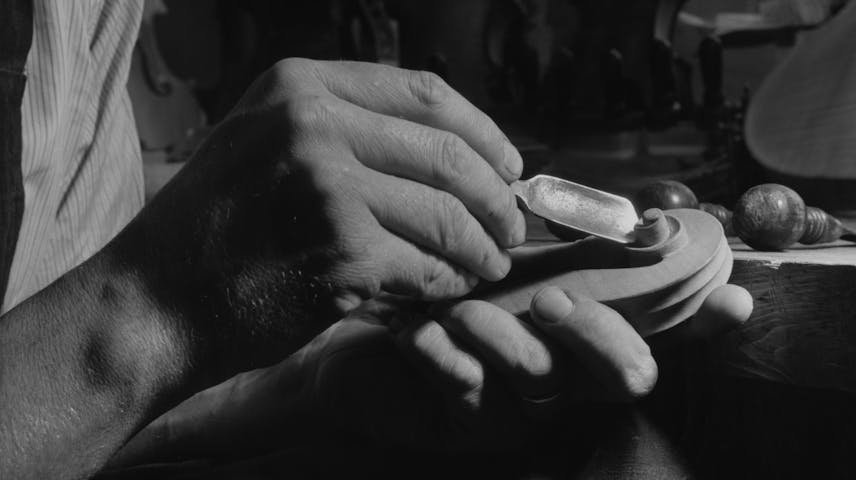
Luthier At Work. A close-up view of British-German luthier Paul Voight using a violin-maker's knife to shape the scroll, the curled embellishment at the top of the neck, at the Voight workshop in Soho, London, England, circa 1955. Photo by Pictorial Press/Archive Photos/Getty Images
Say these Directions: Respond to the following prompts using the Think-Pair-Share routine.
Ask: Imagine you are being introduced to a new person. What kind of first impression would you like to make?
I would want to leave the first impression that I am interesting, smart, and kind.
Ask: What are some ways you could achieve your ideal first impression?
I could share interesting facts about my life. I could listen thoughtfully while others speak. I could use respectful and kind words.
Ask: Why is making a good first impression important?
Making a good first impression is important because it shapes the way that people perceive and think about you. If someone has a bad first impression of you, it could be hard to change their views over time.
Say: Having a strong introduction paragraph is a lot like making a great first impression. It hooks readers and makes them want to read your essay.
Connection to Today’s Learning
Say: Today, you will learn how to write an introduction paragraph—an important part of an essay that introduces your topic to and makes a first impression on your readers.
Writing a Thesis Statement
Briefly review with students what they learned about thesis statements earlier in the unit.
Say: In Lesson 14, you learned that a thesis statement is a single sentence that explains to readers the main idea or argument of an essay. It acts as a guidepost that tells readers what to expect as they read the text. Thesis statements typically include three parts:
The topic of the essay
The writer’s position or claim about the topic
The main points or reasons that support the topic
Prompt students to access the Performance Task handout. Project Part 1 of the Performance Task. Invite a volunteer to read the task aloud.
Part 1:Write an explanatory essay tracing a learner's growth from beginner to skilled creator through mentorship and practice. Describe the stages of learning—observing, trying, failing, refining, and creating—using evidence from A Single Shard and at least one additional text on learning, craftsmanship, or mentorship.
Model breaking down the prompt to determine what information should be included in a thesis statement.
Say: The prompt helps us determine what information to include in your thesis statement. The first and second sentences tell us the purpose of your essay (to explain) and your topic (how a learner grows from beginner to skilled creator through mentorship and practice).
Ask: What other important details does the prompt tell us?
The prompt tells us that we should describe the stages of learning. It also tells us that we should use evidence and examples from A Single Shard and at least one other text.
Project the exemplar thesis statement, then prompt students to evaluate its efficacy:
The novel A Single Shard and the article "Hands That Remember: Artists Who Make Things by Hand" show how the stages of learning and mentorship help learners grow from beginners into skilled creators.
Ask: What makes this thesis statement effective?
It includes a clear topic. It is related to the prompt. It shows two ways the author will support their topic in the essay.
Write-Pair-Share
Say these Directions: Work independently to draft a thesis statement for your explanatory essay before sharing your work with a partner.
Prompt students to give each other feedback using the following questions.
Ask: Does the thesis statement clearly state the topic?
Ask: Is the thesis statement relevant to the prompt?
Ask: Is it clear how the writer plans to support their topic?
Say these Directions: Revise your thesis statement so it clearly includes your claim, both texts, and how you will organize your essay.
Invite two or three volunteers to share their thesis statements with the class.
Reflection
Reflect on your understanding of how to write a strong thesis statement using the following prompt as a guide.
How confident do you feel about your ability to write a clear thesis statement that answers the prompt and previews your essay?
Then write a sentence explaining what part of writing a thesis statement is most clear to you and what you still find challenging.
🎯PURPOSE
Support students in writing a clear, formal thesis that answers the prompt and previews how the essay will be developed, using generalization language (shows that/demonstrates how) and precise academic nouns.
Validate multiple strong thesis paths (by stages, by mentorship, by comparing two crafts) as long as the claim is clear and evidence-ready.
🗣️SAY / ASK
Name the 3 thesis requirements explicitly: topic + claim + “how I’ll prove it” (texts and/or key stages).
Require students to include both texts by name (A Single Shard + chosen source) in the thesis.
Model upgrading vague language (“talks about learning”) into a generalization: “shows that learners grow ...”
Revoice weak claims: “Mentors help” → “Mentorship demonstrates how feedback and practice move a learner toward mastery.”
Press for specificity: “learning” → “the stages of learning (observing, trying, failing, refining, creating).”
Tighten and clarify: replace “and stuff” / “a lot” with precise nouns (apprenticeship, tradition, craft, process).
“The novel A Single Shard and _______ show that ___.”
“Together, these texts demonstrate how ___ through ___.”
“This essay explains ___ by describing ___ and comparing ___.”
👁️WATCH FOR / SUPPORT IF NEEDED
If thesis is only a topic (no claim) → Prompt: “Add ‘shows that’ or ’demonstrates how’ and the outcome (growth from beginner to creator).”
If thesis doesn’t preview development → Prompt: “Add either (a) stages of learning or (b) how you’ll organize body paragraphs (Text 1/Text 2).”
If thesis uses first/second person → Prompt: “Rewrite in third person: readers/learners/the text.”
Theses include both texts and a clear claim.
Students use “shows that” or “demonstrates how” accurately.
Theses read as formal, are in third person, and set up body paragraph organization.
Connection to Today’s Learning
Say: Today, you will begin drafting your explanatory essays. One of the first steps in writing an essay is drafting your thesis statement. Just as the thesis statement acts as a guidepost for readers, it can also help you develop a road map for your writing, including helping you decide what evidence or details to include and where and how to include them.
Part A: Outline Introduction Paragraphs (W.6.2.a-b, W.6.9) (15 minutes)
Say these Directions: The “first impressions” analogy from the Launch gives an accessible frame for understanding what an introduction must accomplish: grab attention, establish context, and make a claim. Just like meeting someone new, your introduction needs to make the reader want to keep going.
Have students take out their copies of A Single Shard, their secondary source for the essay (article or video), and their completed Gathering Evidence (Lesson 36) and Paired Text Analysis (Lesson 37) graphic organizers. Distribute copies of the Research Essay Outline graphic organizer.
Say: Now that you’ve gathered evidence and written a thesis statement, the next step is to begin drafting an outline, or a general plan, for your explanatory essay. Writers use outlines to determine the general structure of their writing and to make decisions about where to put ideas and evidence so that they best support the thesis.
Direct students’ attention to the five spaces on the Research Essay Outline graphic organizer.
Say: Your explanatory essay will include three components:
An introduction paragraph
At least two body paragraphs
A conclusion paragraph
Note that in Part A, students will focus on outlining their introduction paragraph. They will work on outlining their body paragraphs in Part B.
Model Writing an Introduction Paragraph
Say: The first paragraph of your essay is the introduction paragraph. The root of introduction is introduce, or “to present or make known to a person.” Think of your introduction paragraph as the first meeting between your essay and the reader. You want the introduction paragraph to make a good first impression. To do this, your introduction paragraph should include three parts:
A “hook” that grabs readers’ attention and gets them interested in your writing
Background information about your topic
A thesis statement that states how you will discuss the topic
Say: As I model each part of an essay, I will be drawing ideas and evidence from the text “Hands That Remember: Artists Who Make Things by Hand” in addition to those from A Single Shard.
Discuss various ways to “hook” the reader, and model examples of each.
Say: There are many different ways to hook your reader’s attention. Some common methods include:
Using an interesting quote: "I realized that just as I had been given the privilege of becoming a custodian of these skills from my grandmother and mother, I too wanted to pass them on to generations after me." For artist Esther Mahlangu, this belief . . .
Asking a thought-provoking question: What does it take to learn something difficult?
Sharing a relevant anecdote or story: As a little girl, Esther Mahlangu was so in love with Ndebele painting that she would try to paint every afternoon while the adults napped. She got into trouble every day, until eventually the people around her realized that painting was something she deeply wanted to do.
Next, explain how to connect the hook to the thesis statement using background information about the topic.
Say: The next step in writing a strong introduction paragraph is to connect the hook to the thesis statement. Let’s use a thought-provoking question and our example thesis statement from earlier in the lesson.
Hook: What does it take to learn something difficult?
Thesis statement: The novel A Single Shard and the article "Hands That Remember: Artists Who Make Things by Hand" show how the stages of learning and mentorship help learners grow from beginners into skilled creators.
Say: One way we can connect these two ideas is by including background information about the novel A Single Shard, specifically Tree-ear’s journey, and from the article "Hands That Remember: Artists Who Make Things by Hand."
Display the example introduction paragraph, and briefly discuss why the paragraph is effective.
Example Introduction Paragraph: What does it take to learn something difficult? In the novel A Single Shard, Tree-ear, a young boy living in twelfth-century Korea, seeks to learn how to make pottery, a craft that is traditionally passed down from father to son in his village of Ch'ulp'o. Meanwhile, real-life artist Esther Mahlangu set out to master a different tradition: Ndebele mural painting, a craft she began learning from her mother and grandmother when she was about nine years old in Mpumalanga, South Africa. For both Tree-ear and Mahlangu, the answer to this question is simple: learning something difficult takes time, effort, and mentorship. The novel A Single Shard and the article "Hands That Remember: Artists Who Make Things by Hand" show how the stages of learning and mentorship help learners grow from beginners into skilled creators.
Next, have students outline introduction paragraphs for their explanatory essays.
Say: Outline your introduction paragraph using the Research Essay Outline graphic organizer. In the first box of the organizer, write notes about ways to hook your readers, your thesis statement, and background information to help you connect the two.
Introduction
Hook: Use an interesting anecdote from "Hands That Remember: Artists Who Make Things by Hand"; discuss how Esther Mahlangu fell in love with Ndebele painting as a child and got into trouble every day for trying to paint while the adults napped.
Background information: Make a connection between Esther Mahlangu and Tree-ear and how they both learned a difficult craft by watching someone more experienced over many years.
Thesis: The novel A Single Shard and the article "Hands That Remember: Artists Who Make Things by Hand" show how the stages of learning and mentorship help learners grow from beginners into skilled creators.
🎯PURPOSE
Help students plan an introduction that connects hook → background → thesis with a cohesive multi-sentence structure so the reader can follow the logic from first impression to main claim.
Encourage hooks that reflect students’ interests (craft, sports training, music practice) as long as the bridge returns to the prompt.
🗣️SAY / ASK
Name the 3 intro moves explicitly: hook → background bridge → thesis.
Require students to write a bridge sentence that links the hook to the thesis (no “random hook”).
Require one sentence that names the two texts and their shared idea (mentorship/practice/stages).
Quick partner check: partner must be able to answer, “What is this essay going to prove?”
Revoice unclear bridges: “This is interesting” → “This question matters because apprenticeships show how effort becomes skill.”
Upgrade connectors: “and” → “as a result,” “therefore,” or “for example.”
Clarify nouns: “stuff they learned” → “skills, knowledge, and values.”
“This matters because ___.”
“In A Single Shard, ___; in ___, ___.”
“These examples connect because ___.”
“Therefore, this essay shows that ___.”
👁️WATCH FOR / SUPPORT IF NEEDED
If intro is just a hook + thesis (no background) → Prompt: “Add 1–2 sentences introducing Tree-ear and the second source and the shared idea.”
If hook doesn’t connect → Prompt: “Write one bridge sentence starting with ‘This matters because ...’”
If intro becomes plot summary → Prompt: “Keep only the details that set up the claim (learning through mentorship + stages).”
Introduction outlines include hook, background, and thesis.
Bridge sentences clearly connect hook → claim.
Students can state the essay’s purpose in one sentence.
Teacher Tip
Research and display additional examples and non-examples of introduction paragraphs. Have students evaluate what makes the exemplars strong, and have them work collaboratively to rewrite and strengthen the non-examples.
Situation
Try this
Struggling with: Finding interesting quotes
Prompt students to look back at their annotations, Stages of Learning graphic organizers, and other evidence they have found and used from A Single Shard and other sources explored throughout the unit to identify quotes related to the stages of learning and mentorship.
Emphasize that a thought-provoking question is a question that makes the reader think more deeply about or make new connections to a topic. Briefly review with students the Unit 2 Essential Questions and other text-dependent questions related to A Single Shard to reinforce this concept.
Ready for extension: Writing a hook
Ask: Which type of hook did you choose for your introduction paragraph, and why?
Check for Understanding
Which hook strategy do you think is most effective at grabbing the reader’s attention: an interesting quote, a relevant story, or a thought-provoking question? Rank each strategy on a scale of 1–3, with 1 being the least effective and 3 being the most effective. Explain the hook strategy you ranked as most effective and why you chose it.
Part B: Outline Body Paragraphs (W.6.2.a-b, W.6.9) (15 minutes)
Direct students’ attention to the Body Paragraph sections of the Research Essay Outline graphic organizer. Remind students of what they learned about body paragraphs in previous lessons.
Say: The body paragraphs will make up the main part of your essay. They include the evidence and analysis that develop and support the thesis statement. Each body paragraph should focus on a different topic related to the thesis.
Discuss ways students may choose to organize their body paragraphs, using the example thesis statement from the Literacy Lab as an example.
Say: Consider our example thesis statement:
The novel A Single Shard and the article "Hands That Remember: Artists Who Make Things by Hand" show how the stages of learning and mentorship help learners grow from beginners into skilled creators.
Say: The thesis statement tells us that the essay will discuss two different texts: the novel A Single Shard and the article “Hands That Remember: Artists Who Make Things by Hand.” One way to organize the body paragraphs might be by text:
Body paragraph 1: Discuss the novel A Single Shard and its connections to the stages of learning and mentorship.
Body paragraph 2: Discuss the article “Hands That Remember: Artists Who Make Things by Hand” and its connections to learning and mentorship.
Say: The thesis statement also mentions the stages of learning and mentorship. Another way to organize the body paragraphs might be by topic:
Body paragraph 1: Discuss how both the novel and the article show the stages of learning.
Body paragraph 2: Discuss how both the novel and the article show mentorship.
Emphasize that there is no “right” or “wrong” way to structure their essays. The outlining process is iterative; writers use it to determine what works well and what doesn’t and refine and adapt as needed.
Say: Think about the main ideas, evidence, and analysis you want to discuss. As you review the evidence you have gathered, determine which ideas or pieces of evidence are the strongest and most relevant to your thesis. Refine your evidence by excluding weaker or less relevant pieces of evidence that you have gathered.
Say: As you select evidence for your outlines, check that your quotes are copied accurately and include page numbers or segment descriptions. This is part of responsible evidence use.
Have students work independently to draft their body paragraph outlines. Time permitting, have students share their outlines in small groups to receive feedback and make adjustments as needed.
Body Paragraph 1
Topic: how A Single Shard shows connections to the stages of learning and mentorship
Explain how Tree-ear shows the stages of learning.
Observing: Tree-ear watches Min test the clay for readiness.
Trying: Tree-ear rubs the clay between his fingers after purifying it.
Failing: Tree-ear does not know when the clay is ready yet.
Refining: Tree-ear continues to practice feeling the clay until he can finally tell when it is ready for use.
Creating: Tree-ear begins molding his own figurines.
Explain the role of mentorship in the novel.
Min is a begrudging mentor to Tree-ear.
He lets Tree-ear observe the different steps of the process of making pottery.
His knowledge and skill make Tree-ear interested in pottery and help him develop as a creator.
Body Paragraph 2
Topic: how artists in the article “Hands That Remember: Artists Who Make Things by Hand” show learning and mentorship
Esther Mahlangu and her students: Mahlangu learned Ndebele mural painting by watching her mother and grandmother for years, developing the steady hand and pattern knowledge the craft requires. Now she runs an art school in her own backyard, teaching young people to mix pigments and draw straight lines, passing on exactly what her grandmother once passed to her.
🎯PURPOSE
Support students in organizing evidence into two body paragraphs with clear topic sentences and cohesive reasoning, using generalization language and paragraph-level structure (claim → evidence → explanation).
Validate different successful structures; students choose the structure that best matches their strongest evidence set.
🗣️SAY / ASK
Require each body paragraph outline to include: topic sentence + 2 evidence notes + what each evidence shows.
Require students to label organization choice: by text (novel/source) or by topic (stages/mentorship).
Require one generalization sentence starter per paragraph: “This illustrates ...” / “This demonstrates ...”
Remind: evidence notes must include page number or segment description.
Revoice summary into analysis: “Tree-ear learned pottery” → “This demonstrates how repeated practice turns observation into skill.”
Press for cohesion: add “which shows ...” after each evidence note.
Tighten topic sentences: replace “This paragraph is about ...” with a claim-like topic sentence.
“This body paragraph demonstrates how ___ by using evidence such as ___.”
“One example shows ___, which demonstrates ___.”
“As a result, the learner ___.”
“This supports the thesis because ___.”
👁️WATCH FOR / SUPPORT IF NEEDED
If evidence is listed without explanation → Prompt: “After each evidence note, add ‘This shows . . .’”
If paragraphs repeat the same idea → Prompt: “Make paragraph 1 about ___ and paragraph 2 about ___ (different focus).”
If evidence is weak/vague → Prompt: “Replace one note with a more specific moment/step/action.”
The two body paragraphs outline each include a topic sentence + evidence + explanation.
Students use “shows that,” “demonstrates how,” or “illustrates” at least once.
Evidence is specific and clearly supports the thesis (not just a summary).
Checklist
Look to make sure you:
Define topics for at least two body paragraphs related to your thesis.
Cite evidence gathered from A Single Shard and at least one other text of your choosing.
Organize evidence based on the body paragraph topic.
Move or reorganize information as needed for clarity.
Refine evidence to include only “strong” details that support your thesis.
Criterion
1 – Developing
2 – Approaching
3 – Meets
W.6.2.a — Student introduces a topic or thesis and organizes ideas using explanatory strategies and helpful text features.
Writing does not introduce a clear topic or thesis, and ideas are not organized.
Writing introduces a topic but organization is uneven or relies on a partially developed strategy.
Writing introduces a clear topic or thesis and organizes ideas logically using explanatory strategies and supportive text features.
W.6.2.b — Student develops the topic with relevant facts, definitions, concrete details, quotations, or other information and examples.
Writing includes few or no relevant facts, definitions, details, or examples.
Writing includes some relevant information, but development is uneven or partially explained.
Writing develops the topic with clear, relevant facts, definitions, details, quotations, or examples that support understanding.
W.6.9.a — Student draws evidence from literary texts to support analysis, reflection, or research.
Writing includes little or no relevant evidence from the literary text.
Writing includes some relevant evidence but support is uneven or partially explained.
Writing uses clear, relevant evidence from the literary text to support analysis, reflection, or research.
W.6.9.b — Student draws evidence from informational texts to support analysis, reflection, or research.
Writing includes little or no relevant evidence from the informational text.
Writing includes some relevant evidence but support is uneven or partially explained.
Writing uses clear, relevant evidence from the informational text to support analysis, reflection, or research.
Quick Write
Say these Directions: Respond to the following Quick Write prompt in one or two sentences.
Ask: What is the purpose of the introduction paragraph?
The introduction paragraph makes a first impression on the reader. It grabs their attention, tells them the topic, and includes the thesis statement.
Write your thesis statement. Then, label your introduction outline: mark your hook with H, your background with B, and your thesis with T. Turn in your outline with labels.
Have students draft the introduction paragraph to their explanatory essays.
Using your notes and your Research Essay Outline graphic organizer, draft an introduction paragraph for your explanatory essay. Make sure your introduction includes:
A hook
Background information
A thesis statement
This homework continues our routine writing practice—drafting regularly across multiple sessions builds fluency and stamina.