Have you ever practiced something so much that your hands just knew what to do, without your brain having to think about it? Maybe it’s shooting a basketball, or playing a song on an instrument. Now imagine practicing the same skill every day for thirty, forty or even fifty years.
The artists in this article live around the world and express their creativity in a variety of ways. But they all share one big thing in common: they spent years—some of them their entire lives—learning a craft by watching experts, making mistakes, fixing those mistakes and slowly getting better. Their stories show us that becoming truly great at something is never really finished, that failing is part of how you learn and that skills developed over years are among the most powerful gifts one person can ever pass to another. These are stories about artists who spent their lives learning, failing, watching and creating.
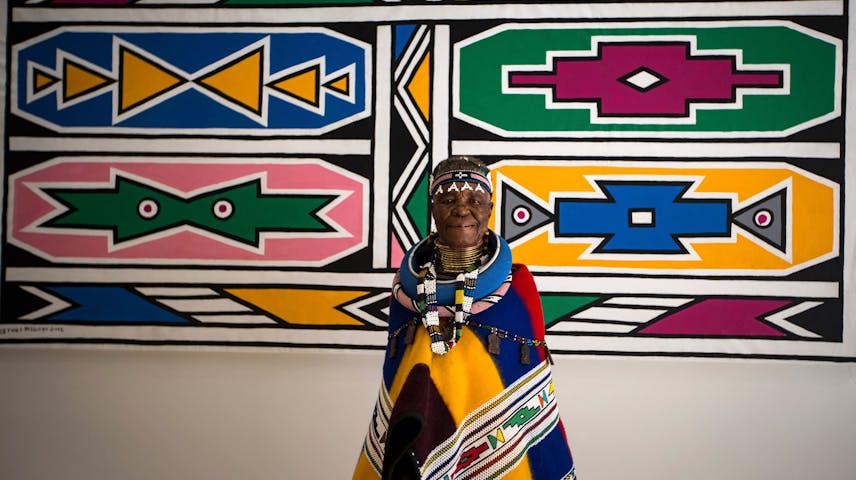
Esther Mahlangu: Lines without a Ruler
Ndebele Painting—Mpumalanga, South Africa
Imagine painting perfectly straight lines—across an entire wall or even a car—without using a ruler. No measuring, no pencil sketch first. Just your hand, a brush made from a chicken feather and decades of practice.
That’s exactly what Esther Mahlangu does. When people watch her work, she told Artsy magazine, “They can’t believe that I don’t use a ruler to paint the lines, and that my hand is so steady, even at my age.”
Mahlangu was born in 1935 in South Africa. She started learning Ndebele mural painting from her mother and grandmother when she was nine or 10 years old. Ndebele women have been painting the outside walls of their homes in bold geometric shapes—triangles, rectangles, bands of color—for many generations. These paintings announce celebrations, mark important milestones like coming-of-age ceremonies and tell the community about a family’s pride and traditions.
As a little girl, Mahlangu was so in love with painting that she would try to paint every afternoon while the adults napped. “I got into trouble every day,” she told Forbes magazine, “until eventually they realized that in my heart I wanted to paint.” She learned by watching, closely studying how her mother and grandmother held their feathers, mixed their colors and made choices about pattern and proportion. Only through all that careful watching, and through many early attempts that didn’t go so well, did her own hand grow steady.
Later in life, Mahlangu did something no one had done before: she took the traditional wall-painting style and put it on canvas so that people all over the world could see it, not just people who could visit the murals in Mpumalanga. She painted a BMW car, worked with international companies and showed her art in museums everywhere. “What many find interesting about my artworks,” she has said, “is that although they are based on traditional Ndebele designs, they are still very modern and current.”
Today, she runs an art school in her own backyard, teaching young people to mix pigments and draw straight lines and passing on exactly what her grandmother once passed to her. “I realized that just as I had been given the privilege of becoming a custodian of these skills from my grandmother and mother,” she explained to Roar Africa, “I too wanted to pass them on to generations after me.”
Julia Parker: Four Generations of Weavers
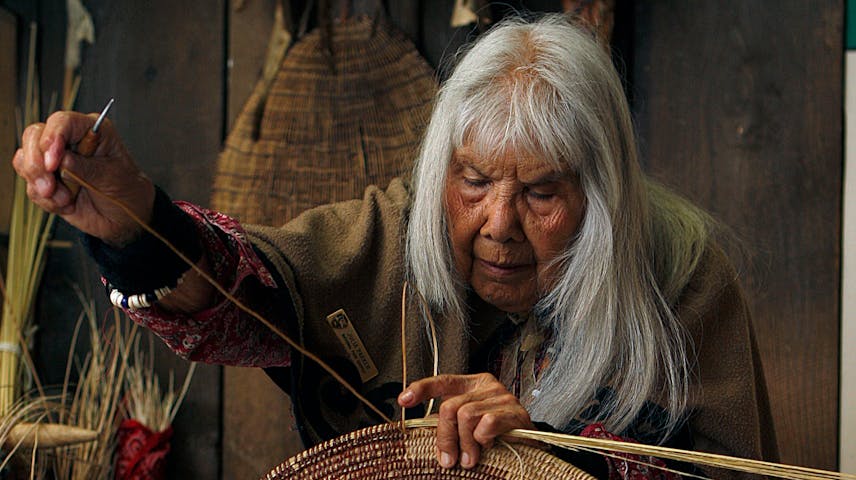
Coast Miwok-Kashaya Pomo Basketry—Yosemite Valley, California, USA
Julia Parker didn’t grow up learning to weave. When she was young, she was orphaned and sent to a boarding school for Native Americans where students were actually told to forget their Indigenous heritage and culture. By the time she arrived in Yosemite Valley as a young woman, she knew almost nothing about the traditional crafts of her people. But then she started to watch.
Her husband’s grandmother, Lucy Telles, was one of the greatest basket weavers of her time. Parker spent hours sitting beside her, watching how Telles gathered willow branches and plant roots at exactly the right time of year, how she scraped and split the fibers and how she waited patiently for the materials to be ready. “I started to kind of watch her and be with her,” Parker said to the National Endowment for the Arts.
When she finally tried weaving herself, she was nervous, but she started. Her first basket was, as she later described it, “a little crooked thing.” She also remembers being told, “when you finish that little basket, you have to give it away and you’ll become a weaver.” Giving away that imperfect first basket was an important lesson on its own: the craft isn’t about showing off. It’s about connection to tradition and community.
Over many years, Parker studied with some of the best weavers in California. “So little by little I began to learn more and more about the baskets, the shapes, the designs”. Making a single basket isn’t quick. You gather willows, split them, wait a full year for them to dry and only then can you start weaving. “I learned very thoroughly about the kind of wood I was working with, willow wood, and they told me stories”.
One of her most special baskets was made for Queen Elizabeth II. “When they asked me to make her a gift, I didn’t know what kind of basket to make,” Julia told True West magazine. “I couldn’t make her a cooking basket, because she doesn’t cook. I couldn’t make her a burden basket, because she doesn’t carry things on her back. I couldn’t make her a baby basket because, well, you know she’s not that age. So I made her an oblong gift basket. It took me a year”.
Today, four generations of Parker women weave together: Julia, her daughter Lucy, her granddaughter Ursula, and her great-granddaughter Naomi. The chain of teaching and learning that started with an old master and a young woman watching goes on.
The Zuni Olla Maidens: Balance, Beauty and the Dance
Pottery and Dance—Zuni Pueblo, New Mexico, USA
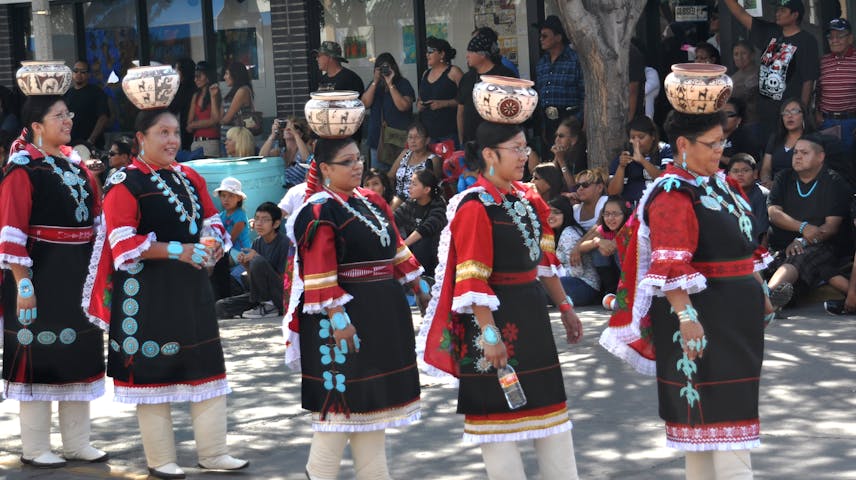
Before a Zuni Olla Maiden dances even one step, something amazing is already happening: a decorated ceramic jar is sitting on top of her head—with no glue, no strap, no support at all. Just her balance and years of practice. Then she begins to dance.
The Zuni Olla Maidens are a group of women, all related to each other, who have been performing a pottery dance since at least the 1940s. The dance honors their female ancestors, who used to carry heavy water jars (called ollas) balanced on their heads across rough terrain—not as a performance, but as part of everyday life. The dance turns that hard daily work into a celebration.
Before each performance, every dancer breathes into her pot, a ceremonial act to thank their ancestors and ask for their blessing. The physical skill required is huge: the jars are fragile, the movements are carefully choreographed and the dancer has to keep her balance while singing in the Zuni language and keeping time with drums and rattles. You don’t learn to do that in a week. It takes years, starting in childhood, within a family where this has been done for generations.
The jars themselves are works of art, too. Classic Zuni water jars display a design called “Deer in the House.” The stylized deer features a red line going to its heart, called the heartline, which represents the animal’s life force. Around it are symbols of water, rain and renewal. Painting these requires deep knowledge of both the symbols and the painting technique.
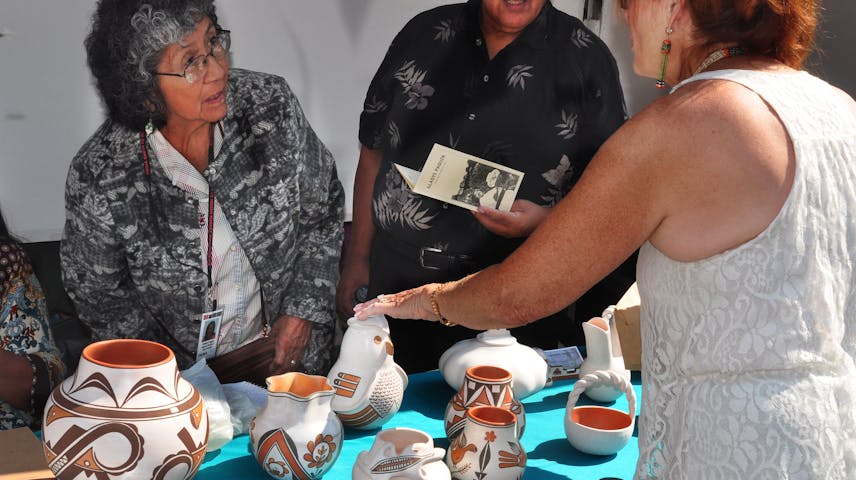
The dance brings together two separate skills at once: the potter’s craft of shaping a jar sturdy enough to be worn and the painter’s craft of covering that jar with meaning. Together, they form a living tradition passed from mother to daughter for over seventy years.
Gladys Paquin: Learning Through Trial, Error and Earth
Laguna Pueblo Pottery—New Mexico, USA
Gladys Paquin came to pottery when she was 43 years old, and she had no teacher standing beside her. Born in 1936 with both Laguna and Zuni heritage, she spent much of her adult life away from her Laguna pueblo. When she came back, she felt strongly drawn to clay. She asked questions of family members and other potters in the community. And then, as she described it, her real teacher was “The Lord”—meaning she learned through trial and error, failing over and over until she figured it out.
What she was trying to do was make pottery the ancient way. No pottery wheel. No store-bought clay. No modern paint. She dug raw gray clay out of the hills near Laguna, broke it into powder and mixed in water until it felt right. Then, using only her hands, she rolled the clay into long ropes and built her pots from the bottom up. This technique is called coiling: you stack ropes of clay on top of each other, smooth them together and shape them entirely by touch. For paint, she boiled a plant called Rocky Mountain bee plant until it turned into a thick black paint, and for other colors, she ground minerals from local rocks. The geometric designs she painted were from ancient pottery shards—pieces of old pots dug up at the pueblo—that had survived for hundreds of years.
Paquin’s pots won major awards and ended up in museums across the country. But she also taught what she’d learned to her sons and to other students, passing on skills she had wrestled out of the earth entirely on her own. An exhibition of her work was called To Know the Fire, an allusion to both the practical challenge of firing pottery in the ground using wood and manure and to the respect for the history behind the art. She passed away in December 2020, but her students still work with the same natural clay and the same coiling technique she rediscovered and mastered.
The Kerala Muralists: Painting with Five Colors from the Earth
Panchavarna Mural Painting—Kerala, India
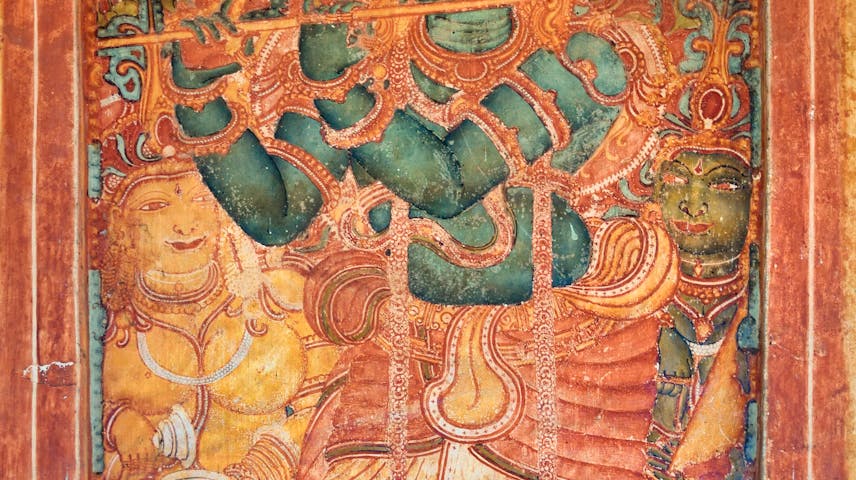
On the inside walls of ancient temples in Kerala, in the southwestern corner of India, enormous painted figures have been looking down at visitors for hundreds of years. These are the famous murals of the Kerala tradition, and they use exactly five colors—red, yellow, green, black and white, collectively called the Panchavarna palette—all made from natural materials.
Every single color comes from the earth. Red comes from a type of rock called laterite. Yellow comes from ochre or turmeric. Green is made by mixing plant-based indigo with yellow. Black comes from the soot of burning sesame oil, collected inside a clay pot. White isn’t painted at all—it’s saved from the original lime plaster of the wall. Learning to make these pigments, and knowing exactly what order to apply them in, is something a muralist has to master before they can paint a single figure.
The wall itself has to be prepared in three separate stages of plaster, and the final surface gets 25 to 30 coats of lime mixed with coconut water. Then the painting happens in six defined steps, in order: sketch the outline, strengthen the lines, apply colors, add shading, finalize the black outlines and finish the details. You can’t skip a step, and you cannot go back. As one Kerala muralist, Saju Thuruthi, described it to Hinduism Today magazine, the art is “a spiritual practice,” requiring the patience of someone who is not just painting, but praying. An ancient text from the 1500s called the Shilparatna acts as a kind of guidebook, describing how to make the pigments, the correct proportions of the divine figures and what every color means.
But within all those strict rules, there’s still room for extraordinary creativity. The general shape of each god or goddess comes from religious texts—but the emotion on the figure’s face? That’s up to the artist. The five colors are fixed, but “the formation of different tones,” as Thuruthi explains, “is purely dependent on one’s creativity”. A muralist painting a goddess’s face has to decide, based on years of study, exactly how to use the angle of an eye or the curve of a mouth to show the right spiritual quality. That kind of creative decision only becomes possible after you’ve completely mastered the technical side first.
The Acadian Weavers: Counting Threads across Centuries
Acadian Textile Weaving—Nova Scotia, Canada and Louisiana, USA
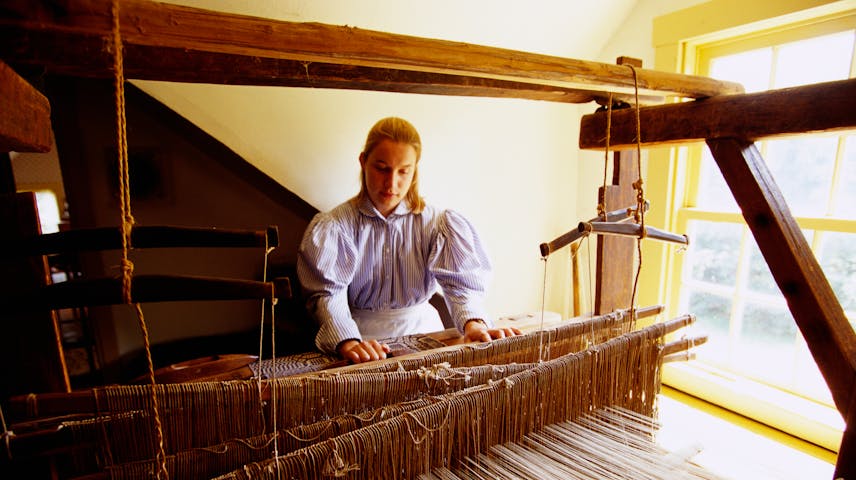
A large weaving loom holds hundreds of threads stretched across it, and every single thread has to go through exactly the right spot. One thread in the wrong place creates a flaw that runs through the entire length of the fabric. So before a weaver throws the first shuttle—the tool that carries thread back and forth—they have to count correctly. Every time.
Gladys LeBlanc Clark was one of the last masters of the Acadian brown cotton weaving tradition, and she once described in a Louisiana Folklife Program publication the particular difficulty of spinning thread for the loom: “You must know just how hard, how fast and when to pull the thread. You also have to have just the right amount of tension, or the thread will snap.”
The Acadian weaving tradition goes back hundreds of years. French settlers came to Nova Scotia in the 1600s and brought weaving with them, but it wasn’t art for them, it was survival. They needed to make their own cloth. In 1755, the British forced the Acadians out of Nova Scotia, scattering them to different places, including Louisiana. But wherever they went, they brought their weaving knowledge with them. The tradition survived not through schools or books, but the way most crafts survive: a daughter sitting beside her mother, watching, then helping, then slowly taking over. As one practitioner put it, “It’s not a complicated weaving process, but it’s unique, and that’s the Acadian way—making the best of what you had.”
A woman named Elaine Bourque learned this tradition from Clark in the late 1980s, after watching her demonstrate at festivals. She watched for months before she ever touched a loom herself. When she finally began weaving, she kept her pieces slightly different from her teacher’s—five white stripes where Clark used four, or adding decorative beads harvested from her garden. Bourque said, “I see how the smaller, finer, even rolags are easier to spin evenly”. (A rolag is a roll of prepared fiber ready for spinning.) Her goal is to one day weave something so good it would be hard to tell apart from Clark’s own work. That gap between student and master isn’t a failure—it’s a map showing how far there is still to go, and the reason to keep going.
Antonius Roberts: Listening to What the Wood Already Knows
Sacred Space Sculpture—Nassau, The Bahamas
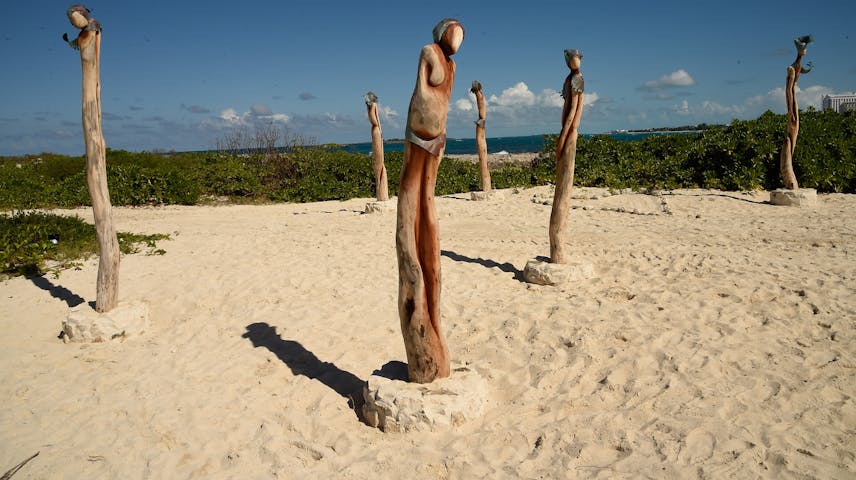
Along the coastline of New Providence in the Bahamas, a type of tree called casuarina used to grow in large numbers. These invasive trees had shallow roots that actually made the shoreline erode faster. Many of them died in hurricanes, their silver-gray trunks still standing upright in the sand, rooted but finished. Most people saw dead wood. Antonius Roberts saw something waiting to be set free.
Roberts, born in Nassau in 1958, is one of the Bahamas’ most respected artists. He told The Bahamian Project in 2019 that he is “inspired by each piece of wood, marble or organic material that comes into his hands,” and that he waits for the material to tell him what to do. This isn’t just a poetic way of talking. He actually lets each individual tree guide his work: its height, the direction of its grain, the holes and knots that time and storms have carved into it. From these he carves female figures that are calm, dignified and turned as if looking at something far away.
His first big installation was at Clifton Heritage National Park, one of the first places where enslaved Africans arrived in the Bahamas. He placed twelve of these carved tree figures there, the forms emerging from the trunks to become monuments to history and turning dead trees into a memorial and a place for quiet reflection.
What makes Roberts’s work particularly demanding is that you can’t undo it. A weaver can pull out a bad row. A painter can re-paint. A sculptor carving directly into a living tree cannot un-make a single cut. Every chisel strike is permanent. That means every decision requires the built-up judgment of decades of experience. Roberts has described working in his studio like a kind of prayer, that he loses track of himself in the material. “When I’m in my studio,” he wrote in Image Journal, “the connection happens between the work and how I feel, my state of mind, and my belief system. It becomes a kind of a trance, losing oneself and just enjoying that ritual.”
For more than forty years, Roberts has also been teaching and mentoring young Bahamian artists through workshops, exhibitions and his studio. He figured out early in his career that making art and teaching art aren’t two separate things. They’re two sides of the same commitment.